
Homeschooling mistakes are a normal part of finding a routine that works for your family. This guide covers 15 common errors, including unrealistic schedules, too much curriculum, burnout, poor record-keeping, and limited socialisation, with practical solutions to help parents make better adjustments.
Every homeschool family makes mistakes. That is not a scary warning; it is simply the truth, and it is actually good news. Because so many families have walked this path before you, the common mistakes are well known, and so are the fixes.
This guide walks through the most frequent homeschooling mistakes parents make, especially in the first year or two, and gives clear, practical ways to avoid or fix each one. Whether you are just starting or you already feel like something is not working, this guide can help you course-correct without giving up on homeschooling altogether.
If you are new to home education, the first step is understanding what it actually means. This guide on What Is Homeschooling? explains the concept, learning process, and what parents can expect.
None of these mistakes mean a family is failing, and none of them are permanent. Homeschooling is one of the few forms of education that can be adjusted in real time, sometimes within the same week a problem shows up. That flexibility is exactly why this guide exists, so you can spot a mistake early and fix it quickly instead of living with it for months.
Why Talking About Mistakes Actually Helps New Homeschoolers
New homeschool parents often feel like they need to get everything right from day one. That pressure is misplaced. Homeschooling is a skill, and like any skill, it improves with practice and adjustment.
Experienced homeschool parents almost always say the same thing when asked for advice. They wish someone had told them it was okay to make changes mid-year instead of pushing through a plan that clearly was not working.
Understanding common mistakes ahead of time does two things. It helps you avoid some of them completely, and it helps you recognize the others quickly instead of struggling for months before making a change. Think of this list as a map of speed bumps other families have already hit, so you can slow down before you hit them too.
It also helps to remember that a mistake in homeschooling rarely causes lasting harm. Unlike a single wrong step on an assembly line that ruins an entire batch of product, education is ongoing and forgiving. A rough month, a curriculum that flopped, or a schedule that never quite clicked can all be corrected the following week without any permanent damage to your child’s learning.
Quick Reference: All 15 Mistakes at a Glance
Use this table to scan every mistake and its fix in one place, then read the full explanations below for more detail.
| # | Mistake | Quick Fix |
| 1 | Copying a traditional school schedule at home | Build a shorter, flexible schedule that fits your family |
| 2 | Buying too much curriculum too soon | Start simple with core subjects, add more slowly |
| 3 | Ignoring your child’s learning style | Match the teaching format to how your child learns best |
| 4 | Skipping state legal requirements | Check your state’s rules before day one |
| 5 | Letting curriculum drive every decision | Adjust the plan when a lesson clearly is not working |
| 6 | Isolating your family from other homeschoolers | Join a co op, park day group, or online community |
| 7 | Setting unrealistic daily schedules | Plan in flexible blocks, not fixed clock times |
| 8 | Comparing your child to school standards | Use standards as a loose guide, not a strict deadline |
| 9 | Not keeping records | Keep a simple log of subjects, dates, and work samples |
| 10 | Forgetting breaks and rest days | Build regular breaks into the yearly calendar |
| 11 | Doing everything alone | Share teaching duties with a spouse, co op, or program |
| 12 | Overloading the schedule with subjects | Rotate non-core subjects across different days |
| 13 | Ignoring burnout | Treat burnout as a signal to simplify, not a failure |
| 14 | Not adjusting when something fails | Permit yourself to change course |
| 15 | Neglecting socialization | Schedule regular social time on purpose |
Mistake 1: Trying to Copy a Traditional School Schedule at Home
One of the most common mistakes new homeschool parents make is recreating a public school day at the kitchen table. This usually means a rigid hour-by-hour block schedule, a bell timer between subjects, and a full six- or seven-hour day that mirrors exactly what a classroom looks like.
This approach almost always backfires. A public school classroom manages twenty-five or more students, so much classroom time goes to lining up, taking attendance, waiting for questions, and switching between activities.
A parent working with one child, or even three or four, does not need nearly that much time to cover the same material. Copying the school schedule usually leads to a burned-out parent, a bored or frustrated child, and a day that feels far longer and harder than it needs to be.
Both homeschooling and traditional schooling have their own strengths and challenges. A closer look at homeschooling vs. traditional school can help parents understand which learning environment may better suit their child.
The fix. Build a schedule around how your own family actually works best, not around how a classroom of many students has to work. Many families find that core academic subjects take three to five hours for a middle school-age child, leaving real time for independent projects, hobbies, and rest.
Mistake 2: Buying Too Much Curriculum Before Knowing What You Need
It is easy to get excited during the first curriculum search and end up buying five different math programs, three history curricula, and a stack of workbooks that never get opened. This is sometimes called curriculum shopping, and almost every homeschool parent has done it at least once.
Buying too much curriculum wastes money, but it also creates a cluttered, overwhelming homeschool space and can make a parent feel like a failure for not using everything that was purchased.
The fix. Start with a simple, solid curriculum for the core subjects, reading, math, and writing, and add extra materials slowly as you learn what your child actually needs. Many experienced homeschool parents recommend waiting at least one full semester before buying anything beyond the basics.
Mistake 3: Ignoring Your Child’s Learning Style
Every child learns a little differently. Some children absorb information best through reading, others through listening, and others through hands-on activities and movement. A common mistake is forcing every subject into one format, usually workbooks and worksheets, because that format is familiar or easy to grade.
When a curriculum does not match how a child learns, the child can start to seem unmotivated or even label themselves as bad at a subject, when the real problem is simply a mismatch in teaching style.
Choosing an education path is not the same for every family. If you are wondering whether home education would work well for your child, read Is Homeschooling Right for My Child? for useful factors to consider.
The fix. Pay attention to what actually holds your child’s attention. A child who struggles with a written history lesson might light up with a documentary, a hands-on project, or a living book read aloud. Adjusting the format, not the content, often solves the problem completely.
Mistake 4: Skipping State Legal Requirements
Some new homeschool parents assume homeschooling simply means keeping a child home and skip the legal steps their state requires, such as filing a notice of intent, tracking instructional days, or arranging required testing. This is a serious mistake, since ignoring these requirements can create real legal trouble down the road.
The fix. Before the first day of homeschooling, check your state department of education website or a trusted homeschool advocacy group for the exact requirements in your state. Rules vary widely, so what a friend in another state does may not apply to you.
Mistake 5: Letting the Curriculum Drive Every Decision
A curriculum is a tool, not a set of unbreakable orders. A common mistake is treating a curriculum’s daily schedule as sacred, pushing through every assigned page even on days when a child is clearly confused, exhausted, or simply not absorbing the lesson.
Homeschooling offers greater flexibility and personalised learning, but it also requires time, planning, and consistency. Before making a decision, explore the Homeschooling Pros & Cons to get a balanced view.
The fix. Remember that you are in charge, not the curriculum publisher. If a lesson is not working, slow down, skip ahead, or find a different way to teach the same concept. A curriculum should serve your child’s actual learning, not the other way around.

Mistake 6: Isolating Your Family From Other Homeschoolers
Some families, especially in the first year, keep entirely to themselves, either from busyness or from feeling unsure how to find other homeschool families nearby. Over time, this isolation can wear down both the parent and the child, since neither has other people who understand the day-to-day reality of homeschooling.
The fix. Look for a local homeschool co op, a park day group, or an online community for encouragement and shared teaching resources. Even one supportive relationship with another homeschool family can make a huge difference during hard weeks.
Mistake 7: Setting Unrealistic Daily Schedules
Color-coded, minute-by-minute schedules look appealing on paper, but they often fall apart within the first few weeks. Real life includes sick days, meltdowns, unexpected errands, and simply having an off day, and a schedule with no flexibility built in can quickly feel like a source of constant failure instead of a helpful tool.
The fix. Plan your day in flexible blocks rather than fixed clock times. For example, hard subject, short break, easier subject, lunch, hands-on project, in that order every day, without tying any of it to an exact minute. This keeps a helpful rhythm without the stress of a schedule that cannot bend.
Mistake 8: Comparing Your Child to Public School Standards
Many new homeschool parents print out their state’s grade-level standards and try to make sure their child hits every single benchmark at the same pace a public school classroom would. This creates unnecessary stress, especially since one of the biggest strengths of homeschooling is the ability to move at a pace that actually fits your child.
The fix. Use general grade-level expectations as a loose guide, not a strict deadline. A child who is behind grade level in one subject and ahead in another is common and usually not a sign of a problem. Individualized pacing is a feature of homeschooling, not a flaw.
Mistake 9: Not Keeping Records
Even in states with light regulation, many parents skip keeping any record of what was taught, when, and how the child performed. This becomes a problem later if the family moves to a stricter state, if the child transfers into a traditional school, or when it is time to build a high school transcript for college applications.
The fix. Keep a simple log of subjects covered, dates, and samples of completed work. This does not need to be complicated. A basic notebook, spreadsheet, or free planning app is enough for most families.
Mistake 10: Forgetting to Take Breaks and Rest Days
Homeschooling without any planned breaks leads directly to burnout for both the parent and the child. Some families push straight through the entire calendar year with no real days off, assuming more days of instruction automatically means more learning.
The fix. Build regular breaks into the yearly calendar, not just the standard summer vacation. Many families find that a schedule of six weeks on and one week off keeps energy and motivation much higher than a nonstop schedule.
Mistake 11: Doing Everything Alone Without a Support System
Some parents feel they have to plan every lesson, teach every subject, and grade every assignment entirely by themselves, without help from a spouse, co op, tutor, or online program. This workload is heavy enough to wear anyone down over time, and it is rarely necessary.
The fix. Share the load where possible. A spouse might handle science experiments on weekends, a co op might cover art and physical education, or an online program might take over a subject you find difficult to teach. Homeschooling does not require one parent to be the sole source of every lesson. Even small pockets of shared responsibility, like a grandparent reading aloud once a week, add up over a full school year.
Mistake 12: Overloading the Schedule With Too Many Subjects
Trying to fit in every possible subject every single day- math, reading, writing, science, history, art, music, a foreign language, and more- often leads to short, rushed lessons in everything and real progress in nothing.
The fix. Focus on core subjects daily, usually reading, writing, and math, and rotate other subjects like science, history, art, or a foreign language across different days of the week. This still covers everything over time without cramming it all into one overwhelming day.
Mistake 13: Ignoring Burnout in Parent and Child
Burnout in a homeschool can build quietly. A parent might notice growing irritability, dread of the school day, or constant exhaustion, while a child might start resisting lessons, acting out, or losing interest in subjects they used to enjoy. Many families ignore these signs for too long, assuming it will pass on its own.
The fix. Treat burnout as useful information, not a personal failure. When signs appear, take a short break, simplify the schedule for a week, or revisit whether the current curriculum and pace actually fit your family. Small adjustments made early are much easier than a full reset made after months of pushing through.
Mistake 14: Not Adjusting the Plan When Something Isn’t Working
Sticking with a curriculum, schedule, or teaching method simply because it was already purchased or already planned, even after it is clearly not working, is one of the most common and most costly mistakes. Sunk cost thinking, the idea that switching now would waste the time or money already spent, keeps many families stuck longer than necessary.
The fix. Permit yourself to change course. If a curriculum consistently causes tears, confusion, or resistance after a fair trial period, it is reasonable to set it aside and try something else. Flexibility is one of homeschooling’s biggest advantages, so use it.
Mistake 15: Neglecting Socialization
A small number of families become so focused on academics that outside social time falls to the bottom of the priority list. Over months and years, this can leave a child with fewer opportunities to build friendships and practice social skills outside the immediate family.
The fix. Intentionally schedule regular social time through a co-op, a sports team, a scouting group, or simple park days with other families. Socialization rarely happens by accident once academics take over the calendar, so it works best when it is planned in from the start.
Mistakes That Show Up More Often in Middle School, Grades 6 to 8
While all fifteen mistakes above can happen at any age, a few problems tend to appear specifically once a child reaches middle school. Recognizing these early can save a rough year later.
Underestimating how much academic rigor grows. Elementary homeschooling often feels relaxed and easy to manage, so some parents keep the same light pace into grades 6 through 8, right as math shifts toward pre-algebra and algebra, science moves toward structured lab work, and writing assignments grow longer. Suddenly the workload feels heavier than expected, simply because the increase was not planned for in advance.
Treating a middle schooler like a much younger child. Some parents continue heavy hand-holding and constant supervision well past the point where a child is ready for more independence.
Middle school is a natural time to start handing over responsibility for tracking assignments, managing a basic schedule, and self-checking work, with a parent reviewing rather than directing every step.
Skipping conversations about high school and beyond. Grades 6 through 8 are a good time to start thinking ahead toward high school credit requirements and eventual transcripts, even loosely. Waiting until ninth grade to think about any of this can create a scramble later.
Reducing social opportunities just as independence grows. As middle schoolers naturally want more peer interaction, some homeschool schedules actually get busier with academics and lighter on social time, which runs opposite to what the child actually needs at this age.
Signs You Might Already Be Making These Mistakes
Sometimes it is hard to see a mistake from the inside. A few common signs can point to a problem worth addressing.
- Lessons regularly end in tears, arguments, or shutdowns from either the parent or the child.
- You feel constant guilt about not doing enough, even on days when real learning clearly happened.
- Your child dreads school time more than they used to, or has started saying they hate a subject they once enjoyed.
- You cannot remember the last time your family took a full day off from academics.
- You feel like you are the only person responsible for every part of your child’s education, with no outside support at all.
If two or more of these feel familiar, it is worth slowing down and reviewing the mistakes above rather than pushing through another difficult week the same way.
How to Recover If You’ve Already Made These Mistakes
If you recognize your family in several of these mistakes, take a breath. None of them are permanent, and almost every experienced homeschool parent has made at least a few of them. Recovery usually follows a similar pattern.
Pick one change at a time. Trying to fix everything in a single week usually backfires. Choose the mistake causing the most stress right now and address that first.
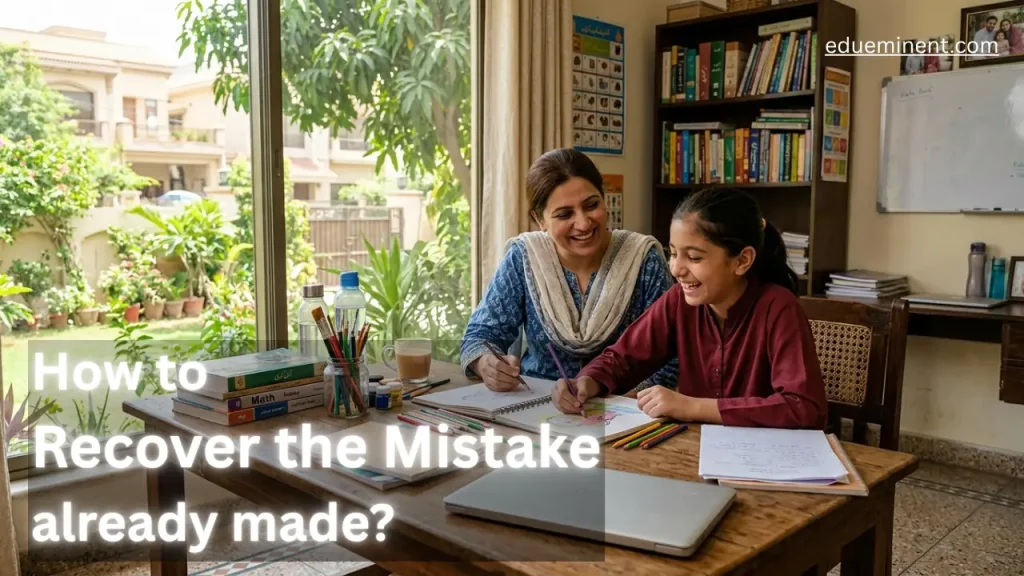
Talk with your child. Older middle school-age children in particular can often tell you directly what is and is not working for them, which saves a lot of guesswork.
Give new routines a fair trial. A new schedule or curriculum often feels awkward for the first week or two simply because it is new, not because it is wrong. Give real changes at least a few weeks before judging whether they worked.
Ask for help. A co op, an online community, or even a single experienced homeschool friend can offer perspective that is hard to find alone.
Track the change. Write down what you adjusted and roughly when. If a problem improves, you will know which change actually helped, and if it does not, you can rule that fix out and try something else without repeating the same mistake twice.
Recovery rarely happens overnight, and that is normal. Most families see real improvement within a few weeks of making even one thoughtful change, especially when the change addresses the mistake causing the most day-to-day friction.
Final Thoughts
Every homeschool family stumbles into a few of these mistakes at some point, and that is a normal part of learning how your family works best. What matters is not avoiding every single misstep, but noticing them early and making adjustments instead of pushing through a plan that clearly is not working.
Homeschooling is flexible by design, so use that flexibility. Slow down when something feels wrong, ask for support when you need it, and remember that a good homeschool year rarely looks perfect. It just looks like steady progress, one adjustment at a time.
If you take one thing away from this guide, let it be this. Mistakes are not proof that homeschooling was the wrong choice for your family. They are simply part of the process every homeschool family goes through on the way to finding a rhythm that actually works.
Give yourself the same patience and grace you give your child while they learn, because you are learning a big new skill too.
Frequently Asked Questions
Is it normal to feel like you are failing at homeschooling?
Yes, this feeling is extremely common, especially in the first year. Most experienced homeschool parents report feeling this way at some point, and it usually fades as routines settle and confidence builds.
How long should I try a curriculum before deciding it is not working?
Most homeschool parents recommend giving a new curriculum at least four to six weeks before making a final decision, since the first couple of weeks often involve an adjustment period for both parent and child.
What is the biggest mistake new homeschool parents make?
Many experienced homeschool parents point to recreating a full public school schedule at home as the single most common and most exhausting early mistake, since it rarely fits the realities of teaching one or a few children directly.
Can switching curriculum mid-year hurt my child’s education?
Generally no. Most curricula cover similar core skills, and a smoother fit for your child usually outweighs any short-term disruption from switching partway through the year.
How do I know if my child is falling behind?
Occasional gaps in one subject while excelling in another are common and usually not a sign of falling behind. A more useful sign to watch for is a consistent, ongoing struggle with a specific skill over several months, which may call for a different teaching approach or outside support.
Is it a mistake to homeschool without joining a co op?
Not necessarily, but families who skip any outside community entirely often feel more isolated over time. A co op is not required, but some form of regular outside social and support contact is worth building into the plan.
Should I follow state academic standards exactly?
No, treat them as a general reference point rather than a strict requirement, unless your state specifically mandates certain benchmarks. Homeschooling allows pacing that fits your child, which is one of its core advantages.
What should I do if I feel completely burned out?
Take a short, planned break, even just a few days, and use that time to honestly evaluate what part of the routine is causing the most strain. Small, early adjustments usually prevent the kind of burnout that leads families to quit homeschooling altogether.
Is it a mistake to homeschool more than one child at very different grade levels at the same time?
Not at all, though it does take some planning. Many families successfully combine subjects like history, science, and read-aloud time across age groups, while keeping math and reading instruction individualized for each child’s actual level.
Can too much screen time in a homeschool day become a mistake?
It can, particularly when online programs or educational videos replace hands-on learning, conversation, and outdoor time almost entirely. A useful habit is treating screens as one tool among several, rather than the default method for every subject.