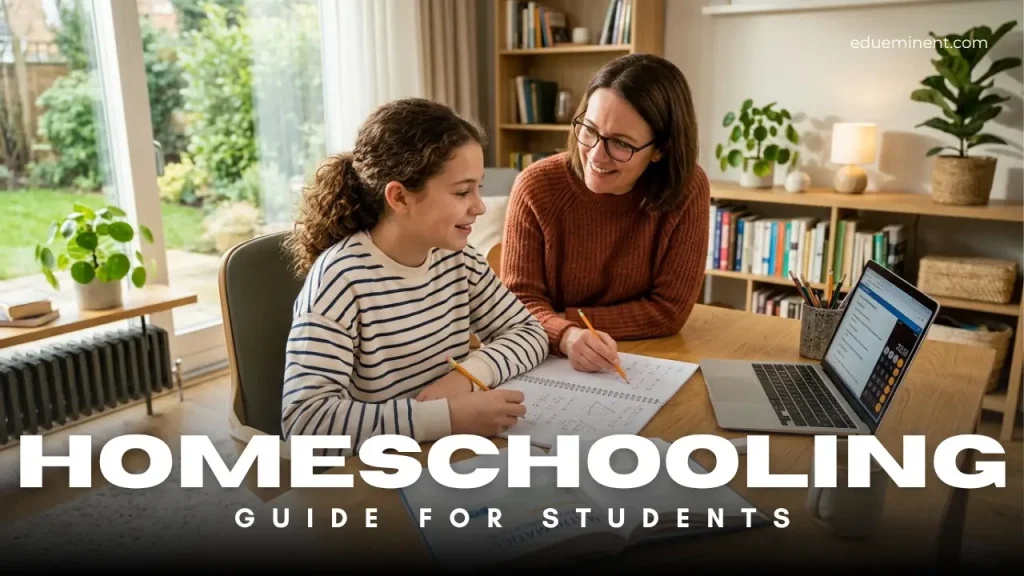
Homeschooling allows students to learn outside a traditional school environment, often with guidance from parents, tutors, or online teachers. This guide explains how homeschooling works, curriculum choices, daily routines, costs, social activities, exams, O Level and A Level pathways, and its advantages and challenges.
Maybe a friend told you they don’t go to a regular school. Maybe you’ve wondered what they do all day, or if they even wear pajamas to class.
Homeschooling might sound mysterious, but it’s simpler than you think. This guide breaks down what homeschooling actually is, how it works, and what a typical day might look like.
Key Takeaways
- Homeschooling means learning outside a traditional school building, usually guided by a parent or guardian.
- It’s legal in all 50 U.S. states, but the exact rules and paperwork depend on which state a family lives in.
- Homeschoolers study the same core subjects as students in regular school — math, reading, science, and social studies.
- Costs range from nearly free, using library books and free resources, to several thousand dollars a year for full online programs.
- Homeschoolers build friendships through co-ops, sports teams, and community groups instead of school hallways.
- Homeschooled students can and do go to college, usually applying with a transcript, test scores, and sometimes a portfolio.
What Does Homeschooling Actually Mean?
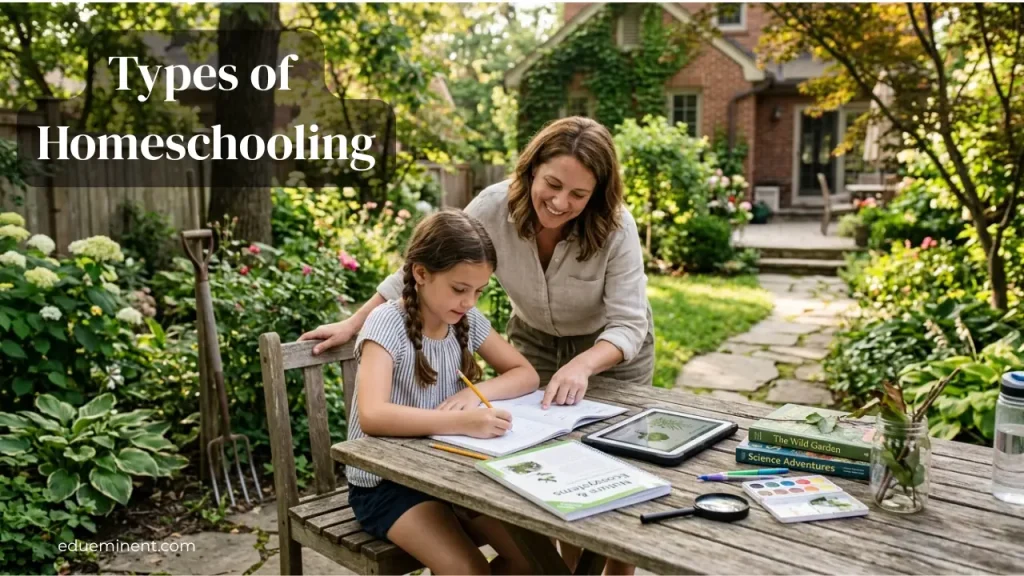
Homeschooling means learning outside of a traditional school building, usually guided by a parent or guardian instead of a classroom teacher. Instead of riding a bus to a room full of desks, a homeschooled student might study at the kitchen table, in a home office, or outside in the backyard. The “school” isn’t a building — it’s wherever the learning happens.
Families choose homeschooling for all kinds of reasons. Some want more flexibility. Some want lessons that fit how their kid learns best. Some live too far from a school for the daily commute to make sense.
A Quick History: How Did Homeschooling Start?
Homeschooling isn’t new — it’s actually the oldest way of learning. For most of human history, kids picked up skills and knowledge from parents, grandparents, and people in their community, not in a school building. Formal public schools only became common in the United States in the 1800s.
Homeschooling as a modern movement really took off in the 1970s and 1980s, when a growing number of families started choosing to teach their kids at home instead of sending them to public school. Since then, it’s kept growing. Today, millions of students in the U.S. alone learn this way, using everything from handwritten lesson plans to online school platforms.
How Is Homeschooling Different From Regular School?
Regular school runs on a fixed schedule, moves at one pace for the whole class, and happens in the same building every day. Homeschooling changes most of that:
- Schedule: Families can start school at 7 a.m. or 11 a.m. — whatever fits their day.
- Pace: A student can slow down on a hard topic like fractions, or move quickly through something they already know.
- Location: Lessons can happen at home, at a library, at a museum, or even on a road trip.
- Class size: It’s usually one student, or a small group of siblings, instead of thirty classmates.
Even with all that flexibility, homeschooled students still cover the same core subjects — math, reading, science, and social studies — just in a different setting.
Who Teaches Homeschooled Kids?
Usually a parent or guardian takes on the teacher role, but that rarely means explaining every subject from memory. Most homeschooling families rely on a mix of tools:
- Curriculum kits or workbooks built for a specific grade level
- Online classes and recorded video lessons
- Tutors for harder subjects like algebra or chemistry
- Co-ops, where a few families team up, and each parent teaches the subject they know best
A “homeschool teacher” often works more like a project manager, pulling together the right resources instead of writing every lesson from scratch.
What Does a Homeschool Day Actually Look Like?
There’s no single answer — that’s kind of the point. A common pattern might look like this:
- Morning: Math and reading, when focus is usually sharpest
- Midday: A break for lunch, chores, or outside time
- Afternoon: Science, history, or a creative project like art or coding
- Some days: A field trip to a museum, a nature walk, or a co-op class with other homeschooled kids
Most homeschool days run shorter than a traditional school day, often 3 to 5 hours, since there’s no time lost to hallway transitions or waiting for the whole class to finish a worksheet.
What Subjects Do Homeschoolers Study?
Homeschooled students study pretty much the same core subjects as students in regular school:
- Math
- Reading and language arts
- Science
- Social studies or history
- Physical education
- Often a foreign language, art, or music
Some states set specific subject requirements that families have to follow. Beyond the basics, homeschooling leaves room to add subjects a regular school schedule might not fit in, like coding, gardening, personal finance, or a deep dive into something like astronomy.
What Tools and Technology Do Homeschoolers Use?
Technology plays a big role in a lot of modern homeschooling. Common tools include:
- Learning apps and websites for practice, like math games, reading trackers, or typing programs
- Video lessons from platforms built for specific subjects
- Video calls for co-op classes or online school days
- Digital planners parents use to track lessons and progress
- E-books and audiobooks alongside print books
Not every family leans heavily on technology, though. Some homeschools stick mostly to books, worksheets, and hands-on projects, especially for younger students.
How Much Does Homeschooling Cost?
There’s no set price tag. Homeschooling can cost close to nothing, or it can add up to a few thousand dollars a year, depending on the choices a family makes.
- Low-cost: public library books, free printable worksheets, free online curricula, and materials borrowed from other homeschool families
- Mid-range: purchased curriculum packages, a used laptop, or memberships to museums and zoos for field trips
- Higher-cost: full online school programs, private tutors, co-op tuition, or specialized courses like a foreign language program or a lab science kit
Some states also offer funding through charter or public virtual school programs, which can cover curriculum costs for families who enroll through them instead of homeschooling fully independently.
Choosing a Homeschool Curriculum
A curriculum is simply the set of lessons, books, and materials a family uses to teach each subject. Picking one is one of the first big decisions in homeschooling, and there’s no single “correct” choice — it depends on the student’s needs, the family’s budget, and where they eventually want to end up, like sitting for O Level or A Level exams.
- A full boxed curriculum that covers every subject for a grade level in one package
- An à la carte mix, picking different resources for math, science, and language separately
- An international curriculum like Cambridge or Edexcel, which lines up with globally recognized exams
- Open educational resources, which are often free and available online
Curriculum by Grade (Grades 6–8)
Since this guide is written for grades 6 through 8, here’s roughly what a curriculum tends to focus on at each level:
- Grade 6: Stronger foundations in fractions and decimals, introductory earth science or biology, paragraph and essay writing, and early world history
- Grade 7: Pre-algebra, life science or physical science, more advanced writing and grammar, and a deeper look at geography or civics
- Grade 8: Algebra readiness or Algebra 1, a full science course like biology or physical science, persuasive and research writing, and often the start of exam-board preparation for students planning to sit the O Level program in the following years
Exact pacing depends on the curriculum a family picks, so this is a general guide rather than a fixed rule.
Different Types of Homeschooling
Not all homeschooling looks the same. Here are the main styles families use.
Traditional Homeschooling
Follows a set curriculum with textbooks, workbooks, and tests — similar to regular school, just at home.
Online or Virtual Homeschooling
Lessons happen through a computer, often with a real teacher on video calls, graded assignments, and a set schedule, sometimes through a public or charter virtual school.
Unschooling
A more relaxed approach where kids learn through curiosity and everyday life instead of a fixed lesson plan — for example, picking up fractions while cooking, or history through historical fiction.
Homeschool Co-ops
Groups of homeschooling families meet regularly so kids can take classes together, work on group projects, and get some of the social time a regular classroom offers.
Homeschool Resources
Beyond a core curriculum, most homeschooling families lean on outside resources to fill in gaps and add depth:
- Public libraries, for free books and sometimes free educational programs
- Past papers and syllabus documents from exam boards like Cambridge or Edexcel
- Educational YouTube channels and free video lesson platforms
- Homeschool forums and social media groups, where parents trade tips and recommend materials
- Local tutoring centers for subjects that need extra support, like math or chemistry
Activities
Learning at home doesn’t mean staying inside all day. Homeschool families often build in activities that add hands-on experience and a break from textbook work:
- Field trips to museums, historical sites, or science centers
- Sports through community leagues, since school-based teams aren’t usually an option
- Art, music, or coding classes, either in person or online
- Volunteer work, which can also build real-world experience for future college or university applications
- Co-op days, where activities and projects happen alongside other homeschooled students
Do Homeschoolers Get Grades and Report Cards?
It depends on the family and the state. Some homeschool parents give grades and put together their own report cards, especially if they’re following a set curriculum with tests. Others skip traditional grading and instead keep a portfolio — a collection of a student’s work that shows what they learned over the year.
States that require regular evaluations usually accept either a standardized test score or a portfolio review as proof of progress. When a homeschooled student applies to college, families often put together an official-looking transcript that lists courses, grades (if used), and any test scores.
Parents who teach at home need reliable material to keep learning structured. Explore these homeschool resources in Pakistan for books, online platforms, and curriculum tools that make teaching easier.
Common Myths About Homeschooling
A few myths stick around, even though they’re not true.
- Myth: Homeschoolers don’t have friends. Reality: Most homeschoolers build friend groups through co-ops, sports, and community activities — just outside of a school building.
- Myth: Homeschooling means no rules or structure. Reality: Many homeschoolers follow a strict daily schedule, and even flexible styles like unschooling still have goals and expectations.
- Myth: Homeschoolers can’t get into good colleges. Reality: Colleges regularly accept, and sometimes actively recruit, homeschooled students.
- Myth: Any parent can homeschool without following any rules. Reality: Every state has its own laws that homeschooling families are required to follow.
A Day in the Life: One Possible Homeschool Schedule
It helps to see a real example instead of just a general outline. Here’s what one seventh grader’s homeschool day might look like:
- 8:00 a.m. — Wake up, breakfast, no rush to catch a bus
- 8:45 a.m. — Math lesson, working through a workbook chapter on ratios
- 9:30 a.m. — Reading time, working through a novel for a book report
- 10:15 a.m. — Short break, maybe a snack or a walk outside
- 10:30 a.m. — Science, this week building a simple circuit for a physics unit
- 11:30 a.m. — Lunch and chores
- 1:00 p.m. — Online co-op class on world history with a few other homeschooled students
- 2:00 p.m. — Independent project time, working through a coding tutorial
- 3:00 p.m. — School day wraps up, free time or an extracurricular like soccer practice
Every homeschool day looks different, but this general mix — core subjects in the morning, a group class or project in the afternoon — is pretty common.
Homeschooling and Different Learning Styles
One reason some families choose homeschooling is the chance to adjust lessons around how a specific kid actually learns, instead of using one method for an entire class of thirty students.
- A student who struggles to sit still might do math while standing at a counter or working with hands-on manipulatives.
- A student with dyslexia might use audiobooks alongside, or instead of, print books.
- A student who needs more time on a subject can slow down without falling behind a fixed class pace.
- A student who’s ahead in one subject, like math, can move forward without waiting on classmates.
This flexibility is part of why some families of kids with ADHD, dyslexia, or other learning differences choose homeschooling, though it still takes real effort from parents to figure out what actually works for their child.
Do Homeschoolers Make Friends?
This is probably the question homeschooled students hear the most: “But how do you make friends?” The answer is that homeschoolers build friendships in plenty of places — co-op classes, sports teams, scouting groups, community or church groups, neighborhood kids, and online classes with live video chats. Many homeschoolers say their shorter school day actually leaves more room for activities during the week, not just on weekends.
Is Homeschooling Legal Everywhere?
Yes. Homeschooling is legal in all 50 U.S. states, though the rules vary by state. Some states only require parents to notify the school district. Others require regular testing or portfolio reviews to show a student is learning grade-level material. Families generally have to follow their state’s specific requirements, which can include keeping attendance records or filing paperwork each year.
Can You Switch Between Homeschool and Regular School?
Yes, and students move between homeschooling and traditional school more often than people think. A student might homeschool for a year and then enroll in public school the next, or the other way around. Schools usually place a new student based on an assessment, past transcripts, or grade-level testing to figure out where they fit.
Switching can take some adjustment — a different daily schedule, new social dynamics, a different pace — but it’s a normal, manageable change that plenty of students go through.
Homeschooling Around the World
Homeschooling is legal and common in the United States, but the rules look very different elsewhere. In Canada and parts of the U.K., homeschooling is legal with relatively light regulation.
In Germany, homeschooling is illegal in almost all cases, and kids are required to attend school in person. Other countries fall somewhere in between, with permits, inspections, or specific requirements families must meet.
If a family moves internationally, they usually need to research that country’s specific homeschool laws rather than assume the same rules apply.
Homeschooling in Pakistan
Homeschooling looks a bit different in Pakistan than it does in the United States. There’s no single homeschool law spelling out exact rules the way many U.S. states have, so families have more freedom in how they set things up — but that also means less official guidance to follow.
Many homeschooling families in Pakistan choose to follow an international curriculum, most commonly the British curriculum through Cambridge Assessment International Education (CAIE) or Pearson Edexcel, since these lead to globally recognized O Level and A Level qualifications.
Others build a homeschool around a mix of local textbooks and international resources, especially in the earlier grades. Because homeschooling isn’t tied to a public school system in Pakistan, students usually need to register directly with an exam board once they’re ready to sit for formal exams like O Levels.
O Level Homeschooling
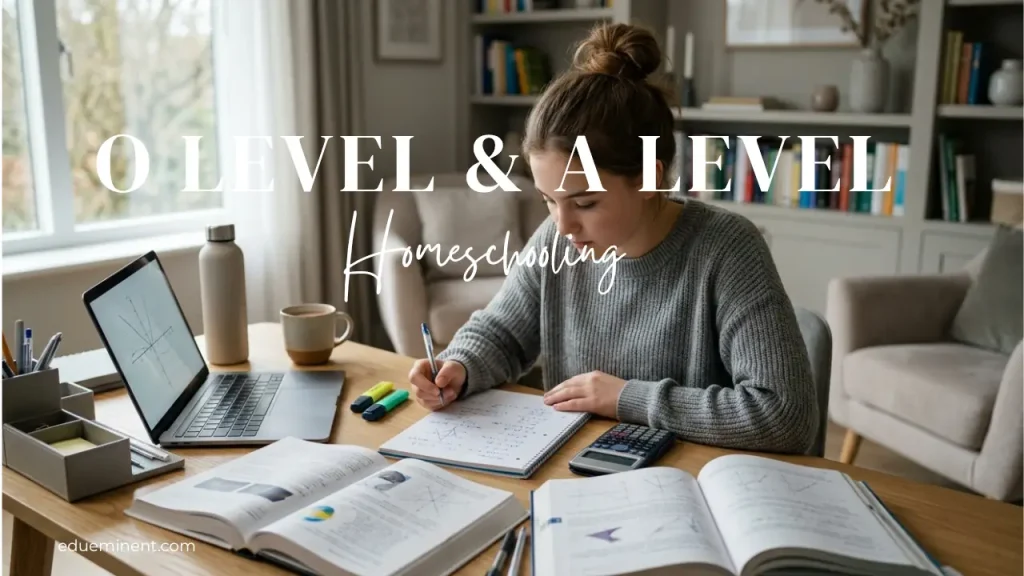
O Levels, short for Ordinary Levels, are internationally recognized exams usually taken around ages 14–16. Homeschooled students preparing for O Levels typically:
- Follow a syllabus from an exam board like Cambridge (CAIE) or Edexcel for each subject
- Study using textbooks and past papers designed specifically for that syllabus
- Register as a private candidate at an approved exam center to actually sit the exams, since the exams happen in person at registered centers, not at home.
Students usually take a set of O Level subjects, commonly around 5 to 8, rather than a single exam — similar to taking several final exams across different classes.
A Level Homeschooling
A Levels, or Advanced Levels, are the next step after O Levels, usually taken around ages 16–18. They’re more specialized: students pick a smaller number of subjects, often 3 to 4, and go deeper into each one. A Level results are widely used for university admissions, both in Pakistan and internationally.
Homeschooled A Level students follow the same general process as O Level students: studying a specific exam board’s syllabus, then registering as a private candidate to sit the exams at an approved center.
Exams
Whether a homeschooled student is working toward O Levels, A Levels, a state-required evaluation in the U.S., or another system entirely, exams usually serve one main purpose — showing that learning actually happened. A few things hold across most systems:
- Exams are usually tied to a specific syllabus, so studying the right material matters as much as studying hard
- Past papers are one of the most useful prep tools, since they show the real style and difficulty of actual questions
- Homeschooled students planning to sit formal exams like O Levels or A Levels need to register with an exam board or approved center in advance, sometimes months ahead of the exam date.
- Results from these exams usually replace a traditional school report card when it comes to college or university applications.
Pros and Cons of Homeschooling
No school setup works perfectly for every student. Here’s a fair look at both sides.
Pros:
- A flexible schedule that fits a family’s life
- Lessons paced to the student, not the whole class
- More one-on-one attention
- Freedom to dig deep into subjects a student loves
Cons:
- Parents need to invest real time and effort
- Social time takes more planning to arrange
- Fewer built-in extracurriculars, like school sports teams
- Harder to access specialized classes, like AP courses or full science labs
How to Tell If Homeschooling Might Be a Good Fit
There’s no single sign that homeschooling is “right” for someone, but a few questions can help sort it out:
- Does the family have time — usually one parent has significant time — to guide daily lessons?
- Does the student learn well with more independence, or do they thrive on classroom energy and group work?
- Are there co-ops, sports leagues, or community groups nearby for social time?
- Does the family understand their state’s homeschool requirements?
There’s no wrong answer here. Homeschooling, traditional school, and hybrid options all work well for different kids. What matters most is whether the setup actually supports how a specific student learns.
Getting Started: What Does a New Homeschool Family Do?
Families who are new to homeschooling usually go through a similar first-step process:
- Check the home state’s requirements — some states need a simple letter of intent, others ask for more paperwork
- Decide on a general approach — traditional, online, unschooling, or a mix of styles
- Pick or build a curriculum for each core subject
- Set up a workspace, even if it’s just a corner of the kitchen table
- Find a local co-op or homeschool group for support and social time
Most families adjust their plan after the first few months. What looks good on paper isn’t always what actually works once the school year gets going.
Homeschooled students still need recognized qualifications to move ahead. Learn how homeschooling exams in Pakistan work, including registration, boards, and the options available for each grade.
Frequently Asked Questions
Can homeschoolers go to college?
Yes. Colleges accept homeschooled students all the time. They usually ask for transcripts, test scores, and sometimes a portfolio of work in place of a typical school report card.
Do homeschoolers take standardized tests?
Often, yes. Many states require an annual test or evaluation to confirm a student is progressing at grade level.
Is homeschooling free?
It depends. Some families rely on free resources like public library books and free online curricula. Others pay for structured programs, tutors, or co-op fees.
Can a homeschooled student play school sports?
In many states, yes. Some public schools let homeschooled students join sports teams or specific classes under certain rules, though this varies by state and district.
Is homeschooling harder than regular school?
Not harder exactly, but different. It takes discipline and self-motivation, since there’s no built-in class schedule pushing a student from one subject to the next.
What is the difference between homeschooling and traditional schooling?
Homeschooling is when children learn at home under their parents’ guidance or with tutors, while traditional schooling takes place in a school with teachers and classmates.
Do homeschoolers get a diploma or graduation ceremony?
Yes. Homeschooled seniors can earn a diploma, usually issued by their parent or an umbrella school, and many homeschool families or co-ops organize their own graduation ceremonies.
Is homeschooling the same thing as online school?
Not exactly. Online school, sometimes called virtual school, is one type of homeschooling, where lessons happen through a computer with a certified teacher. Homeschooling is the bigger, broader category — it includes online school, but also textbook-based learning, unschooling, and co-op approaches that don’t rely on a screen at all.
Do homeschoolers get summer break?
Most do, but not always in the same pattern as public school. Some families follow a traditional nine-month school year with summer off. Others do school year-round with shorter breaks spread throughout the year instead of one long summer break. It really depends on what works for that family.
Can both parents work full-time if their kids are homeschooled?
Yes, some families make it work, though it usually takes extra planning. Common options include splitting teaching time between two parents, hiring a tutor for part of the day, using an online school program that runs mostly independently, or joining a co-op that covers a few days a week.
What age can a student start homeschooling?
There’s no single starting age. Families can begin homeschooling for kindergarten, switch over partway through elementary school, or start in high school. Each state sets its own age range for when schooling becomes legally required, usually somewhere between ages 5 and 8.
Can siblings of different ages be taught together?
Often, yes, especially for subjects like history, science, or read-aloud books, where the whole family can explore one topic at different levels of depth. Subjects like math usually still need to be taught separately, since kids move through them at different paces.
Homeschool Glossary: Key Terms to Know
- Curriculum: The set of lessons, books, and materials used to teach a subject
- Co-op: A group of homeschooling families who meet regularly to share teaching and social time
- Umbrella school: A private school that oversees homeschool students’ records to help families meet state requirements
- Portfolio: A collection of a student’s work used to show learning progress over the year
- Unschooling: A homeschool style built around curiosity-driven learning instead of a fixed lesson plan
- Transcript: An official record of the courses and grades a student completed, used for college applications
- Letter of intent: A form some states require to notify the school district that a student will be homeschooled
The Bottom Line
Homeschooling isn’t one single thing — it’s a mix of approaches families shape to fit their kids. Whether it’s a strict daily schedule with textbooks or a relaxed unschooling style built around curiosity, the goal is the same as any school: helping a student learn, grow, and eventually move on to whatever comes next, whether that’s college, a job, or something else entirely.
Want to dig deeper? Check out our related guide on how homeschool curriculum is chosen and organized.