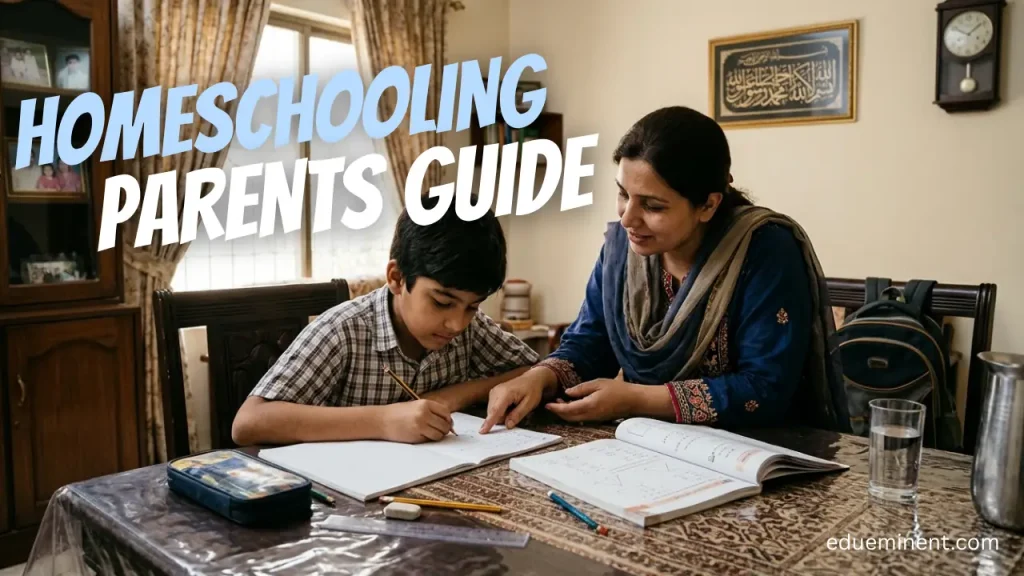
This homeschooling parents’ guide for Pakistan helps families support children in grades 6 to 8 through middle-school challenges. It covers school systems, study routines, homework, tuition, screen safety, puberty, emotional wellbeing, exam pressure, health habits, and early career planning to help parents build their children’s confidence and independence.
If your child has just moved into grade 6, you have probably noticed it already. The little one who needed help packing the school bag now rolls their eyes at you, and the homework diary seems to grow longer every week.
This parents’ guide for Pakistan is written for exactly this stage. It covers school systems, study routines, tuition, mobile phones, exams, friendships, and the big changes that arrive between the ages of 11 and 14. You don’t need a degree in education to use it. A little patience and a willingness to listen will take you a long way.
Understanding what homeschooling is the first step for parents exploring alternatives to traditional education. Learn how home-based learning works, its benefits, and how families can create a structured education plan for their children.
Why Are Grades 6 to 8 So Important for Pakistani Students?
Grades 6 to 8 are the bridge between primary school and the serious years of Matric, Intermediate, or O and A Levels. Children are roughly 11 to 14 years old at this point, and the study habits they build now will decide how comfortably they handle grade 9.
Think about how school feels at each stage. In primary, the class teacher holds your child’s hand through almost everything. In middle school, subjects get separated, every teacher expects more independence, and the syllabus quietly doubles in size.
Maths brings in algebra and geometry properly. English moves from short stories to essays, comprehension, and real grammar. Science starts asking “why” instead of just “what”.
At the same time, your child’s body and feelings are changing. Mood swings, a sudden love for friends over family, and a strong need for privacy are all normal. Many parents read this as disrespect. Most of the time it is simply growing up.
So your role changes too. You move from manager to coach. You stop doing things for your child and start guiding them. That shift sits at the heart of every useful parents’ guide, and it is what the rest of this article is about.
How Does the School System Work for Grades 6 to 8 in Pakistan?
Most students in grades 6 to 8 follow a provincial curriculum, a national curriculum, or a Cambridge-style programme, and exams at this level are usually set by the school instead of an outside board.
Pakistan doesn’t offer one single schooling experience. Your child might attend a government school, a private Urdu medium school, an English medium school, a large private chain, a small neighbourhood academy, or a madrassa that also teaches formal subjects. Each one runs a little differently, so it helps to know what to ask.
| School type | Common medium | What it usually follows | What parents should check |
| Government school | Urdu or a regional language, sometimes English | Provincial textbook board syllabus | Textbook supply, teacher attendance, whether a grade 8 exam applies |
| Private Urdu medium | Urdu | Provincial syllabus | Strength of English teaching, extra fees |
| Private English medium | English | Provincial or national syllabus with extra books | Fee increases, homework load, pace of teaching |
| Cambridge style school | English | Cambridge Lower Secondary or a school-designed syllabus | Checkpoint tests, preparation for O Levels |
Curriculum policy in Pakistan has also changed more than once in recent years, including the push for a Single National Curriculum that began around 2020. Rules differ by province and by school, and they can change again. So always ask the school office for the current syllabus, book list, and exam schedule instead of relying on a neighbour’s advice.
Some provinces hold a public exam at grade 8 for certain schools. Others leave all exams to the school. Ask early, because it changes how seriously you should plan the final year of middle school.
Setting clear homeschooling goals gives parents a practical way to measure progress and keep children focused. Learn how to establish achievable academic targets, develop essential skills, and review learning outcomes regularly.
Whatever system your child is in, three things stay the same. Strong reading, solid basic maths, and the habit of finishing work will help in every classroom.
What Should a Daily Study Routine Look Like at Home?
A good routine for a grade 6 to 8 student includes a fixed homework time, a quiet corner, short breaks, and an early bedtime. Most children in this age group manage one to two hours of focused work a day, though the exact amount depends on the school’s workload.
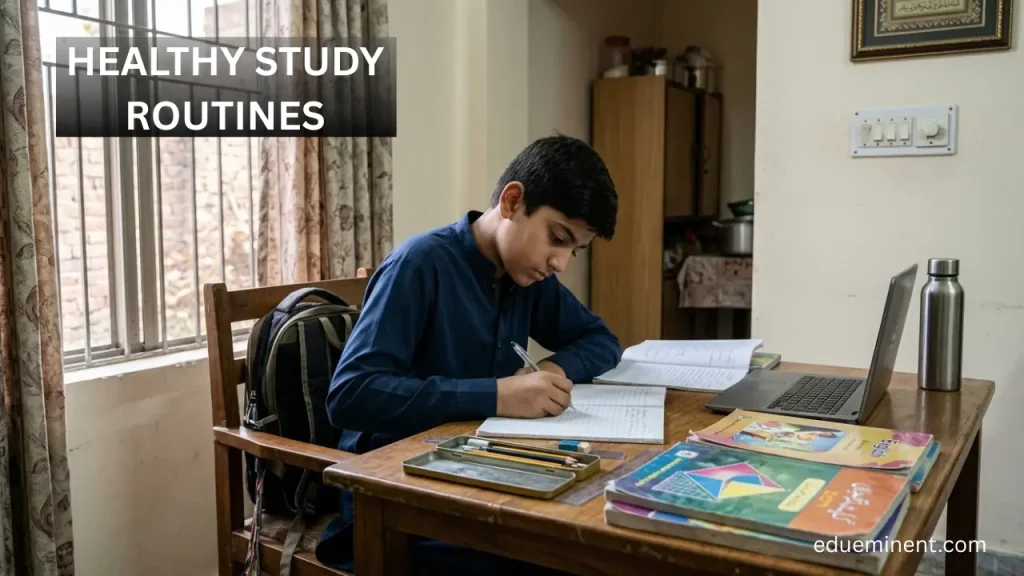
Routines work because they remove arguments. When homework always starts at the same time, nobody has to negotiate. Here is a simple pattern you can adjust for your home:
- Your child comes home, changes, eats lunch, and rests for 30 to 45 minutes.
- Homework begins at a fixed time, for example, 4:30 pm, with the phone in another room.
- Your child works in blocks of 30 to 40 minutes, with a 10-minute break between them.
- Before dinner, they spend 15 minutes reading something that isn’t a textbook, in Urdu or English.
- They pack the bag and check the school diary for tomorrow.
- Screens go off at least 30 minutes before sleep.
Let your child help build this timetable. A routine they helped design is far easier to follow than one handed down like an order. Many children prefer to tackle the hardest subject first while their mind is fresh, and that works well.
Load shedding and busy evenings are real in many homes. Keep a rechargeable lamp ready, do heavy writing work in daylight when you can, and don’t turn a power cut into a family crisis. Flexible routines survive. Rigid ones break.
Give your child a proper study spot as well. It doesn’t have to be a separate room. A table near a window, away from the television, is enough.
How Can You Help with Homework Without Doing It for Them?
Sit nearby, ask questions, and let your child struggle a little before you step in. The goal is a student who can finish work alone, not a parent who finishes it for them.
Many caring parents end up writing the assignment or solving the sums themselves. Teachers can usually tell. More importantly, your child learns that somebody will always come to the rescue, and that lesson costs a lot later.
Try asking three questions instead of giving answers:
- What is the question asking you to do?
- What have you tried so far?
- Where exactly did you get stuck?
If they still can’t move forward, show a similar example, not the exact answer. Then let them try the real question again.
What if you didn’t study much yourself, or English feels difficult? That is very common, and there’s no shame in it. You can still help in powerful ways. Check the diary every day, sit with your child while they work, and ask them to teach you the topic.
Explaining an idea to someone else is one of the best ways to learn it. If a subject truly goes beyond what you can support, ask the teacher about extra help, or look for an older cousin, a neighbour, or a trusted free online lesson.
How Can Parents Support Each Subject?
Each subject needs a slightly different kind of help. Here is a quick guide for the main subjects in Pakistani middle schools.
English
Reading is the secret. Encourage 15 to 20 minutes of daily reading, whether it is a storybook, a children’s newspaper page, or a magazine. Ask your child to retell what they read in their own words. For writing, ask for just five good sentences a day about anything at all.
Urdu
Urdu often gets ignored in English medium homes, and that’s a mistake. Strong Urdu helps with comprehension, handwriting, and expression. Read a short poem or a story together on weekends and talk about new words.
Maths
Maths in grades 6 to 8 builds on itself. If fractions are weak, algebra will feel painful. When your child struggles, go back to the earlier topic instead of pushing forward. Short daily practice of 20 minutes beats a long panic session before the test.
Science
Connect lessons to everyday life. Cooking, plants in the garden, a ceiling fan, a bicycle tyre and the monsoon rain are all science. Ask “why do you think that happens?” and enjoy the answer, even when it’s wrong.
Islamiat, Social Studies and Pakistan Studies
These subjects involve a lot of reading and memory. Help your child make short notes, timelines, and simple maps. Discuss values and history at the dinner table, not only in textbooks. Stories stick better than paragraphs.
Computer Studies
Don’t dismiss this as a minor subject. Typing, safe internet use, and basic digital skills matter for the future. Let your child show you what they learned in class. It builds confidence and keeps you informed.
Is Tuition Really Necessary in Grades 6 to 8?
No, not always. Many children do well with good school teaching and steady support at home. Tuition helps when a child clearly struggles in one particular subject, usually Maths or English, and the school can’t give that extra attention.
Pakistan has a strong tuition culture. Some families start academies and home tutors as early as primary school. The trouble is that a child can end up tired, with no time to play, and with a tutor who dictates answers instead of building understanding.
Ask these questions before you hire anyone:
- What exact problem are we trying to fix?
- Will it cover one subject or everything?
- Does the tutor explain ideas, or only give notes to memorise?
- How will we measure progress after two months?
Try a short trial of eight to twelve weeks and then review. Watch your child’s energy as well. If they come home exhausted every day and their marks haven’t improved, the arrangement isn’t working. Sometimes the better fix is a simpler one, such as 20 minutes of daily practice with you.
What Should Parents Know About Screen Time, Phones and Online Safety?
Keep phones and tablets in shared spaces, set clear time limits, and talk openly about what your child watches and plays. In grades 6 to 8, children are curious, social, and easily influenced, which makes the internet both useful and risky.
Class WhatsApp groups are a good example. They can share homework updates quickly, but they can also become a place for teasing, rude jokes, and bullying. Online games and video apps bring their own problems, including strangers, spending money, and hours lost without anyone noticing.
Here are practical rules that many families find workable:
- Charge phones and tablets in the parents’ room at night, not beside the child’s bed.
- Agree on weekday and weekend time limits together, and write them down.
- Use parental controls and supervised accounts on YouTube and app stores.
- Talk about what is okay to share and what is not, especially photos and personal details.
- Remind your child never to meet an online contact in person.
The most important rule is this: promise your child they won’t be punished for telling you about something that upset or scared them. If they fear losing their phone, they will hide problems. If they know you’ll stay calm, they will come to you.
Set the example, too. If parents scroll through their phones all evening, children notice. Keep one phone-free hour at dinner for the whole family.
If something serious happens, such as blackmail, threats, or harassment, keep screenshots and report it to the FIA cybercrime wing, which handles online offences in Pakistan. You can also speak to the school.
How Do You Handle Puberty and Emotional Changes?
Stay calm, honest, and available. Puberty can begin around age 9 or 10 for some children and later for others, so by grades 6 to 8 most students are noticing changes in their bodies and moods.
In many Pakistani homes, these topics feel awkward, so children end up learning from friends or the internet, and that information is often wrong or confusing. It is far better if the first accurate explanation comes from you.
A mother can talk to a daughter and a father to a son, or whichever parent the child feels more comfortable with.
Keep the conversation short, simple, and respectful. Explain that body changes are natural and that every child grows at a different speed. Girls should hear about periods before they start, including hygiene and what to do at school. Boys should hear about voice changes, growth spurts, and personal hygiene as well. You can also ask the school counsellor or a trusted doctor for help.
Emotions change just as much. Your child might worry about looks, compare themselves with classmates, or feel hurt by small things. Listen without joking about it. Teasing a sensitive child often shuts the door for months.
Some warning signs deserve attention. These include sadness that lasts for weeks, losing interest in everything, big changes in sleep or appetite, refusing to go to school, or talk of hurting themselves. If you notice any of these, speak to a doctor or a mental health professional without delay. If your child is in immediate danger, get urgent help right away.
How Can You Talk to Your Child So They Actually Listen?
Listen first and lecture last. Children in grades 6 to 8 open up when they feel heard, and they close down when they feel judged.
Pick the right moment. Car rides, evening walks, and the time just after dinner work better than the minute your child walks through the door, or the moment you’re angry. Side-by-side conversations often feel safer than sitting face to face across a table.
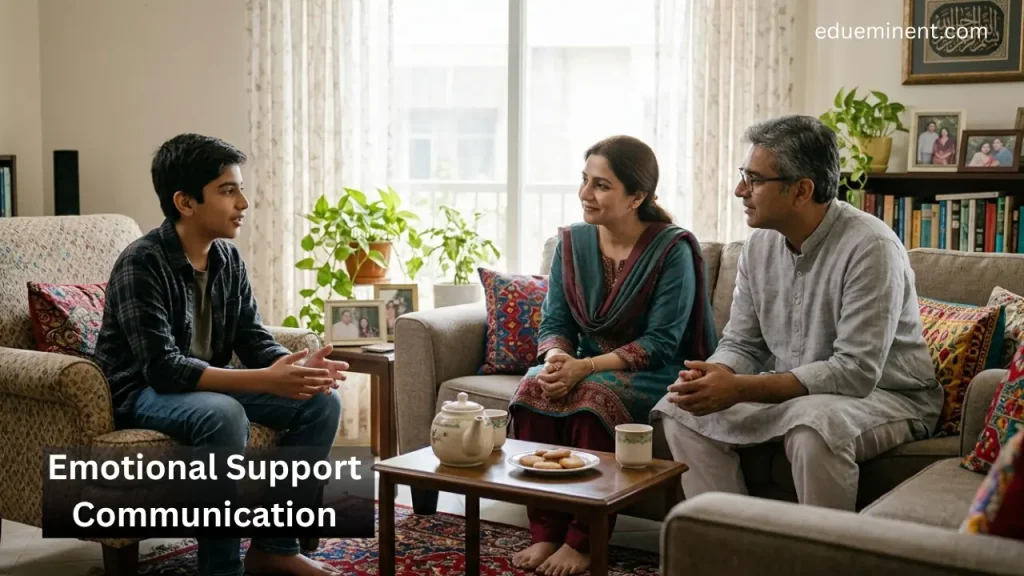
Ask open questions. “What was the best part of your day?” gets a real answer. “How many marks did you get?” gets a grunt. Praise effort, not only results. Saying “I saw how hard you worked on that” lasts longer than “well done, you topped”.
Avoid comparisons. Every parent has heard about the cousin or neighbour’s child who always gets the first position. Your child has heard it too, many times, and it only teaches them that they’re not enough.
Finally, admit your own mistakes. If you shouted unfairly, say sorry. A child who sees you apologise learns that apologising is strong, not weak.
How Do You Work Well with Teachers and the School?
Treat teachers as partners, not opponents. Attend parent-teacher meetings, ask specific questions, and raise concerns early and politely. Teachers see your child in a different setting, and what they notice can be very helpful.
Questions worth asking at every meeting:
- Where is my child strong right now?
- What is one thing they should improve this term?
- How is their attendance and behaviour in class?
- Do they have friends, and who do they sit with?
Some good habits help as well. Don’t criticise teachers in front of your child, because it weakens their respect for school. Use the school diary, a message to the office, or an approved group for communication instead of long angry calls. And don’t wait for the result card. If you notice a drop in interest or marks, speak to the teacher that week.
If a problem such as bullying or unfair treatment keeps happening, put your concern in writing and ask for a meeting with the coordinator or principal. Stay calm and stick to facts.
How Should Parents Handle Exams, Marks and Pressure?
Focus on understanding and effort, not only percentage. In grades 6 to 8, marks are feedback, not a verdict on your child’s future.
Exam pressure in Pakistan can be heavy. Families compare results, relatives ask about positions, and a single low mark can feel like a disaster. Children absorb that stress quickly. A calm home helps them perform better than a frightened one.
Start revision two or three weeks before exams instead of the night before. Make a simple timetable together, practise with school worksheets and past tests, and make sure your child sleeps properly during exam time. Last-minute all-night study rarely works.
After the exam, don’t scold. Look at the paper together and find out what really went wrong. Different mistakes need different fixes.
| Type of mistake | What it looks like | What helps |
| Careless error | Child knew the answer but made a small slip | Slow down, check work, practise reading questions twice |
| Concept gap | Child didn’t understand the topic | Go back to basics, use examples, ask the teacher |
| Time problem | Paper was left unfinished | Timed practice at home, learn to skip and return |
| Memory problem | Child forgot what they studied | Short notes, spaced revision, teaching someone else |
When your child sees that mistakes can be understood and fixed, exams stop feeling like a threat.
Which Health Habits Matter Most at This Age?
Enough sleep, a proper breakfast, daily physical activity and regular eye checks matter more than most parents realise. A tired, hungry child can’t learn well, no matter how clever they are.
Children in this age group generally need around 8 to 10 hours of sleep. Late-night phone use and early school mornings often cut this short, so protect bedtime like you protect homework time.
Breakfast matters. A paratha with an egg, daliya, milk, or fruit is better than chips and a soft drink at the school canteen. Pack water, especially in the long hot summers.
The World Health Organization recommends that children and teenagers get an average of at least 60 minutes of moderate to vigorous physical activity every day. Cricket in the street, football, cycling, skipping, or a family walk all count. It also helps with mood and concentration.
Two small things often get missed. First, check whether your child squints at the board, because poor eyesight is easy to fix but easy to overlook. Second, look at the school bag. A very heavy bag can strain young shoulders and backs, so help your child carry only what they need for the day.
How Early Should You Think About Matric, Streams and Careers?
Start gently in grade 8. Don’t pressure your child, but begin noticing their strengths and interests, because grade 9 is when subject choices start to matter.
In many schools and boards, students choose between groups such as science, computer science, and general or arts subjects when they enter grade 9. The names and rules vary, so ask the school what options exist and when decisions are due.
Open the conversation with curiosity, not demands. Ask what subjects they enjoy, what they are good at, and what problems they’d like to solve one day. Many children only know a few careers, usually doctor or engineer. Show them the wider world by talking about teachers, designers, pilots, farmers, accountants, writers, software developers, entrepreneurs, and more.
Invite a relative or family friend to share what their job looks like on an ordinary day. This kind of everyday exposure helps children connect school with real life.
Keep options open for as long as you can. Good reading, clear writing, comfort with numbers, and basic digital skills help in almost every path.
What Common Mistakes Should Parents Avoid?
The most common mistakes are comparing children, doing their work for them, ignoring their feelings, and waiting too long to act on problems. Almost every parent makes some of these, so treat this list as a gentle check rather than a judgement.
- Comparing your child with cousins, classmates, or neighbours.
- Doing homework or projects for them to get better marks.
- Shouting or scolding in front of relatives or classmates.
- Packing the whole day with school, tuition, and classes, leaving no time to play or rest.
- Dismissing worries as “silly” or “just a phase”.
- Believing every rumour from parent groups instead of checking with the school.
- Ignoring early signs of struggle until the result card arrives.
- Expecting your child to be perfect while you struggle with the same habits.
If you spotted yourself in one or two of these, don’t feel guilty. Noticing is the first step, and changing small things can improve the mood at home quickly.
Final Thoughts
Raising a child through grades 6 to 8 isn’t about perfect marks or perfect behaviour. It’s about building habits, trust, and confidence in a child who is slowly becoming their own person.
Keep routines simple, stay in touch with the school, protect sleep and play, guide screen use, and talk often and kindly. Most of all, let your child know that you’re on their side, even on the difficult days.
You won’t get everything right, and nobody does. But a parent who listens, learns, and keeps showing up is the strongest support a young student can have. Pick one idea from this parents’ guide for Pakistan and try it this week. Then come back for the next one.
Frequently Asked Questions
How many hours should a grade 6 to 8 student study at home?
Most students manage about one to two hours of focused study each day, including homework and revision. Quality matters more than quantity. If your child needs much more than that regularly, talk to the teacher about the workload.
Should I hire a tutor in grade 6?
Only if there is a clear need. A tutor can help with a specific weak subject, but many children do fine without one. Try a short trial and measure real progress before continuing.
At what age should my child get a smartphone?
There’s no single perfect age. Many families start with a shared family device or a basic phone and add independence slowly. What matters most is clear rules, supervision, and open conversation, not the age on the calendar.
How can I improve my child’s English at home?
Make reading a daily habit, talk to your child in simple English sometimes, and let them watch age-appropriate English programmes with you. Encourage them to write a few sentences each day. Don’t laugh at mistakes, because fear of mistakes stops children from speaking.
What should I do if my child is being bullied?
Listen calmly, thank them for telling you, and avoid blaming them. Write down what happened and when, then speak to the class teacher or coordinator. If it involves online messages, keep screenshots. Follow up until the problem is dealt with.
Is there a board exam in grade 8?
It depends on the province and the school. Some government schools take a public exam, while many private schools handle exams internally. Ask your child’s school for the latest information.
My child doesn’t want to go to school. What should I do?
First, stay curious, not angry. There may be a reason such as bullying, a difficult subject, a friendship problem, or anxiety. Talk to your child privately and then to the teacher. If the refusal continues, consider asking for support from a school counsellor or doctor.