This guide explains homeschooling in Pakistan for students in Grades 6–8, covering legal considerations, curriculum options, daily schedules, costs, socialisation, and exam pathways.
Use the 10-step setup guide for implementation, the curriculum guide for pathway decisions, and the programs guide for provider comparisons.
Parents can compare Cambridge, Pakistani board, American, and blended approaches while planning a practical transition toward O-Level programs, Matric, or other qualifications.
Middle school is usually when the cracks start showing: tuition fees go up again, subjects get noticeably harder, and your kid is finally old enough that they don’t need you sitting next to them for every lesson.
That combination is exactly why so many Pakistani parents seriously consider pulling their child out around this stage rather than earlier.
So let’s get into it properly. Is it even legal? What curriculum do you actually use? How do you structure a day that doesn’t fall apart by Wednesday? What does it cost, and what happens with exams after grade 8? I’ll go through all of it here, in the order you’ll actually need to think about it.
Is Homeschooling Legal in Pakistan?
Yes, completely. There’s no law that regulates it, licenses it, or bans it. The Ministry of Federal Education and Professional Training doesn’t require you to register anywhere, doesn’t set a mandatory curriculum, and nobody shows up to inspect your living room.
Article 25-A of the Constitution puts the responsibility for providing education on the state, not on individual parents, which is a big part of why home education was never legally restricted here the way it is in a handful of other countries.
What that actually means for you, day to day:
● No registering your child with any government office.
● No teaching degree required; you can teach them yourself.
● Full freedom to pick whatever curriculum you want: Cambridge, Pakistani board, American, a mash-up of all three, as long as it eventually leads to an exam your child can sit.
● No inspections, no home visits, no paperwork chasing you down.
Here’s the part people don’t love hearing, though: that freedom cuts both ways. Because nothing is mandated, nothing is checked either.
There’s no government safety net making sure your child is actually learning something useful. If the education falls short, that’s on you, not on any system failing to catch it. Worth sitting with before you commit.
Why Parents Actually Pull Their Kids Out Around Grade 6–8
Pakistan’s school system is genuinely under pressure right now. Depending on which report you read, somewhere around 25 to 26 million children are out of school entirely, which is part of why the Prime Minister declared a national education emergency back in 2024.
Most of that number is about kids with zero access to any schooling, which is a different, much bigger crisis.
But it points to something a lot of paying-tuition families feel too: classrooms are crowded, exams reward memorising over understanding, and fees keep climbing faster than most households can keep up with.
Ask around any homeschooling group in Karachi or Lahore, and you’ll hear a similar mix of reasons, usually a few of these together rather than just one:
The child is bored out of their mind and coasting, or on the flip side, quietly falling behind in a class of thirty-plus kids where nobody has time to notice. A lot of middle schools lean hard into memorisation for exams, and a curious kid who keeps asking “but why” doesn’t always get a satisfying answer.
Then there’s the social side: grades 6 to 8 line up with early adolescence, and that’s exactly when bullying and nasty peer dynamics tend to spike. Fees are another huge one, especially for families with two or three kids in private school at once.
Some parents want more room for religious or values-based teaching than a mainstream school offers. And some families are dealing with a child who has ADHD, a health condition, or just doesn’t thrive in a large classroom no matter how good the school is on paper.
None of that automatically means homeschooling is the right move for your family; it trades one set of problems for another, and the one you’re trading in (structure, a built-in daily routine) is bigger than people expect going in.
The parents who make it work tend to go in with an actual plan, not as an emergency exit.
Grades 6–8 Are Not the Same Job as Homeschooling a Six-Year-Old
Worth saying plainly: teaching a middle schooler at home is a different task than teaching a first grader. A few things shift once you hit grade 6.
Subjects start to specialise properly. Math moves out of simple arithmetic into pre-algebra and geometry. Science stops being one blended subject and splits into biology, chemistry, and physics.
English pushes into real essay writing and closer analysis rather than just reading comprehension.
You also can’t put off the exam-pathway decision much longer; by grade 8, you need a rough idea whether you’re heading toward O-Levels, matric, or an American diploma, because that choice shapes everything you teach from grade 9 onward.
The good news is your child can actually help carry some of the load now. A twelve-year-old can follow written instructions, work through an online platform without you hovering, and manage a real chunk of self-directed study, which, honestly, makes grades 6 to 8 an easier entry point into homeschooling than starting from scratch in grade 1.
On the flip side, this is also puberty territory. Mood swings, more academic pressure, more emotional weight to the day. You’re not just an instructor anymore; you’re doing a fair bit of mentoring too.
If you’re pulling a child out midway through middle school rather than starting fresh, give it a few weeks. Both of you are adjusting to a new rhythm, and it rarely clicks on day one.
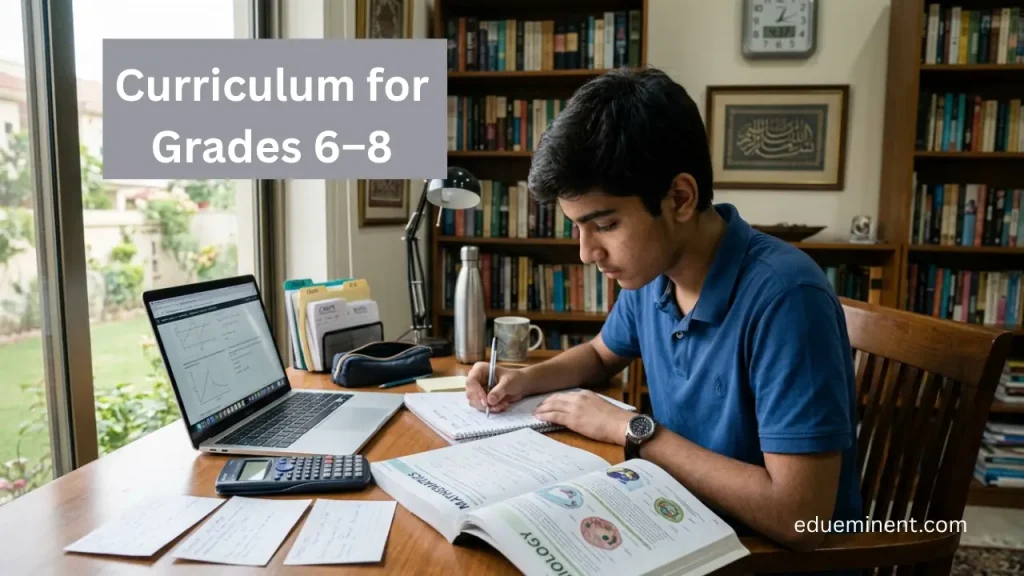
Picking a Curriculum for Grades 6–8
There’s no official homeschool syllabus in Pakistan; you’re choosing this yourself, which is freeing and a little overwhelming at the same time. Most families land on one of four routes.
Cambridge / British Curriculum
By far the most common pick among Pakistani homeschoolers, and for good reason. Kids typically work through Cambridge Lower Secondary up to grade 8, then move into IGCSE or O-Levels around grade 9 or 10.
It’s a familiar, well-worn alternative to the local board system, and O-Level/A-Level results are recognised in well over a hundred countries, so the international door stays open.
Providers like Wolsey Hall Oxford, CambriLearn, and Cambridge Home School Online all offer structured coursework with tutor support and help with exam registration, which honestly takes a lot of the planning stress off your plate.
American K-12 Diploma
Less common here, but it’s growing. This follows a US scope and sequence and ends in an accredited American high school diploma, which is the more direct route if your child might apply to a US or Canadian university, or if the family has plans to relocate eventually.
Pakistani Board-Aligned (Matric Track)
Some families just stick close to the local BISE syllabus using Pakistani textbooks, so the child sits matric as a private candidate later on. It’s usually the cheapest of the four options, and it keeps the door open to public universities and medical or engineering entry tests without needing any equivalence certificate down the line.
Mix-and-Match / Eclectic
Many homeschoolers don’t pick just one lane: Cambridge math and science paired with Urdu and Pakistan Studies from local textbooks, or free resources like Khan Academy layered on top of a structured English curriculum.
Maximum flexibility, but it also means you’re doing all the planning work yourself instead of following someone else’s roadmap.
| Route | Exam Pathway | International Recognition | Best For |
| Cambridge/British | IGCSE, O-Level, A-Level | Very high (160+ countries) | Families eyeing international or top private universities |
| American K-12 | US high school diploma | High in US/Canada | Families likely to move abroad or apply to US colleges |
| Pakistani board-aligned | Matric, Intermediate | Standard within Pakistan | Families prioritising local universities and lower cost |
| Eclectic/blended | Flexible, decided later | Depends on the exam eventually chosen | Families who want full control over the mix |
One piece of advice regardless of which you pick: settle on the exam board by grade 7 or 8.
O-Level subjects and matric subjects don’t line up neatly, and switching late usually means redoing content your child already covered.
Homeschooling vs. Regular School: Where They Actually Differ
Neither one wins outright; it comes down to your child’s personality, how much bandwidth you have as a parent, and your budget. Here’s the honest comparison for the middle-school stage specifically.
| Factor | Homeschooling | Traditional School |
| Learning pace | Fully customised | Set to the class average |
| Daily social contact | You have to build it in yourself | Happens automatically |
| Cost | Varies, sometimes lower, sometimes not | Fixed tuition, usually rising every year |
| Curriculum control | Entirely yours | Set by the school |
| Extracurriculars | You arrange separately | Often already included |
| Teaching consistency | Depends on you and whoever you bring in | Trained subject teachers every day |
| Flexibility (travel, health needs) | High | Low |
| Exam registration | You manage it, as a private candidate | Handled by the school office |
If you value pacing and flexibility enough to take on the extra legwork, homeschooling tends to feel worth it.
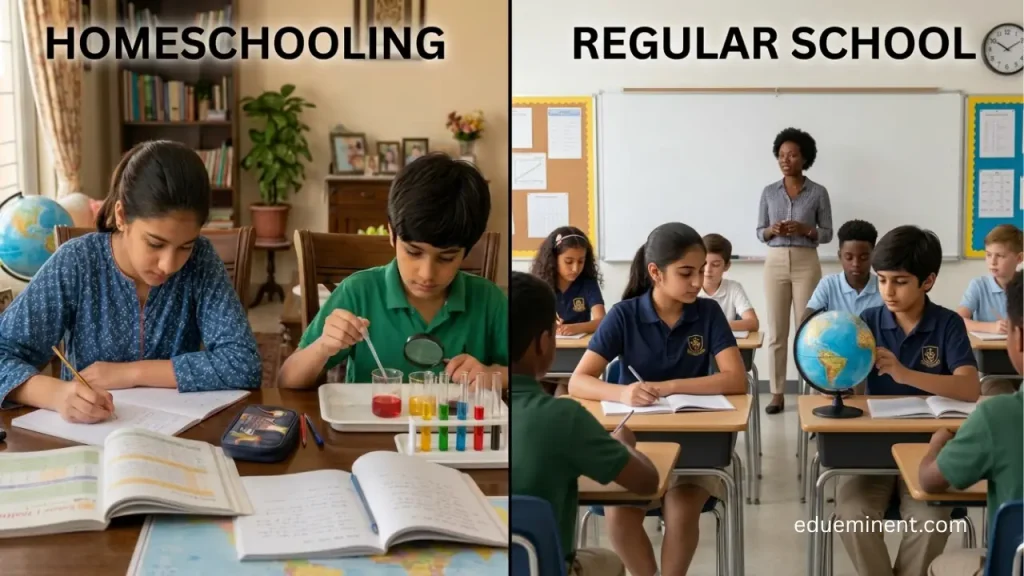
If you’d rather have the built-in structure, trained teachers, and a ready-made social circle even if it means less individual attention, regular school still makes sense for a lot of families.
Genuinely undecided? Try one term of homeschooling before locking in three years of it; it’s a more reversible decision than people assume.
What a Homeschool Week Actually Looks Like
Here’s something that surprises a lot of parents: a full academic day at home rarely needs six or seven hours.
No commute, no assembly, no shuffling between classrooms every forty minutes, no managing thirty other kids’ attention.
Most homeschooled middle schoolers get through a full day’s material in three to five focused hours.
A rough weekly spread might look like this: math five times a week, English (grammar, writing, and literature together) also five times, science four times rotating through the three strands, Urdu three or four times, Islamiyat and Pakistan Studies two or three times, Social Studies three times, and one elective, art, computer skills, a language, Quran memorisation, whatever fits two or three times a week.
For a single day, say a Grade 7 student, it could look something like:
| Time | Activity |
| 8:00 – 8:45 | Math |
| 8:45 – 9:00 | Break |
| 9:00 – 9:45 | English |
| 9:45 – 10:30 | Science |
| 10:30 – 10:45 | Break |
| 10:45 – 11:30 | Urdu / Islamiyat (alternating days) |
| 11:30 – 12:15 | Social Studies or elective |
| Afternoon | Reading, project work, extracurriculars |
Don’t lock this in too tightly. Middle schoolers do better with short focused blocks and real breaks in between, not marathon sessions.
And build a fixed hobby or elective slot into every single day; skip that, and homeschooling starts feeling like an endless grind pretty fast, for both of you.
What Grades 6, 7, and 8 Actually Cover
Grade 6 works mostly as a bridge year. Math moves into ratios, negative numbers, and the earliest groundwork for algebra.
English shifts toward paragraph and essay structure, wider vocabulary, and reading longer, denser texts.
Science usually splits for the first time into biology, chemistry, and physics rather than staying one blended “general science” subject.
Urdu and Islamiyat keep building on what was covered in primary school, with more focus now on comprehension and writing.
Grade 7 pushes deeper into everything. Math brings in linear equations, basic geometry proofs, and probability.
English essays get longer, formal letter writing shows up, and literary analysis replaces plain reading. Science becomes more quantitative: chemical equations, forces and motion, and the body’s major systems (digestive, respiratory, circulatory).
Social Studies usually goes deeper into Pakistan’s history and geography while widening out into world history too.
Grade 8 is the run-up year. By the end of it, math should be solidly through pre-algebra and into early algebra if O-Level or matric math is coming next year.
English writing needs to be at a proper essay level, with structured arguments rather than just descriptive paragraphs. Science should be strong enough across all three strands that splitting into separate O-Level subjects in grade 9 doesn’t feel like a shock.
This is also when you formally register your interest with whichever exam board you’ve chosen; registration and syllabus deadlines get set well ahead of the actual exam, so don’t leave this to the last minute.
Online Platforms Worth Knowing About
You don’t have to teach every subject yourself; plenty of parents don’t. A handful of platforms specifically serve homeschooling families in Pakistan:
Wolsey Hall Oxford runs UK-based, Cambridge-approved courses from primary all the way through A-Level. It’s self-paced with tutor feedback rather than fixed live classes, which suits families juggling different time zones or unpredictable daily routines.
CambriLearn delivers an International British Curriculum built around Cambridge Assessment International Education, and it’s also a registered Pearson Edexcel exam centre, meaning it simplifies the exam-registration headache that would otherwise fall entirely on you.
Cambridge Home School Online runs small live classes, roughly 8 to 10 students per group, across cities including Karachi, Lahore, Islamabad, and Rawalpindi. It tries to give you classroom structure without giving up homeschool flexibility.
Beyond the big three, private tutors are everywhere in Pakistani cities and commonly hired for a subject or two; math and science tend to top that list, while parents handle the rest themselves.
And a lot of families layer in free resources like Khan Academy for extra math or science practice on the side.
Before you commit to a paid platform, check that it actually prepares students for the exact exam board you’re targeting, ask if there’s a trial period, and try to talk to current families rather than trusting old reviews; pricing and course offerings shift often enough that what someone posted two years ago may not hold anymore.
For students and professionals looking to earn from home, online tutoring can be a practical career option. Explore our guide to online tutoring jobs in Pakistan to learn where to find teaching opportunities, what skills you need, and how to get started.
So, What Does This Actually Cost?
There’s no single figure anyone can hand you honestly; it depends entirely on which route you pick and how much outside help you bring in. The main things that drive the cost up or down:
Curriculum materials are the cheapest end of things; buying Pakistani board textbooks yourself, or imported Cambridge materials, costs far less than a full subscription-based program that includes lesson plans and marking.
Private tutors are priced per subject, per hour, or per month depending on the tutor and the city, and rates vary a lot.
Online school subscriptions from full-service providers usually run per term or per year, and the price shifts by grade level and how many subjects you’re taking; always check current rates directly with the provider rather than going off something you read somewhere.
And then there are exam registration fees, charged per subject when you sit O-Levels, IGCSE, or matric as a private candidate.
As a general pattern, families who go the Pakistani board route and teach it themselves tend to spend the least. Families who go all-in on a Cambridge program with tutors plus an online subscription often end up spending close to, sometimes more than, mid-range private school fees.
So don’t assume homeschooling is automatically the cheaper option; it depends entirely on how you build it. Go in with a real budget, not a vague assumption.
What About Socialization?
This is the worry almost every parent raises first, and it’s a fair one. A classroom puts your kid around dozens of peers every single day without you having to lift a finger.
Take that away, and yes, it disappears by default, but it doesn’t have to stay gone. Families who treat socialization as something to actively plan for, rather than something that’ll just sort itself out, tend to see their kids keep pace just fine.
Some of the more common ways Pakistani homeschooling families handle this are joining homeschool co-ops or support groups that organise joint classes, field trips, and get-togethers with other homeschooled kids in the same city.
Enrolling in sports, martial arts, swimming, or team activities that put them around the same group of kids every week. Art, music, or drama classes that double as both an elective and a social outlet.
Mosque programs, Quran classes, or community service, which build values-based learning and peer contact at the same time. And honestly, cousins and extended family matter a lot more here than they might in other countries. Pakistan’s close-knit family culture does a lot of quiet social work on its own.
Middle school specifically is where peer relationships start shaping a kid’s sense of identity, so this isn’t something to leave loose.
A schedule that’s wall-to-wall academics with zero social time is one of the more common mistakes new homeschooling parents make. Build the social calendar in from week one; don’t wait until you notice your child getting isolated to start fixing it.
Exams After Grade 8: O-Levels, Matric, or Something Else
Grade 8 is really the checkpoint, since most exam-board subject specialisation kicks in properly from Grade 9.
If you’re heading toward O-Levels or IGCSE, your child sits these as a private candidate through an approved exam centre, either an independent one or one attached to a provider like CambriLearn.
The results then get converted into Pakistani matric/intermediate equivalency through the Inter Board Committee of Chairmen, or IBCC.
Every O-Level and A-Level student goes through this conversion, homeschooled or not, so it’s a standard step, not something specific to home education.
If you’re heading toward matric, the process is simpler on paper: you register your child directly with the local BISE as a private candidate, following the Pakistani board syllabus, and you skip the IBCC equivalency step entirely since it’s not needed.
On the university side, Pakistani universities accept O-Level, A-Level, matric, and intermediate qualifications without distinguishing between homeschooled and school-educated students.
Students with A-Levels, including homeschooled ones, can also sit the MDCAT for medical college admission, as long as they’ve got their IBCC equivalency sorted first. The same rule applies to everyone taking that exam, not just homeschoolers. Whichever path you’re on, start a proper records folder from grade 6: coursework samples, test scores, a running log of what you’ve covered.
You will be asked for this later, and trying to reconstruct three years of coursework from memory in grade 9 is a genuinely painful exercise compared to just updating a folder as you go.
The Hard Parts Nobody Warns You About
Homeschooling grades 6 to 8 comes with real friction, and it’s better to know what’s coming than to be blindsided by it mid-year.
Parent burnout is a big one; teaching several subjects daily on top of everything else you’re already managing gets exhausting fast.
Sharing the load with a spouse, a tutor, or an online platform for even one or two subjects makes a real difference here. Without a school bell schedule, days can drift without you noticing, so a written weekly timetable, even a loose one, keeps things from sliding.
Motivation dips happen too, especially without classmates around to apply that low-key peer pressure to keep going; short-term goals and visible progress tracking tend to help more than just pushing through longer hours.
Then there’s the honest gap in subject expertise most parents have: nobody’s equally strong in math, science, English, and Urdu, and that’s exactly where a tutor or a structured online course earns its cost.
Screen time can creep up fast too if your curriculum leans heavily online, so balancing it with handwriting, actual experiments, and physical activity matters more than people expect.
It’s also completely normal to second-guess the whole decision partway through the year; talking to other homeschooling parents, in person or in an online group, helps far more than sitting with the doubt alone.
If you’ve got more than one child homeschooling at different grade levels, sibling dynamics get tricky; staggering subjects, giving one child independent workbook time while you teach the other directly, or bringing in a tutor for the overlapping slots all help.
And don’t underestimate extended family skepticism; homeschooling is still less common here than regular school, and relatives will ask questions. Having your curriculum, schedule, and exam plan ready to explain tends to settle that faster than arguing the concept in the abstract.
How to Actually Start
1. Pick your exam pathway first, Cambridge /O-Level, matric, or American diploma. Everything else follows from this one decision.
2. Choose your curriculum approach based on your budget and how much teaching you’re personally up for: a full online program, Pakistani board syllabus, or a blend of both.
3. Set a realistic weekly schedule before day one, including social and extracurricular time, not just academics.
4. Figure out where you need help, which subjects you’ll teach yourself, and which need a tutor or platform.
5. Start a records folder immediately. Coursework, test results, a running syllabus log.
6. Get at least one regular outside-the-home activity locked in before you start, not months later.
7. Give yourself and your child a full month of grace. It won’t click immediately, and that’s normal.
8. Reassess at the end of each term: is the curriculum working, is the pace right, and adjust instead of forcing the original plan to keep working if it isn’t.
Conclusion
Homeschooling grades 6 to 8 in Pakistan is legal, it’s genuinely flexible, and more families are doing it every year, but it goes best when it’s a deliberate decision, not a reaction to a bad term at school. Pick your exam pathway early.
Build a schedule you can actually stick to. Bring in outside help wherever your own knowledge runs thin. And treat socialization as something you schedule on purpose, not something you hope works itself out.
Get that right, and the middle school years end up being the strongest possible foundation for whatever comes next: O-Levels, matric, or a diploma from somewhere else entirely.
If you’re still on the fence, don’t overthink it into paralysis. Pick a pathway, plan out one term, and see how the first few weeks actually go before you commit to anything longer.
Frequently Asked Questions
Is homeschooling legal in Pakistan?
Yes. No law regulates or bans it, and the Ministry of Federal Education and Professional Training doesn’t require registration or set any mandatory requirements for home educators.
Do I need a teaching qualification to homeschool my grade 6–8 child?
No, none at all. Many parents bring in subject tutors or use structured online programs to cover whatever’s outside their own comfort zone.
What curriculum is actually best for grade 6 to 8 homeschoolers here?
There isn’t a single “best”; it comes down to where your child is headed afterward. Families aiming for international universities usually go Cambridge/British; families prioritising local universities and lower cost tend to stick with a Pakistani board-aligned syllabus instead.
How do homeschooled students in Pakistan actually sit exams?
As private candidates, through an approved Cambridge/Edexcel centre for O-Levels or IGCSE, or through the local BISE for matric.
The IBCC converts O-Level and A-Level results to Pakistani equivalency when needed for local admissions.
Will my homeschooled child still get into a Pakistani university later?
Yes. Universities here accept O-Level, A-Level, matric, and intermediate qualifications regardless of whether the student attended a physical school or was homeschooled, as long as the right equivalency is sorted where needed.
Can a homeschooled Grade 8 student go back into regular school?
Generally, yes, though it depends on the individual school’s admissions and placement testing. Keeping organised academic records makes this transition a lot smoother when the time comes.
How many hours should a homeschool day actually take at this age?
Most families find three to five focused hours cover a full day’s core work. No commute, no transition time between classes, no managing a room of thirty kids- that’s what stretches a regular school day out to six or seven hours in the first place.
Is this actually cheaper than private school?
It depends entirely on the route. Teaching a Pakistani board syllabus yourself can be the cheapest option out there.
A fully outsourced Cambridge program with tutors and an online subscription can cost as much as, sometimes more than, mid-range private schooling. Budget for the specific route you’re choosing, not a general assumption either way.
What if I can’t teach a subject well myself?
Bring in a tutor or an online course for just that one subject; there’s no rule saying you have to cover everything solo.
Most homeschooling families in Pakistan end up teaching some subjects directly and outsourcing one or two others, and that’s completely normal.
Do homeschooled kids miss out on science labs?
Not necessarily. Some families put together simple home experiment kits for basic biology, chemistry, and physics work.
Others sign up for short in-person lab sessions or summer camps specifically to cover hands-on practical work before it’s needed for O-Level or matric science exams.