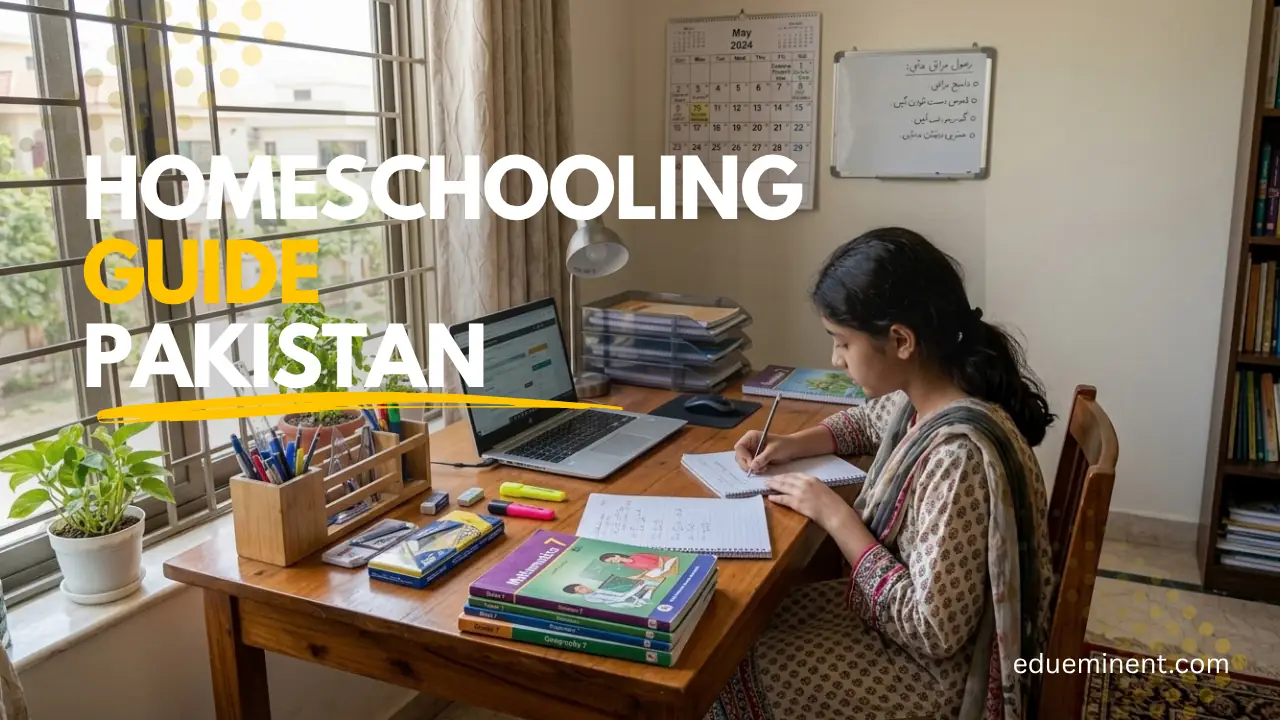
This guide explains how to homeschool in Pakistan for Grades 6 to 8, covering legal considerations, academic pathways, curriculum choices, core subjects, schedules, recordkeeping, private candidate exams, IBCC equivalence, budgeting, social activities, and preparation for Grade 9.
If you are new to home education, it helps to understand what homeschooling actually involves. What Is Homeschooling? explains the basics and gives parents a clearer starting point.
More families in Lahore, Karachi, Islamabad, and smaller cities across Pakistan are choosing to teach their children at home rather than send them to a traditional school every morning.
Rising school fees, long commutes, an exam-heavy culture, and a simple desire for more control over what and how a child learns are pushing this shift forward, and it is picking up pace fastest among parents of middle school-aged children.
Grades 6 to 8 bring their own challenges, though. Subjects get more specific, exam pathways start to matter, and parents suddenly have real questions about what happens when this all needs to lead somewhere, whether that is a Pakistani board certificate or an international one.
This guide walks through how to homeschool in Pakistan for grades 6 to 8 step by step, from the legal picture to curriculum choice to exam registration and budgeting, so you can build a plan that actually holds up over these three important years.
Is Homeschooling Legal in Pakistan?
Yes, homeschooling is legal in Pakistan, and there is currently no specific law that regulates it one way or another.
The Ministry of Federal Education and Professional Training does not require parents to register as homeschoolers, does not mandate a specific curriculum, and does not conduct home inspections.
Pakistan’s constitution guarantees the right to education broadly, but it does not require that education to take place inside a registered school building. In practice, this means the decision to homeschool sits entirely with the parent.
That freedom is also the catch. Because there is no government office overseeing homeschooling, there is no official body checking whether your child is on track, which means the full responsibility for a solid education, and for planning toward exams and university, rests with you.
Regulations can also shift over time, so it is worth checking the Ministry’s website or a current homeschool guide once a year to confirm nothing has changed since you last looked.
Why Families in Pakistan Choose to Homeschool Grades 6 to 8?
The reasons vary from family to family, but a few patterns show up again and again among Pakistani homeschoolers in this age group.
Some parents are unhappy with how exam-focused and memorization-heavy the mainstream system becomes once a child hits middle school, and want more room for genuine understanding rather than rote learning. Others are dealing with a child who has fallen behind or gotten bored in a large classroom and needs a more individualized pace.
A growing number are overseas Pakistani families returning home who want continuity with an international curriculum their child already knows. Frequent school closures, long and unsafe commutes in some cities, and the sheer cost of private schooling also factor heavily into the decision for many households.
Middle school also happens to be a stage where the mainstream classroom model starts showing its weakest points. Class sizes in many private and public schools grow larger just as subjects grow more demanding, which leaves less room for a teacher to notice when a specific child is struggling with, say, algebra or essay structure. At home, that same struggle gets caught and addressed within days rather than sitting unnoticed for an entire term.
How Middle Schoolers Learn Differently Than Younger Children
Before choosing a curriculum or a schedule, it helps to understand what is actually changing in a child’s thinking between grade 6 and grade 8, since this shapes nearly every decision that follows.
Somewhere around age eleven or twelve, most children begin developing stronger executive function skills such as planning, managing time across several subjects, and organizing multi-step assignments.
It is easier to plan lessons when you know what you want your child to achieve. Homeschooling Goals explains how parents can set realistic academic and personal goals for the year.
This is exactly why grades 6 to 8 subjects start asking for longer essays, multi-step mathematics, and independent research rather than short worksheet-style answers.
A child who did fine with light supervision in earlier years may suddenly need real study skills and a bit more structure, and that shift can feel bumpy for both parent and child at first.
Learning style also becomes easier to spot during these years. Some middle schoolers do best with visual aids such as diagrams, timelines, and highlighted notes, while others learn better by talking a problem through out loud or working with something hands-on.
Paying attention to which mode your child leans toward will make curriculum choice, covered in the next step, considerably easier.
Step 1: Decide Your Long-Term Academic Path
Before choosing a single textbook, decide roughly where this education is heading, since that choice shapes almost every decision that follows in this guide.
Broadly, homeschooling families in Pakistan tend to aim toward one of three destinations. The first is the Pakistani board system, working toward matriculation through a provincial BISE (Board of Intermediate and Secondary Education) or the federal board, FBISE.
The second is the Cambridge international pathway, working toward O Level and eventually A Level qualifications. The third is a hybrid approach, where a family follows an internationally flavored curriculum day to day but keeps the door open to either exam route later, since a strong grasp of English, mathematics, and science transfers reasonably well between both systems.
There is no universally correct choice here. A family planning to send their child to a Pakistani medical or engineering university after intermediate may lean toward the board system, since it aligns directly with entry test syllabi.
A family aiming for study abroad, or wanting maximum flexibility if they relocate, often leans toward Cambridge. What matters most is picking a direction now, in grade 6, rather than discovering in grade 9 that three years of work does not map cleanly onto the exam your child actually needs to sit.
Step 2: Choose a Curriculum That Fits Grades 6 to 8
Select a curriculum based on your chosen academic path, your child’s learning style, and how much daily teaching time you can realistically commit.
If you are aiming toward the Pakistani board system, many families loosely follow the Single National Curriculum framework, which for grades 6 to 8 typically covers subjects such as Urdu, English, mathematics, science, social studies or Pakistan studies, Islamiyat, and computer science, alongside optional additional languages such as Arabic.
You can source textbooks from your provincial textbook board or use private publishers whose books align with the same broad framework.
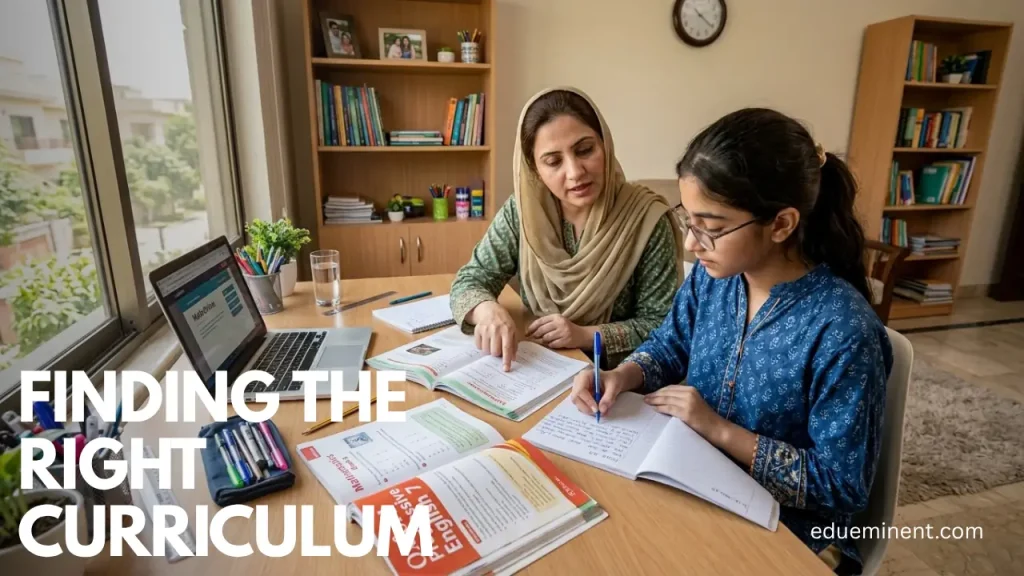
If you are aiming toward Cambridge, the Lower Secondary program, which culminates in the Cambridge Checkpoint assessment around the end of grade 8, gives a structured international framework covering English, mathematics, and science, with additional subjects available depending on the school or provider you register through.
Comparing Your Main Curriculum Options
A full boxed Pakistani-style curriculum, sourced from a textbook board or private publisher, tends to be the most affordable option and keeps you closely aligned with local board exams later.
A Cambridge-aligned curriculum, whether self-taught using official Cambridge resource lists or delivered through an online homeschool provider, costs more but keeps international options open and comes with more structured teacher support if you choose a provider that includes it.
Hiring a private tutor for specific subjects, common and widely available in most Pakistani cities, works well as a middle ground, letting you teach subjects you are comfortable with while outsourcing math or science to someone more specialized.
Step 3: Cover the Core Subjects for Middle School
A complete grade 6 to 8 homeschool plan in Pakistan should include language, mathematics, science, social studies, Islamiyat, and computer skills every year, with depth increasing each grade.
Here is a general breakdown that many homeschooling families in Pakistan follow, adjusted for either the board pathway or the Cambridge pathway.
| Subject | Grade 6 Focus | Grade 7 Focus | Grade 8 Focus |
| Urdu / English | Grammar, comprehension, paragraph writing | Essay writing, vocabulary, formal letters | Précis writing, literature, advanced comprehension |
| Mathematics | Fractions, ratios, basic algebra | Pre-algebra, geometry basics | Algebra and geometry, exam-style problems |
| Science | General science introduction | Physics, chemistry, and biology basics | Deeper physics, chemistry, and biology |
| Social Studies / Pakistan Studies | Geography and general knowledge | Pakistan’s history and civics | Government structure and current affairs basics |
| Islamiyat and Computer Science | Basic Islamic studies, typing and digital literacy | Continued Islamic studies, basic coding or applications | Islamic studies review, more advanced computer skills |
Whichever pathway you follow, do not skip English comprehension and writing practice, since both the board system and Cambridge exams place heavy weight on written expression, and this is the skill that is hardest to rebuild later if it falls behind.
Step 4: Build a Weekly Routine That Works in Pakistan
Design a weekly schedule around your household’s real rhythm, including prayer times, extended family routines, and the practical realities of things like load shedding or internet interruptions.
Many Pakistani homeschooling families structure their day with a morning academic block after Fajr or breakfast, when the house is quieter and the weather is cooler for much of the year, followed by a lighter afternoon session for review, reading, or project work. A sample structure might look like this:
- Morning block, roughly three hours: core academic subjects requiring parent involvement, such as mathematics and writing feedback.
- Midday break: lunch, rest, and prayer, especially important during warmer months.
- Afternoon block, one to two hours: independent reading, Islamiyat, computer skills, or project work.
- Evening: lighter review or catch-up time if power outages or other interruptions disrupted the day’s plan.
Build slack into the week for the realities of daily life in Pakistan, including occasional electricity or internet interruptions if you rely on any online resources. A schedule that assumes perfect conditions every single day will fall apart quickly, while one built with a buffer day, often Friday or Saturday depending on your family’s routine, holds up much better.
Step 5: Keep Records and Build a Portfolio
Maintain a simple, ongoing record of what your child studies and completes each year, since this becomes essential once exam registration and, eventually, university applications come into the picture.
At minimum, keep a running log of subjects covered, textbooks or resources used, completed assignments or test results, and any certificates from outside courses or activities.
If you are working toward the Cambridge pathway, this record also becomes useful if you ever need to demonstrate prior learning when registering with a new exam center or provider. If you are working toward the board pathway, a portfolio is less formally required but still gives you and your child a clear picture of progress and helps when compiling documents for private candidate registration later.
A simple folder, physical or digital, organized by subject and updated monthly rather than assembled all at once at year-end, is enough. Consistency here matters far more than any particular format.
Step 6: Plan for Exams and Private Candidate Registration
Homeschooled students in Pakistan can sit board exams, including matriculation and Cambridge exams such as O Level, by registering as a private candidate, though the exact process depends on which board you choose.
For the Pakistani board pathway, private candidates typically register through their relevant provincial board, such as BISE Lahore or BISE Karachi, or through the federal board, FBISE, if your family is based in Islamabad or falls under its jurisdiction.
Registration generally involves a form, a fee, proof of identity, and sometimes proof of residence within the board’s jurisdiction. The Aga Khan University Examination Board, AKU-EB, is another option some homeschoolers use, and is known for an exam style that emphasizes understanding over memorization.
Since requirements and deadlines shift from year to year, contact your chosen board directly, or check their official website, well before the registration window opens.
For the Cambridge pathway, private candidates register through an approved Cambridge exam center rather than directly with Cambridge itself. Several cities in Pakistan have accredited centers that accept external, homeschooled candidates for O Level and A Level sittings, sometimes for an additional fee compared to enrolled students.
It is worth contacting a few centers directly during grade 7 or early grade 8, since some fill their external candidate slots early and require lead time for subject registration.
Step 7: Understand IBCC Equivalence
If your child is on the Cambridge pathway but may later need to apply to a Pakistani university or sit a local entrance test, plan for IBCC equivalence well ahead of time.
The Inter Board Committee of Chairmen (IBCC) is the body responsible for converting O Level and A Level results into an equivalent Pakistani grade or percentage, which most Pakistani universities and entrance tests require for admission.
This step matters even for homeschooled students who performed extremely well on their Cambridge exams, since without an equivalence certificate, some local institutions simply cannot process the application.
While grades 6 to 8 is early to think about this in detail, it is worth knowing it exists now, since it directly affects whether the Cambridge pathway you choose in middle school will translate smoothly if your child’s plans shift toward a Pakistani university later.
Step 8: Budget for Homeschooling in Pakistan
Set a realistic annual budget that accounts for curriculum materials, any tutoring you bring in, exam registration fees, and incidental costs like transport to an exam center.
Costs vary enormously depending on the path you choose. A Pakistani board-aligned curriculum using standard textbooks and your own teaching time can be very affordable, often costing little beyond the price of books and stationery.
Bringing in private tutors for specific subjects adds a recurring monthly cost that varies by city and subject, with mathematics and science tutors generally commanding higher rates than language tutors.
The Cambridge pathway tends to be the most expensive route once you factor in resource costs, potential provider or online school fees if you choose that route, and exam center fees for each subject sat as a private candidate.
Whichever path you follow, it helps to price out a full year, including exam fees, before committing rather than discovering the total cost partway through.
Step 9: Add Social Interaction and Extracurricular Activities
Build regular social contact into your middle schooler’s week, since this is one of the most common concerns relatives and friends raise about homeschooling in Pakistan.
The homeschooling community in Pakistan is smaller than in some countries but is steadily growing, particularly in Lahore, Karachi, and Islamabad. Facebook groups and other online communities connect homeschooling families, some of whom organize informal co-op style meetups, shared classes, or group outings.
Beyond dedicated homeschool circles, mosque-based Quran classes, sports academies, martial arts clubs, and community youth programs all offer regular contact with peers outside the immediate family.
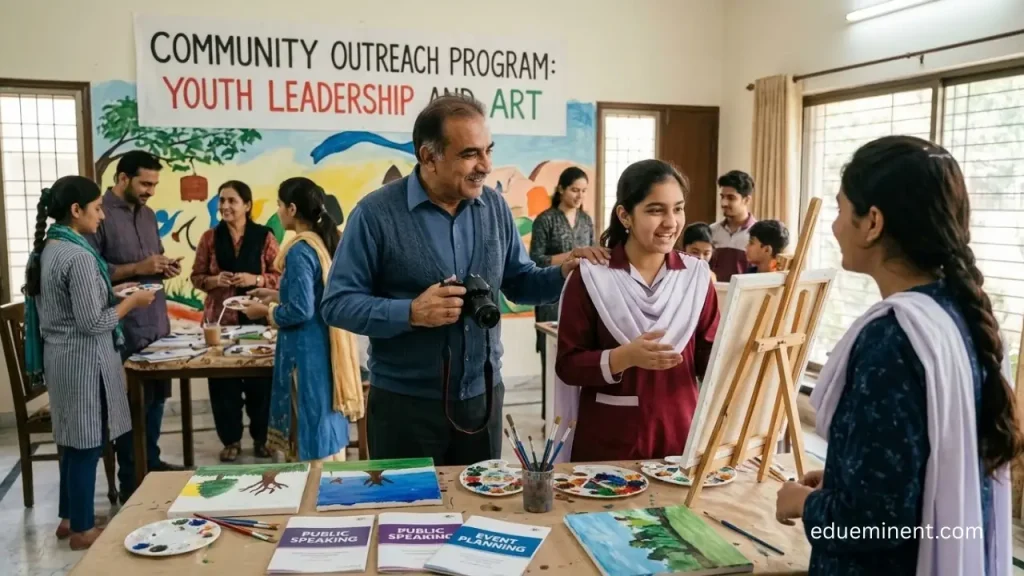
Cousins and extended family, a strong feature of most Pakistani households, also play a real role in a homeschooled child’s social life in a way that may not be as central in other countries.
Aim for at least one consistent weekly activity outside the home, rather than relying only on occasional family gatherings, since regular contact with a peer group matters more for social development than sporadic events.
Step 10: Prepare for Grade 9 and Beyond
Use eighth grade to firm up your child’s exam pathway and start any registration research needed for grade 9 and grade 10.
If you are on the board pathway, this means confirming which board your family falls under, understanding matriculation subject group choices (typically a science or arts and humanities split), and reaching out to that board about private candidate procedures before the school year begins.
If you are on the Cambridge pathway, this means confirming an exam center that will accept your child as an external O Level candidate and mapping out which subjects to sit and in what order, since not every subject needs to be completed in the same sitting.
Either way, have an honest conversation with your child about which subjects genuinely interest them, since grade 9 and grade 10 subject choices in Pakistan often start narrowing a student toward a broader field, whether that is pre-medical, pre-engineering, computer science, or humanities.
Quick Reference: Homeschool in Pakistan Checklist
Use this condensed checklist as a quick self-audit at the start of the year or a midyear check-in.
- Confirmed homeschooling remains unregulated, and no registration is currently required.
- Chosen a long-term academic path: Pakistani board, Cambridge, or a hybrid approach
- Selected curriculum that matches that path and your child’s learning style
- Planned core subjects: language, mathematics, science, social studies, Islamiyat, computer skills
- Built a weekly routine that accounts for prayer times and possible power or internet interruptions
- Set up a simple system for recordkeeping and a subject-based portfolio
- Researched private candidate registration with the relevant BISE, FBISE, AKU-EB, or Cambridge center
- Understood whether IBCC equivalence will eventually apply to your child’s path
- Set a realistic annual budget covering materials, tutoring, and exam fees
- Scheduled at least one regular social or extracurricular activity
- Started thinking about grade 9 subject groups and exam center or board procedures
Common Mistakes to Avoid
The most common mistakes homeschooling parents make in Pakistan involve picking an exam pathway too late, underestimating English writing practice, and assuming registration procedures stay the same every year.
Waiting until grade 9 to decide between the board system and Cambridge is a costly mistake, since three years of a mismatched curriculum can leave real gaps that are hard to close quickly.
Underestimating how much English writing and comprehension practice matters is another common issue, since both exam pathways lean heavily on written expression, not just correct answers.
Finally, assuming that whatever registration process worked for a friend last year will work identically this year can cause real problems, since exam boards and Cambridge centers do adjust fees, deadlines, and requirements from year to year. A quick check with the board or center directly, every single year, avoids most of these surprises.
Conclusion
Homeschooling grades 6 to 8 in Pakistan comes with genuine freedom, since there is no government body dictating your curriculum or checking in on your progress, but that same freedom means the planning responsibility sits entirely with you. Decide your long-term academic path early, choose a curriculum that actually matches it, cover the core subjects with real depth, and keep simple, consistent records along the way.
Every homeschooling family in Pakistan builds a slightly different version of this plan, shaped by their city, their budget, and their child’s goals, and that flexibility is part of what makes homeschooling worth considering in the first place.
Use this guide as a working framework, revisit your plan each year, and stay in direct contact with whichever board or exam center your family ultimately chooses, since procedures do shift from year to year.
Handled this way, the middle school years become a genuinely strong foundation for whatever exam pathway and, eventually, university path your child chooses next.
If you found this guide useful, explore our Cambridge O Level Homeschool Preparation Guide for the next stage, or our Homeschool Curriculum Comparison for Pakistan to help narrow down your options.
Frequently Asked Questions
Is homeschooling legal in Pakistan?
Yes, homeschooling is legal in Pakistan. There is no specific law that regulates it, and the Ministry of Federal Education and Professional Training does not require registration, reporting, or a mandated curriculum for homeschooling families.
Do I need to register my homeschooled child anywhere in Pakistan?
No general registration is required to homeschool itself. However, you will eventually need to register your child as a private candidate with a specific board or exam center when it is time to sit exams such as matriculation or O Level.
Can a homeschooled child sit board exams in Pakistan?
Yes, homeschooled students can sit Pakistani board exams, Cambridge O Level and A Level, or other options such as AKU-EB exams, by registering as a private or external candidate through the relevant board or exam center.
What curriculum should I use to homeschool in Pakistan?
This depends on your long-term academic path. Families aiming for a Pakistani university often loosely follow the Single National Curriculum framework, while families keeping international options open often use a Cambridge-aligned curriculum, and many families blend elements of both.
How much does homeschooling cost in Pakistan?
Costs vary widely. A board-aligned approach using standard textbooks and parent-led teaching can be quite affordable, while a Cambridge pathway with tutors, resources, and exam center fees tends to cost considerably more, so it helps to price out a full year in advance.
Can homeschooled students get admission to Pakistani universities?
Yes. Homeschooled students who complete matriculation and intermediate through a board, or O Level and A Level through Cambridge with IBCC equivalence, are generally eligible to apply to Pakistani universities on the same basis as traditionally schooled applicants.
What is IBCC equivalence and do homeschoolers need it?
IBCC equivalence converts O Level and A Level results into an equivalent Pakistani grade for university admission purposes. Homeschooled students following the Cambridge pathway typically need this if they plan to apply to a Pakistani university or entrance test later.
How do I handle socialization while homeschooling in Pakistan?
Build at least one regular weekly activity outside the home, such as a sports academy, mosque-based class, or a homeschool co-op meetup, and lean on extended family gatherings, which are a common and valuable source of social contact for many Pakistani households.