

This guide compares O Level vs IGCSE, explaining their curriculum, assessment methods, grading systems, global recognition, advantages, disadvantages, and future opportunities. It helps students and parents choose the qualification that best matches their learning style, academic goals, and higher education plans.
When it comes to international education at the secondary level, many students and parents find themselves comparing O Level and IGCSE qualifications. Both are internationally recognized programs offered by Cambridge Assessment International Education (CAIE) and are designed for students aged 14 to 16.
However, they differ in structure, grading methods, assessment style, and global recognition. The O Level (Ordinary Level) follows a more traditional and exam-focused approach, often preferred in countries like Pakistan, Singapore, and Bangladesh.
Meanwhile, the IGCSE (International General Certificate of Secondary Education) offers a broader, more flexible curriculum that emphasizes practical knowledge, coursework, and analytical skills.
In this Content, we’ll break down the main differences between O Level and IGCSE, explore their pros and cons, and help you decide which qualification best suits your academic goals and plans.
There are some key differences in their structure, grading, flexibility, and teaching approach that students and parents should understand before making a decision.
What Is O Level?
The O Level (Ordinary Level) is an internationally recognized secondary school qualification offered by Cambridge Assessment International Education (CAIE). It is typically taken by students aged 14 to 16 and serves as a foundation for advanced studies like A Levels or other equivalent qualifications.
O Levels focus on developing a strong academic base in core subjects such as English, Mathematics, Science, and Social Studies, along with optional subjects like Computer Science, Business Studies, or Economics.
The O Level curriculum is known for its structured and exam-based approach, emphasizing theoretical understanding, problem-solving, and memorization. Most subjects are assessed through written examinations, with practical assessments in science and technical subjects.
Key Features of O Level
Here are the features of O Level:
- Structured Curriculum: The O Level program follows a well-defined syllabus that provides a strong foundation in both core and optional subjects. It focuses on building conceptual understanding and academic discipline.
- Exam-Based Assessment: O Levels are primarily evaluated through written examinations at the end of the course. These exams test a student’s theoretical knowledge, analytical ability, and understanding of key concepts.
- Limited Coursework: Unlike IGCSE, O Level has less emphasis on coursework or internal assessments. Most of the final grade depends on performance in external exams conducted by Cambridge.
- Subject Flexibility: Students can choose from a wide range of subjects, including compulsory subjects like English and Mathematics, as well as optional subjects such as Biology, Business Studies, or Computer Science.
- Regional Adaptation: O Level syllabuses are often tailored to regional needs, with some variations designed specifically for certain countries (for example, Pakistan Studies and Islamiyat in Pakistan).
- Grading System: O Levels use a grade scale from A to E*, where A* represents the highest achievement. These grades reflect a student’s performance in standardized international exams.
In countries like Pakistan, Singapore, India, and Bangladesh, O Levels are widely recognized by both local and international universities.
Students who complete O Levels often move on to A Levels, the IB, or other pre-university programs, making it an important academic milestone for those aiming for higher education, whether locally or abroad.
What Is IGCSE?
The IGCSE (International General Certificate of Secondary Education) is a globally recognized qualification offered by Cambridge Assessment International Education (CAIE) and other examination boards such as Pearson Edexcel.
Designed for students aged 14 to 16, the IGCSE provides an internationally focused and flexible curriculum that prepares learners for further education such as A Levels, IB Diploma, or other pre-university programs.
Unlike O Level, the IGCSE emphasizes practical learning, application of knowledge, and critical thinking rather than rote memorization. It offers a balanced combination of coursework, oral tests, practical exams, and written papers, giving students multiple ways to demonstrate their understanding.
Students can choose from over 70 subjects, including core options like English, Mathematics, and Sciences, as well as electives such as ICT, Global Perspectives, Business Studies, and Art & Design. This flexibility allows learners to tailor their education according to their strengths and career goals.
Key Features of IGCSE
Here are the features of IGCSE:
- Flexible Curriculum: The IGCSE offers a wide range of over 70 subjects, including core and optional ones. Students can choose combinations that suit their interests, career goals, and strengths.
- Balanced Assessment: Unlike O Level, IGCSE assessments include a mix of written exams, oral tests, coursework, and practical work, allowing students to demonstrate both theoretical knowledge and practical skills.
- Global Relevance: The IGCSE curriculum is internationally focused, designed to meet the educational needs of students worldwide. It promotes a global outlook while maintaining local relevance through subject options.
- Focus on Skills Development: IGCSE emphasizes critical thinking, communication, and problem-solving skills. It encourages students to understand concepts deeply rather than memorize facts.
- Grading System: IGCSE uses an 8-point grading scale from A to G* (similar to O Levels), but some versions also include a 9–1 scale used by Pearson Edexcel and Cambridge (with 9 being the highest).
- Coursework Component: Many IGCSE subjects include coursework or project-based assessment, which helps students apply what they learn in real-life contexts and develop research and analytical skills.
The IGCSE is accepted by universities and employers around the world, making it one of the most internationally recognized and versatile qualifications at the secondary level. It encourages independent learning, analytical skills, and adaptability, qualities essential for success in today’s global academic and professional environments.
Main Differences Between O Level and IGCSE
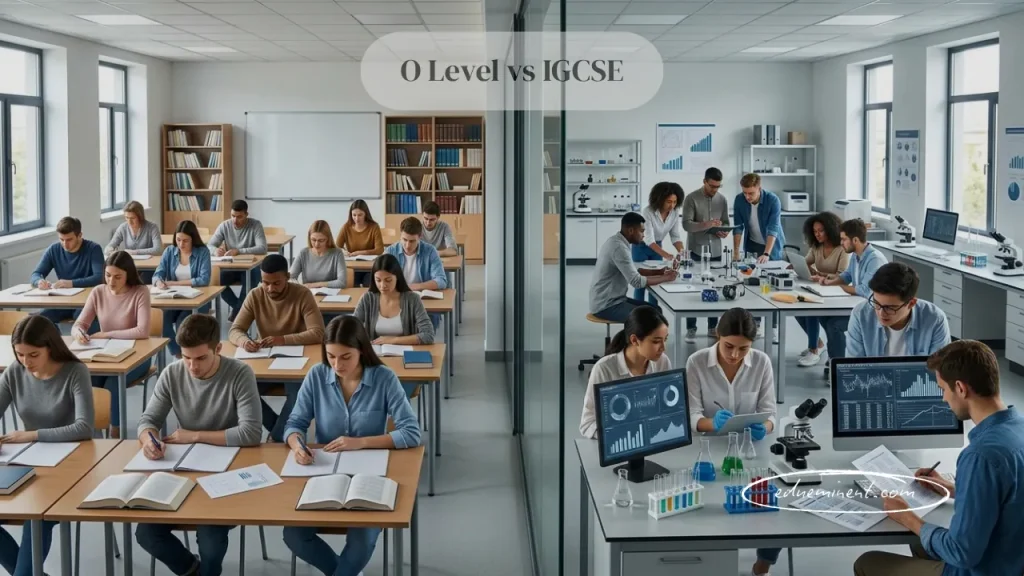
While both O Level and IGCSE are internationally recognized qualifications offered by Cambridge Assessment International Education (CAIE), they differ in teaching approach, assessment style, flexibility, and global recognition. Below are the key distinctions between the two systems:
- Curriculum Approach
- O Level: Follows a traditional, exam-focused approach that emphasizes theoretical understanding and memorization.
- IGCSE: Offers a modern, skills-based curriculum that focuses on critical thinking, practical learning, and application of knowledge.
- Assessment Style
- O Level: Primarily assessed through written examinations at the end of the course. Coursework is minimal or optional in most subjects.
- IGCSE: Includes a variety of assessment methods such as written exams, oral tests, practicals, and coursework, providing a more balanced evaluation.
- Flexibility in Subjects
- O Level: Offers a good range of subjects, but students must often follow specific combinations (e.g., Pakistan Studies and Islamiyat in Pakistan).
- IGCSE: Provides greater flexibility with more than 70 subjects to choose from, allowing students to customize their study plan.
- Focus and Learning Style
- O Level: Focuses on academic content and exam preparation, with less emphasis on independent research.
- IGCSE: Encourages analytical thinking, communication, and creativity, promoting active participation and inquiry-based learning.
- Global Recognition
- O Level: Recognized in many Commonwealth countries (like Pakistan, Singapore, and Bangladesh) and accepted by most universities worldwide.
- IGCSE: Considered the more globally adaptable qualification, widely accepted by international schools, universities, and employers across the world.
- Grading System
- O Level: Uses grades A to E* (A* being the highest).
- IGCSE: Uses grades A to G* or the 9–1 scale (depending on the exam board and region).
- Coursework Requirement
- O Level: Usually does not require coursework, making it more exam-dependent.
- IGCSE: Coursework is integral in many subjects, assessing a student’s consistent effort throughout the course.
- Teaching and Learning Environment
- O Level: More teacher-led and structured, with a focus on textbook learning and exam techniques.
- IGCSE: More student-centered, encouraging independent study, research, and practical application.
- Suitability
- O Level: Ideal for students who prefer structured learning and traditional exams, especially if they plan to study locally or in Commonwealth countries.
- IGCSE: Suitable for students seeking international education opportunities or planning to pursue higher studies abroad.
- Overall Objective
- O Level: Builds strong theoretical foundations and prepares students for A Levels in a traditional academic framework.
- IGCSE: Provides a well-rounded education, developing both academic and life skills essential for global competitiveness.
Which Is Easier: O Level or IGCSE?
The question of whether O Level or IGCSE is easier depends largely on a student’s learning style, study habits, and academic strengths, but in general, both have their own challenges and advantages.
The O Level is often considered more straightforward and exam-focused. It follows a structured syllabus that emphasizes memorization, textbook learning, and theoretical understanding. Students who are comfortable with traditional exams and prefer clear, predictable question patterns may find O Levels easier to manage. It’s especially suitable for learners who perform well under timed, written assessments.
On the other hand, the IGCSE is viewed as more flexible but slightly more challenging because it demands conceptual understanding, analytical thinking, and practical application of knowledge. Its assessments include coursework, oral tests, and practicals, which require consistent effort throughout the course.
Students who enjoy independent learning, research, and continuous evaluation often find IGCSE more engaging, but also more demanding.
In short:
- O Level may feel easier for students who prefer a structured, exam-based system.
- IGCSE may seem harder initially, but it helps develop stronger critical thinking and problem-solving skills useful for A Levels and higher education.
So, neither qualification is “easier” in an absolute sense; it all depends on how you learn best and what your future academic goals are.
Recognition and Future Opportunities

Both O Level and IGCSE are internationally recognized qualifications, but they serve slightly different purposes depending on your academic and career goals. Understanding how each is valued by schools, universities, and employers can help you decide which path best suits your plans.
1. Global Recognition
Both O Level and IGCSE are offered by Cambridge Assessment International Education (CAIE) and are accepted worldwide. However, IGCSE tends to have broader international recognition, especially among schools and universities outside of Commonwealth countries.
O Level, on the other hand, is highly respected in countries like Pakistan, Singapore, India, and Bangladesh, where it has been part of the education system for decades.
2. Higher Education Pathways
Both qualifications lead naturally to A Levels, IB Diploma, or equivalent pre-university programs.
- Students who complete O Levels often continue to A Levels or local intermediate programs (FSc or FA) in countries like Pakistan.
- IGCSE students usually proceed to international curricula such as A Levels, IB, or Advanced Placement (AP) programs offered worldwide.
3. University Admissions
Universities globally recognize both O Level and IGCSE results.
- In Pakistan, O Level results are accepted for intermediate equivalence (through IBCC), which allows students to apply to local colleges and universities.
- Abroad, especially in countries like the UK, USA, Canada, and Australia, IGCSE is often more familiar to admission officers due to its broader presence in international schools.
4. Career Prospects
Both qualifications are valued by employers for their emphasis on English proficiency, analytical thinking, and academic discipline. However, IGCSE may offer a slight edge in international job markets because of its skill-oriented and globally standardized approach.
5. Long-Term Opportunities
- O Level is ideal for students planning to pursue higher education within Pakistan or Commonwealth nations, as it aligns closely with local systems.
- IGCSE opens doors for those aiming to study or work internationally, as it encourages adaptability, communication, and independent learning, skills highly valued by global universities and employers.
Both O Level and IGCSE provide strong foundations for academic and professional growth. If your goal is to study abroad or work in an international environment, IGCSE might offer a wider range of opportunities. But if you plan to remain in Pakistan or Commonwealth regions, O Level remains a solid, respected choice.
Advantages and Disadvantages of O Level and IGCSE
Both O Level and IGCSE are excellent academic pathways that prepare students for higher education, but each has its own strengths and limitations. Understanding these pros and cons can help students and parents make an informed decision based on learning style, goals, and plans.
Advantages of O Level
- Structured Curriculum: The O Level syllabus is clear, well-organized, and easy to follow, ideal for students who prefer a traditional learning environment.
- Strong Theoretical Foundation: It focuses on developing a deep understanding of key academic concepts, particularly in science and mathematics.
- Exam-Focused System: Students who perform well in written exams can excel easily, as most subjects rely on final assessments rather than continuous coursework.
- Widely Recognized in Commonwealth Countries: O Level is highly respected in countries like Pakistan, Singapore, Bangladesh, and India, making it suitable for students planning to study locally or regionally.
- Smooth Transition to A Level: The O Level curriculum directly prepares students for A Level studies, ensuring continuity in subject knowledge and exam structure.
Disadvantages of O Level
- Less Emphasis on Practical Learning: The system focuses more on theory and memorization, with limited opportunities for hands-on or creative application.
- Limited Coursework or Continuous Assessment: Since grades depend mostly on final exams, students with strong analytical or creative skills may feel restricted.
- Fewer Subject Choices: Compared to IGCSE, O Level offers fewer subjects, and some are mandatory depending on the region (e.g., Pakistan Studies, Islamiyat).
- Not as Globally Flexible: While respected, the O Level is not as widely known in non-Commonwealth countries as the IGCSE.
Advantages of IGCSE
- Internationally Recognized Qualification: IGCSE is accepted by schools, universities, and employers worldwide, making it ideal for students with global academic ambitions.
- Balanced Assessment Methods: It includes coursework, oral tests, and practical exams, giving students multiple ways to demonstrate their learning, not just through written exams.
- Wide Range of Subjects: Students can choose from 70+ subjects, offering flexibility to design a personalized curriculum suited to their interests and career goals.
- Focus on Skills Development: IGCSE encourages critical thinking, problem-solving, research, and communication skills, preparing students for higher education and professional success.
- Modern and Practical Curriculum: The syllabus connects academic content to real-world contexts, making learning more engaging and meaningful.
Disadvantages of IGCSE
- More Demanding Coursework: The inclusion of continuous assessments and projects means students must stay consistent throughout the year.
- Higher Costs: IGCSE exams and school fees are generally more expensive than O Level programs, which can be a challenge for some families.
- Challenging for Traditional Learners: Students accustomed to rote learning may initially struggle with the analytical and application-based approach of IGCSE.
- Availability Issues: Not all schools in every region offer IGCSE, and finding qualified teachers or resources can be more difficult compared to O Level.
O Level is ideal for students who prefer structured, exam-oriented study and plan to continue their education within Pakistan or Commonwealth countries. IGCSE, on the other hand, suits learners who seek a flexible, skill-based curriculum with global recognition and diverse subject options.
Which One Should You Choose?
Choosing between O Level and IGCSE depends on your learning style, academic goals, future study plans, and personal preferences. Both qualifications offer excellent foundations for higher education, but they cater to different types of learners and ambitions.
If you are someone who prefers a structured and exam-oriented approach, enjoys following a clear syllabus, and plans to continue studies in Pakistan or Commonwealth countries, then O Level might be the better fit.
It provides a strong theoretical foundation, is widely recognized in the region, and smoothly transitions into A Level or local intermediate programs like FSc or FA.
On the other hand, if you are a student who enjoys interactive learning, critical thinking, and project-based assessments, and you plan to study abroad or at international universities, then IGCSE may be the right choice. Its flexible subject options and modern curriculum prepare students for global standards of education, such as A Levels, IB, or AP programs.
Conclusion
In conclusion, both O Level and IGCSE qualifications offer valuable academic foundations and are accepted worldwide by universities and employers. The main difference lies in their approach to learning and assessment.
O Level focuses on theoretical understanding and exam performance, while IGCSE emphasizes practical application and continuous assessment. For students in Pakistan or other Commonwealth countries, O Level remains a popular choice because of its alignment with the British education system and the availability of experienced teachers and resources.
On the other hand, IGCSE provides more flexibility and a modern curriculum that encourages critical thinking and independent learning, making it ideal for students who prefer a more interactive and less exam-centric environment.
Ultimately, the best option depends on your learning style, future goals, and preferred study environment. If you plan to continue with A Levels or international education, both are equally valid and respected. The key is to focus on your personal strengths and choose the qualification that will best support your long-term academic and career ambitions.
Frequently Asked Questions (FAQs)
1. Are O Level and IGCSE the same?
No, they are not the same. While both are offered by Cambridge Assessment International Education (CAIE) and are equivalent qualifications, O Level focuses on traditional, exam-based learning, whereas IGCSE offers a more flexible, skills-based approach with a mix of exams and coursework.
2. Which qualification is more recognized internationally?
Both are internationally recognized, but IGCSE has broader global recognition, especially in countries outside the Commonwealth, such as the USA, Canada, and European nations.
3. Which is easier: O Level or IGCSE?
It depends on your learning style. O Level is easier for students who prefer structured, theory-based exams, while IGCSE may seem easier for those who enjoy practical learning, continuous assessment, and critical thinking.
4. Can I switch from O Level to IGCSE or vice versa?
Yes, but it can be challenging because the teaching styles and assessment methods differ. Transitioning might require adjustment to new learning strategies and coursework requirements.
5. Do universities prefer IGCSE or O Level?
Most universities accept both qualifications equally. However, IGCSE may be slightly more familiar to universities abroad due to its widespread international use.
6. Which qualification is better for studying in Pakistan?
If your goal is to continue your studies locally (for example, FSc, FA, or A Levels in Pakistan), then O Level is often the more suitable choice because it aligns better with local education systems and equivalence criteria.
7. Does IGCSE have more subjects than O Level?
Yes. IGCSE offers over 70 subjects, giving students more flexibility to choose areas that match their interests, while O Level has a smaller but focused subject range.
8. Which qualification focuses more on practical learning?
IGCSE includes practical exams, oral assessments, and coursework in many subjects, encouraging hands-on learning. In contrast, O Level mainly relies on written exams and theory-based evaluation.
9. How long does it take to complete O Level or IGCSE?
Both qualifications generally take about two years to complete, typically from Grade 9 to Grade 11 (or Year 10 to Year 11), depending on the school’s curriculum.
10. Which qualification prepares students better for A Levels?
Both O Level and IGCSE are excellent foundations for A Levels, but IGCSE may give students a slight advantage because it encourages independent thinking, research skills, and analytical reasoning, which are crucial for success in A Level studies.
