This guide explains homeschooling costs in Pakistan across curriculum, tuition, exam fees, books, technology, tutoring, and extracurricular activities. It compares low-cost and premium approaches, examines homeschooling versus private school expenses, and provides practical budgeting tips for families planning Grades 6 to 8, O Level, or A Level.
Homeschooling cost in Pakistan varies enormously depending on the path a family chooses, from almost free self-study using library books and free online resources to a premium package that can run into hundreds of thousands of rupees a year.
There is no single number that answers how much homeschooling costs, because the real answer depends on curriculum choice, exam board, tuition support, and the city you live in.
This guide breaks down every major cost category involved in homeschooling in Pakistan, compares the numbers against private school fees, and offers practical budgeting advice so you can build a plan that actually fits your household.
Exchange rates used below reflect roughly 280 Pakistani rupees to one US dollar, though this figure shifts over time and should be checked before making a final budget.
Whether you are considering homeschooling for the first time or already teaching at home and trying to control rising costs, the categories in this guide give you a full picture rather than a single misleading headline number.
Is Homeschooling Cheaper Than Private School in Pakistan?
It can be, but it is not automatic. A family that relies on free resources, self-teaching, and only pays exam fees when a child sits O Level or A Level exams as a private candidate can spend far less than a mid-range private school charges in monthly tuition alone.
On the other end of the spectrum, a family that enrolls in a full online homeschooling platform with live teachers, weekly assessments, and premium support can end up spending an amount comparable to, or even higher than, a well-regarded private school in a major city.
The deciding factor is almost always how much paid support a family chooses to add on top of the core curriculum.
Homeschooling gives Pakistani families more control over where the money goes. Instead of a single bundled school fee covering tuition, facilities, transport, and activities, homeschooling costs break into separate pieces that a parent can adjust individually based on what actually matters for their child.
What Determines the Cost of Homeschooling in Pakistan
Several factors combine to determine your total homeschooling spend for the year, and understanding them helps you plan a realistic budget before committing to any single curriculum or platform.
- Curriculum choice. The Cambridge International British Curriculum tends to cost more than following the local Pakistani board syllabus independently, largely due to platform subscription fees and internationally set exam charges.
- Grade or stage level. Costs rise as a child moves from primary stage into lower secondary and then into O Level and A Level, since subject counts increase and exam fees apply.
- Number of subjects. More subjects mean more textbooks, more tuition hours if you use a tutor, and higher total exam fees at the O Level and A Level stage.
- Level of paid support. A fully independent, self-taught approach costs the least, while live online classes, subject tutors, and full-service platforms add to the cost.
- City and exam center. Exam fees and tuition rates vary by city, with major urban centers such as Karachi, Lahore, and Islamabad generally charging more for private tuition than smaller cities.
Curriculum and Platform Costs
Most Pakistani homeschooling families choose between the Cambridge International British Curriculum delivered through an online platform, or an independent path built around the local Pakistani curriculum using textbooks, guidebooks, and self-study.
According to figures published by CambriLearn, one of the more established online providers used in Pakistan, annual online homeschooling fees for primary stage students covering three subjects typically range from around 639 to 1,839 US dollars per year, which converts to roughly 179,000 to 515,000 Pakistani rupees at current exchange rates. Textbooks at this stage generally add another 100 to 200 US dollars, or about 28,000 to 56,000 rupees.
At the lower secondary stage, the same source reports annual online homeschooling fees for six subjects ranging from about 2,305 to 3,642 US dollars per year, or roughly 645,000 to 1,020,000 rupees.
These figures are illustrative rather than fixed, since actual pricing depends on the number of subjects, the specific package selected, and whether textbooks are purchased in print or digital format.
Families who prefer the local Pakistani curriculum can spend dramatically less, since textbooks published by provincial textbook boards are inexpensive and widely available, and many parents rely on free or low-cost guidebooks and past papers rather than a paid platform subscription.
O Level and A Level Exam Fees in Pakistan
Once a homeschooled student reaches O Level or A Level, examination fees become one of the largest and most predictable cost categories, since these exams are administered by Cambridge Assessment International Education or Pearson Edexcel through registered exam centers across Pakistan.
| Cost Item | Typical Range (PKR) | Notes |
| Cambridge O Level exam fee, per subject | 20,000 to 35,000 | Varies by exam board and exam center chosen |
| O Level tuition, per subject (affordable online options) | 3,000 to 4,000 | Entry-level pricing for independent tutors or small academies |
| O Level tuition, per subject (established institutes) | 20,000 to 25,000 | Higher for well-known academies and experienced tutors |
| Total O Level investment, 7 to 9 subjects, academy path | Roughly 20,000 to 200,000 | Wide range depending on tuition intensity and materials used |
Most Pakistani institutes stretch O Level preparation across two and a half to three years rather than the standard two-year international timeline, which affects the total tuition cost if a family pays monthly tutor fees throughout that period.
A Level costs follow a similar pattern, generally running somewhat higher per subject than O Level due to the more advanced material and longer exam papers.
Students preparing independently can register as private candidates through approved exam centers, including the British Council and local Cambridge-affiliated centers, which removes the need to pay any school administration fee on top of the standard exam charge.
Tuition and Tutor Costs for Homeschoolers
Many homeschooling families in Pakistan combine self-teaching with paid tutoring for specific subjects, especially mathematics, sciences, and English composition, where outside expertise often saves time and reduces frustration for both parent and child.
Tutor rates vary widely by city, subject difficulty, and the tutor’s experience level. Online tutoring tends to cost less than in-person sessions, since it removes travel time and allows tutors to serve students across multiple cities.
Group tuition, where several homeschooled students share a tutor, can reduce the per-subject cost significantly compared to one-on-one sessions.
A practical approach many families use is combining tutoring only in the two or three subjects where a parent feels least confident, while handling the remaining subjects through self-study, guidebooks, and free online resources.
This hybrid model keeps total tuition spending well below what a family would pay for tutoring across every subject.
Regional Cost Differences Across Pakistani Cities
Tuition and tutoring rates differ noticeably between major metropolitan areas and smaller cities or towns. Karachi, Lahore, and Islamabad generally have the highest concentration of experienced O Level and A Level tutors, and rates in these cities tend to sit at the upper end of the ranges covered in this guide, particularly for well-known academies with strong exam results.
Smaller cities and towns often have fewer specialized tutors available, especially for less common A Level subjects, which can push families toward online tutoring instead of in-person sessions.
Online tutoring partly levels this gap, since a family in a smaller city can often access the same tutor a family in Lahore or Karachi would use, though this depends on reliable internet access.
Exam center fees are more consistent nationwide, since Cambridge and Edexcel set standardized pricing structures, though the specific exam center a family chooses can still affect the exact fee due to local administrative charges.
Books, Study Material, and Past Papers
Study materials form a smaller but still meaningful part of the homeschooling budget. Costs here depend heavily on whether a family buys new printed textbooks, secondhand copies, or digital versions where available.
- Local Pakistani curriculum textbooks are typically the least expensive option, since provincial textbook boards price them for mass affordability.
- Cambridge and Edexcel aligned textbooks cost more, particularly when imported or purchased through authorized distributors rather than secondhand markets.
- Past papers and marking schemes are often available free through official exam board websites, which can meaningfully reduce spending on paid revision guides.
- Secondhand book markets and homeschool community groups in major cities frequently offer used O Level and A Level books at a fraction of the new price.
Families who plan and buy secondhand materials, or share resources within a homeschool group, can often cut this category of spending by half or more compared to buying everything new.
Technology and Internet Costs
Homeschooling that uses an online platform or relies on video lessons requires a reasonably reliable internet connection and a device capable of handling video streaming and interactive content.
For families already paying for home internet and owning a laptop or tablet, this cost is largely already absorbed into existing household spending.
For families setting up a homeschool from scratch, budgeting for a mid-range laptop or tablet, along with a stable internet package, adds a one-time or ongoing cost that should be factored into the first year specifically.
A basic device paired with a standard home broadband or mobile data package is generally sufficient for most middle school and secondary level online coursework.
Hidden and Often Overlooked Costs
Beyond curriculum, tuition, and exam fees, a few smaller cost categories often get missed in early budgeting but matter over a full school year.
- Extracurricular and social activities. Sports clubs, art classes, or homeschool co op membership fees replace some of the built-in extracurricular access a traditional school provides.
- Field trips and hands-on learning. Museum visits, science kits, and educational outings add modest but real costs, particularly for science-heavy stages of the curriculum.
- Printing and stationery. Worksheets, practice papers, and general school supplies add up over a full year, especially for families printing materials at home.
- Assessment and mock exam fees. Some tutoring academies charge separately for mock exams or progress tests ahead of the actual O Level or A Level sitting.
On the savings side, homeschooling families in Pakistan typically avoid several costs that private school families pay routinely, including school uniforms, daily transport or van fees, and the various termly fees many private schools charge for facilities, activities, or development funds.
Payment Timing and Installment Options
How and when you pay for homeschooling can affect your household cash flow just as much as the total annual figure. Many online curriculum platforms bill annually or in fixed installments, such as quarterly or monthly payments, which can make premium options more manageable for families who prefer smaller, predictable payments over one large upfront charge.
Local tutors and academies in Pakistan typically bill monthly, which aligns naturally with household budgeting and makes it easier to pause or adjust tutoring support mid-year if a subject no longer needs extra help.
Exam fees, on the other hand, are usually due in a single payment at registration, several months before the actual exam sitting, so building that lump sum into your savings plan well in advance avoids a stressful scramble close to the deadline.
Some platforms and academies offer sibling discounts or reduced rates for enrolling in multiple subjects at once, which is worth asking about directly, since these discounts are not always advertised openly on a pricing page.
Low Cost Versus Premium Homeschooling Paths in Pakistan
Two families with the same child in the same grade can end up with very different total costs depending on how much paid support they choose to add. Seeing both paths side by side makes the trade-offs clearer.
The low-cost path relies on the local Pakistani curriculum, free or secondhand textbooks, self-teaching by a parent, free past papers from official sources, and only pays for exam registration once a child is ready to sit O Level or A Level as a private candidate. This path keeps annual spending relatively low but requires more parent time and confidence in teaching.
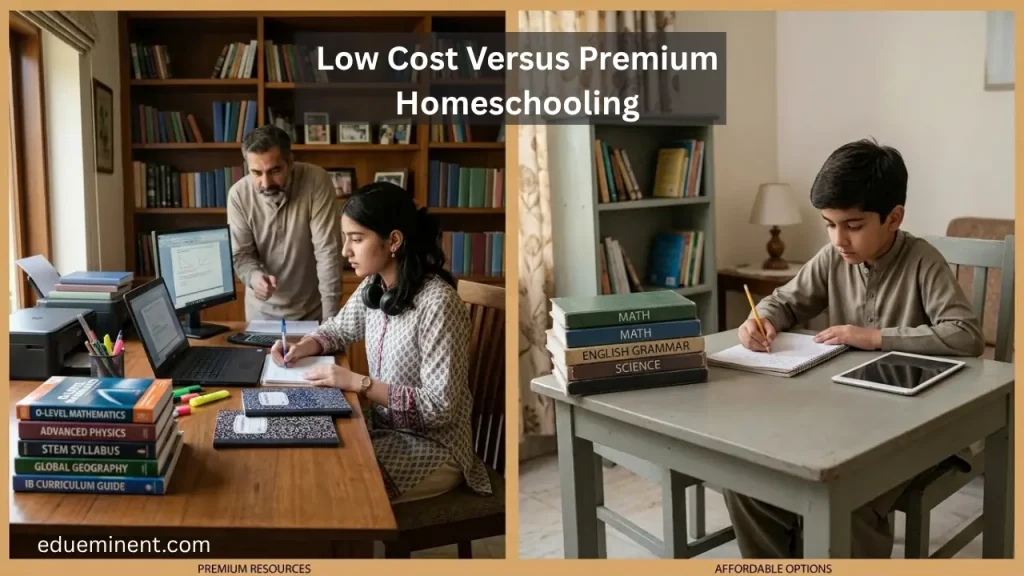
The premium path uses a full online Cambridge curriculum platform with live teachers, structured weekly lessons, built-in assessments, and dedicated support staff, combined with subject tutors for reinforcement. This path costs significantly more per year but reduces the direct teaching burden on the parent and provides more built-in structure and accountability.
Most Pakistani homeschooling families land somewhere between these two extremes, mixing free resources with selective paid support in the subjects where it matters most.
Sample Annual Budget by Stage
Putting real numbers side by side across grade stages makes the overall cost picture much easier to plan around. The table below shows a rough annual range for each major stage, covering curriculum, materials, and typical tutoring support, though your actual numbers will shift based on the choices covered earlier in this guide.
| Stage | Low Cost Path (PKR per year) | Premium Path (PKR per year) |
| Primary (self-taught, local curriculum vs full online platform) | 30,000 to 80,000 | 180,000 to 520,000 |
| Middle stage, grades 6 to 8 | 60,000 to 150,000 | 400,000 to 700,000 |
| O Level, per year across the program | 100,000 to 250,000 | 400,000 to 900,000 |
| A Level, per year across the program | 150,000 to 300,000 | 500,000 to 1,000,000 |
These ranges are meant as planning guides rather than exact predictions, since tutoring intensity, subject count, and city all shift the real number for any individual family. The gap between the low cost and premium columns widens considerably at the O Level and A Level stages, mainly because exam fees and specialized tutoring both scale up with subject count and difficulty.
Homeschool Co-ops and Community Cost Sharing in Pakistan
Homeschool co-ops and parent-led community groups are growing in major Pakistani cities, and they offer a practical way to reduce cost while still giving children regular peer interaction and some subject-specific instruction outside the home.
A co op typically charges a modest membership or per-class fee, far below the cost of individual private tutoring, since the expense of a teacher or facilitator is shared across several families. Some co-ops focus purely on social and extracurricular activities, while others run structured classes in subjects such as science labs, art, or a foreign language.
Joining a local homeschool community also opens the door to sharing secondhand books, past papers, and recommendations for affordable tutors, all of which help reduce the material and tuition costs covered earlier in this guide.
Parents new to homeschooling in Pakistan often find that a single well-connected community group saves more money over a year than any single budgeting tip on its own.
Facebook groups and WhatsApp communities built around homeschooling in specific Pakistani cities have become a common way for parents to find these co-ops, trade used books, and compare notes on which tutors or platforms actually delivered good results for the price.
Reaching out to an existing homeschooling family before committing to a curriculum or platform is one of the simplest ways to avoid an expensive misstep in your first year.
How Homeschooling Cost Compares to Private School Fees in Pakistan
Private school fees in Pakistan vary enormously by city and school tier, ranging from modest monthly charges at community schools to significant monthly tuition at well-known private and international schools in major cities, before adding admission fees, annual charges, uniforms, books, and transport.
When a homeschooling family chooses the low-cost, self-taught path, the annual total often comes in well below what a mid-tier or premium private school charges across a full year once every fee category is included.
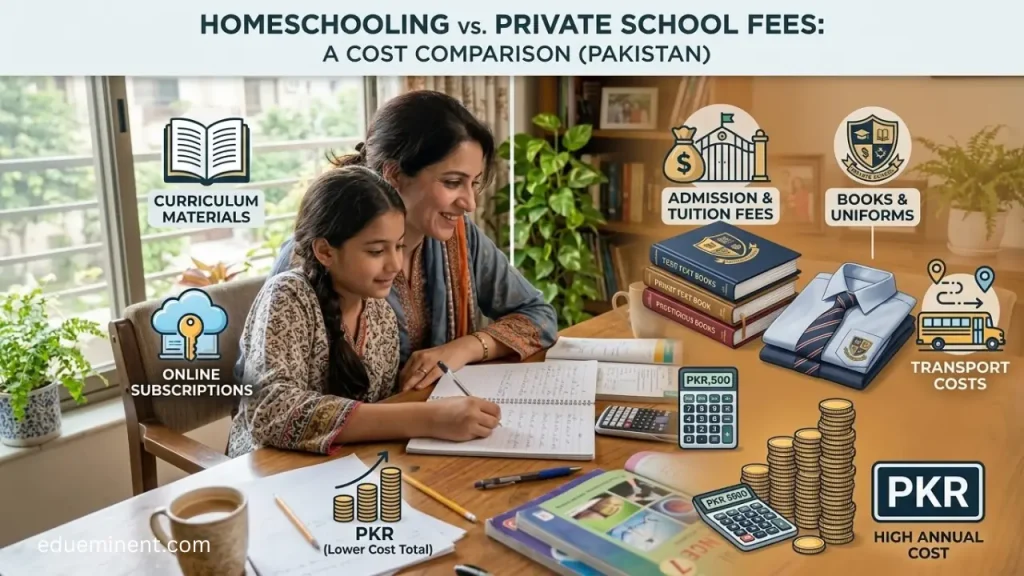
When a family chooses the premium online platform path with heavy tutoring support, the gap narrows considerably and can, in some cases, approach what an established private school costs.
The honest comparison depends entirely on which private school tier you are comparing against and which homeschooling path you choose. Families evaluating the switch should compare their actual expected homeschooling spend, built from the categories above, against the full annual cost of their current or prospective private school, not just the advertised monthly tuition figure.
Budgeting Tips for Homeschooling Families in Pakistan
Building a realistic homeschool budget before the year starts prevents surprise costs from derailing your plan partway through.
- Decide on your curriculum path first, since this single decision affects nearly every other cost category more than any other factor.
- Set a subject-by-subject tutoring budget rather than a vague overall number, so you can see exactly where paid support is going.
- Buy secondhand books and materials where possible, and check homeschool community groups before purchasing anything new.
- Register for exams early and budget for exam fees well in advance, since O Level and A Level charges are a high, predictable cost.
- Track spending by category, such as curriculum, tuition, materials, and technology, so you can adjust the following year based on what actually mattered.
Is Homeschooling Legal in Pakistan?
Homeschooling in Pakistan is not regulated by specific legislation, and the Ministry of Federal Education and Professional Training does not mandate a registration process or a fixed curriculum for homeschooling families.
This matters for cost planning too, since there are no government registration fees or mandatory inspections to budget for, unlike in some countries with formal homeschool oversight.
O Level and A Level qualifications earned through homeschooling are treated on equal footing with SSC and HSSC by Pakistani universities, employers, and professional bodies once verified through IBCC equivalency, which is why so many Pakistani homeschooling families build their plan around the Cambridge or Edexcel exam pathway.
Final Thoughts
Homeschooling cost in Pakistan is not one fixed figure, but a set of choices that add up differently for every family. Curriculum path, exam board, tutoring intensity, and city all shape the final number far more than any single line item.
Start by deciding on your curriculum approach, sketch a rough annual budget using the categories in this guide, and compare that total honestly against your current or prospective private school costs. With a clear cost breakdown in hand, homeschooling in Pakistan becomes a financial decision you can plan for with confidence, rather than a guess.
Revisit your budget every few months rather than setting it once and forgetting it, since tutoring needs, exam schedules, and even exchange rates can shift the real cost of your plan over the course of a school year.
Frequently Asked Questions
How much does homeschooling cost per year in Pakistan?
Costs range from well under 100,000 rupees a year for a mostly self-taught, local curriculum approach to well over 500,000 rupees a year for a premium online Cambridge platform with heavy tutoring support.
Is homeschooling cheaper than private school in Pakistan?
It often is, particularly for families using free resources and self-teaching, though a premium homeschooling package with full online support and tutors can approach or match the cost of a well-regarded private school.
What is the highest cost in homeschooling for O Level and A Level students?
Exam fees and tuition are usually the two largest categories at this stage, since Cambridge and Edexcel exam fees apply per subject and many families add subject tutors for exam preparation.
Can I homeschool using only free resources in Pakistan?
Yes, particularly through the primary and lower secondary stages, though most families still budget for exam fees once a child reaches O Level or A Level, since those charges are largely unavoidable.
Do homeschooling families in Pakistan pay any government fees?
No. Since homeschooling is not regulated by specific legislation in Pakistan, there is no government registration fee or mandatory inspection cost to budget for.
How can I reduce homeschooling costs without hurting my child’s education?
Focus paid tutoring on only the subjects where support genuinely helps, buy secondhand books, use free past papers from official exam board sources, and reserve premium platform subscriptions for stages where structure matters most.
Are there scholarships or financial aid for homeschooling in Pakistan?
Formal homeschool-specific scholarships are rare in Pakistan, though some online curriculum platforms occasionally offer sibling discounts, multi-subject bundle pricing, or need-based fee reductions, so it is worth asking providers directly before enrolling.
Does homeschooling cost more for science subjects than arts subjects?
Generally yes, since science subjects often require lab equipment, practical assessments, and sometimes specialized tutors, while arts and humanities subjects can usually be covered with textbooks, past papers, and self-study at a lower cost.