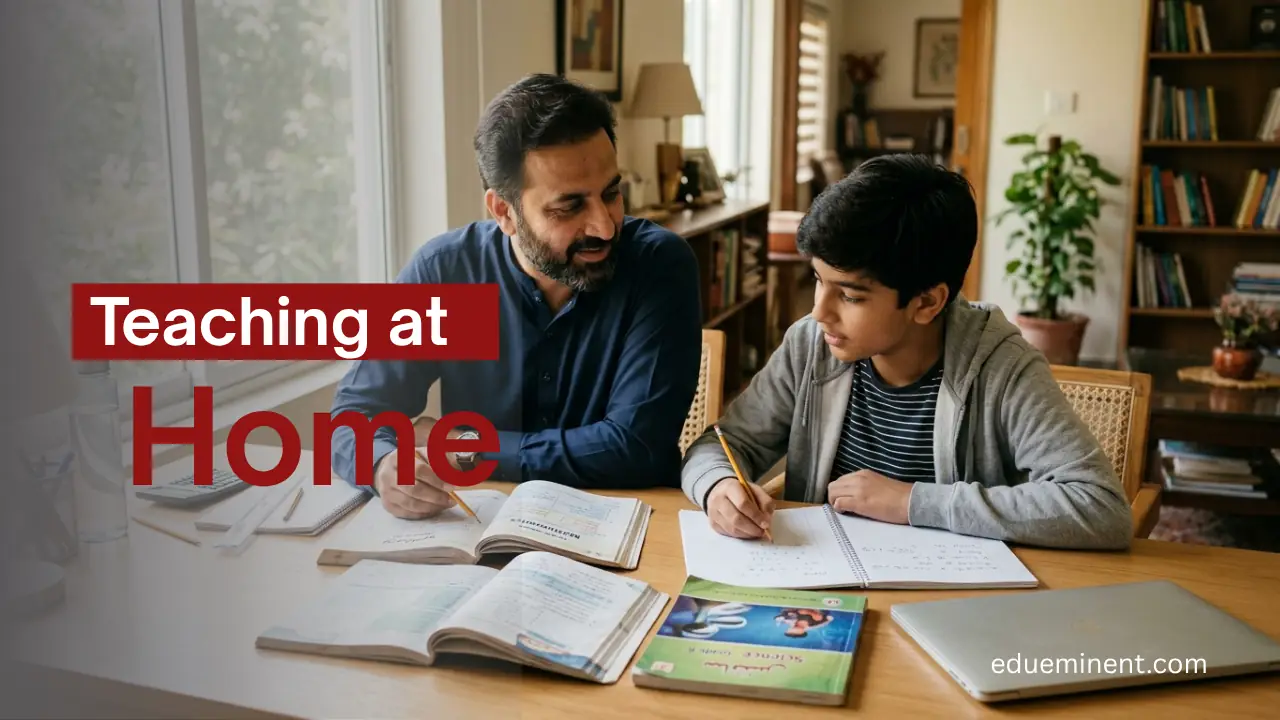
This guide explains how to teach at home effectively during Grades 6 to 8. It covers realistic schedules, lesson delivery, core subjects, outside support, student independence, motivation, common mistakes, and practical ways parents can create a flexible and productive homeschool routine.
The first week of homeschooling a middle schooler rarely goes the way a parent imagined it. There is often a stack of curriculum on the table, a printed schedule taped to the wall, and a genuine sense of readiness.
Then by Wednesday afternoon the plan has already fallen apart in some small way. A math lesson took twice as long as expected. A reluctant essay turned into a standoff. Someone forgot lunch entirely.
This is completely normal, and it does not mean homeschooling is going wrong. Teaching at home is a skill, not a personality trait, and it develops the same way any skill does, through practice, small adjustments, and a realistic sense of what a day actually needs to include.
Homeschooling means taking a child’s education outside the usual school classroom and managing learning at home. If the idea is new to you, What Is Homeschooling? gives a simple look at how it works and what homeschooling can involve.
Grades 6 to 8 come with their own particular challenges, since students at this age are academically capable of much more than elementary work but are not yet ready for the full independence high school will eventually require.
This guide walks through exactly how to teach at home during the middle school years, covering how to structure a day, how to actually deliver a lesson without a classroom, how to handle subjects a parent does not feel confident teaching, and how to keep a household from feeling like a battle every single morning.
Understanding What Teaching at Home Actually Requires
Many new homeschooling parents assume they need to recreate a classroom in miniature, complete with a full school day, formal lectures, and constant instruction. This assumption creates unnecessary stress and rarely reflects how effective homeschool teaching actually works.
At home, one adult is teaching one student or a small handful of students, which means the pace of instruction moves far faster than it does in a room of twenty five kids.
A concept that takes a teacher forty minutes to explain to a full class, allowing time for questions, redirection, and repetition, might take a parent ten minutes to explain directly to their own child.
Knowing what homeschooling is is one thing; actually getting started is another. From choosing subjects to setting up a daily routine, How to Start Homeschooling covers the practical steps parents can take at the beginning.
This is why most successful middle school homeschool days run on focused blocks of two or three hours rather than a full six hour school day, with the remaining time spent on independent work, reading, projects, or simply life outside of formal academics.
Teaching at home also does not require a parent to be an expert in every subject. It requires a parent to be a guide, someone who can set up the material, ask the right questions, notice when a concept has not landed, and know when to bring in outside help.
This distinction matters enormously for confidence, since many parents avoid homeschooling middle school specifically because they do not feel qualified to teach algebra or a foreign language, when in reality very few homeschooling parents teach every subject personally by the time their child reaches this stage.
Building a Realistic Daily Schedule
A schedule is the backbone of a homeschool day, but it works best when it reflects how your family actually functions rather than an idealized version copied from someone else’s routine.
Most middle school homeschool days work well with two or three focused academic blocks, commonly built around math, reading and writing, and one additional content area such as science or history on a rotating basis.
Each block typically runs somewhere between thirty and sixty minutes depending on the subject and the student’s attention span. Around these blocks, families build in time for independent reading, physical movement, a proper lunch break, and either a hands on project or personal interest time.
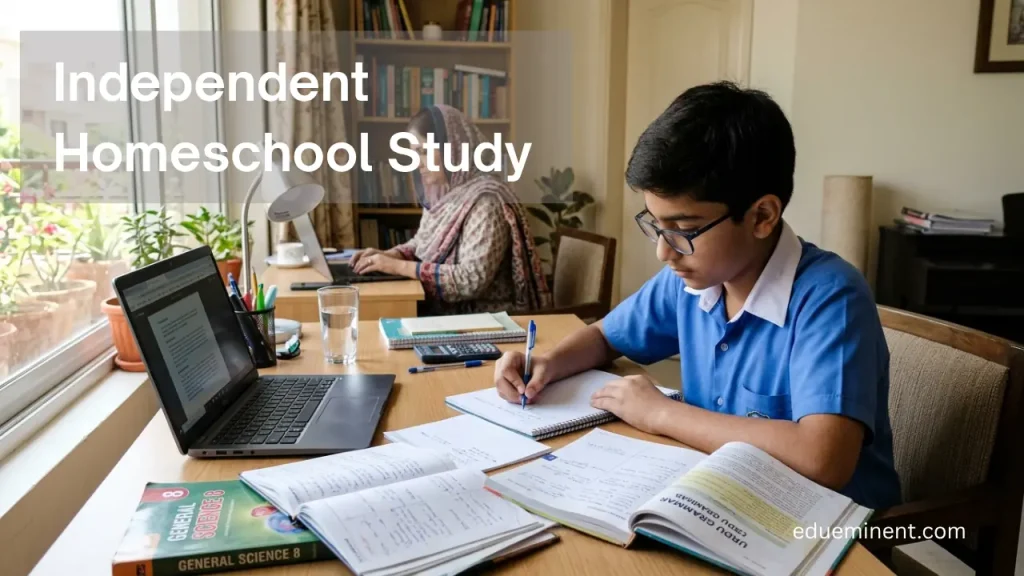
A sample middle school day might begin with math first, while focus is highest, followed by a short break, then reading and writing, another break, and finally science or history along with any electives.
This is only one possible order, and plenty of families find that starting with a lighter subject helps ease a reluctant learner into the day, while others prefer to tackle the hardest subject first to get it out of the way.
The key to a schedule that actually works is flexibility built in from the start. Leave room for a subject that runs long, a discussion that goes somewhere interesting, or a day when energy is simply low. A rigid schedule that cannot bend usually breaks within the first month, while a flexible framework tends to last the whole year.
How to Actually Teach a Lesson at Home
Once a schedule is in place, the next question most parents ask is how to run an actual lesson without a classroom, a whiteboard, or years of teacher training behind them. The good news is that effective home teaching follows a simple, repeatable pattern that works across nearly every subject.
Start With a Clear, Short Introduction
Before diving into a worksheet or textbook chapter, spend two or three minutes explaining what the lesson is about and why it matters. This does not need to be elaborate. A simple statement like “today we are learning how to solve equations with a variable on both sides, which builds directly on what we did yesterday” gives a middle schooler a mental frame for the material that follows.
Model the Skill Before Asking for Independent Work
Whether the subject is math, grammar, or a science concept, working through one or two examples together before handing over independent practice makes an enormous difference.
Talk through your thinking out loud as you solve a problem, since this shows a student the reasoning process, not just the correct answer.
Ask Questions Instead of Only Giving Answers
When a middle schooler gets stuck, the instinct is often to simply explain the answer. A more effective approach is to ask a guiding question first, such as “what do we know so far” or “what happened the last time we saw a problem like this.”
This builds independent thinking skills that will matter far more in high school than any single answer to any single problem.
Let Your Child Work Independently, Then Check In
After modeling a skill, step back and let your middle schooler attempt practice problems or a writing assignment on their own. Resist the urge to hover over every step.
Check in after a set amount of work rather than after every single question, since this builds the self monitoring skills that grades 6 to 8 are specifically meant to develop.
Review Mistakes as Learning Moments, Not Failures
When a mistake shows up, treat it as useful information rather than a problem to fix quickly and move past. Ask your child to explain their thinking on a missed problem, since this often reveals whether the issue was a small careless error or a genuine gap in understanding, and those two situations call for very different follow up.
Teaching Core Subjects at Home in Grades 6 to 8
Each core subject comes with its own particular challenges and strategies at the middle school level. Here is a practical breakdown of how to approach the subjects that come up most often.
Math
Math is the subject most parents worry about, particularly once pre algebra and early algebra concepts appear. The most effective approach at home combines a structured curriculum with plenty of worked examples, since middle school math depends heavily on building each new skill on top of a previous one. If a parent does not
feel confident with the material, a curriculum that includes video instruction, an online course, or occasional tutoring sessions can fill that gap without requiring the parent to personally master every topic first.
What matters most is making sure a student truly understands a concept before moving forward, since gaps in math tend to compound quickly at this stage.
Reading and Language Arts
By grades 6 to 8, reading instruction typically shifts from learning to read toward reading to learn, meaning that comprehension, analysis, and written response become the focus rather than basic decoding.
A strong approach includes regular independent reading of both fiction and nonfiction, guided discussion about theme and character rather than simple plot summary, and consistent writing practice that moves from paragraphs toward full multi paragraph essays across the three years.
Keeping a reading journal, where a student records thoughts on what they have read, works well as a low pressure way to build both comprehension and writing fluency at the same time.
Writing
Writing improves through repetition and feedback far more than through grammar drills alone. A workable approach at home involves short, frequent writing assignments rather than occasional long essays, direct feedback focused on one or two specific areas at a time rather than marking every error at once, and gradually increasing the complexity of assignments from a single paragraph to a full essay with an introduction, body paragraphs, and a conclusion.
Letting a middle schooler write about a topic they genuinely care about, even within an assigned format, tends to produce far stronger effort than a generic prompt ever will.
Science
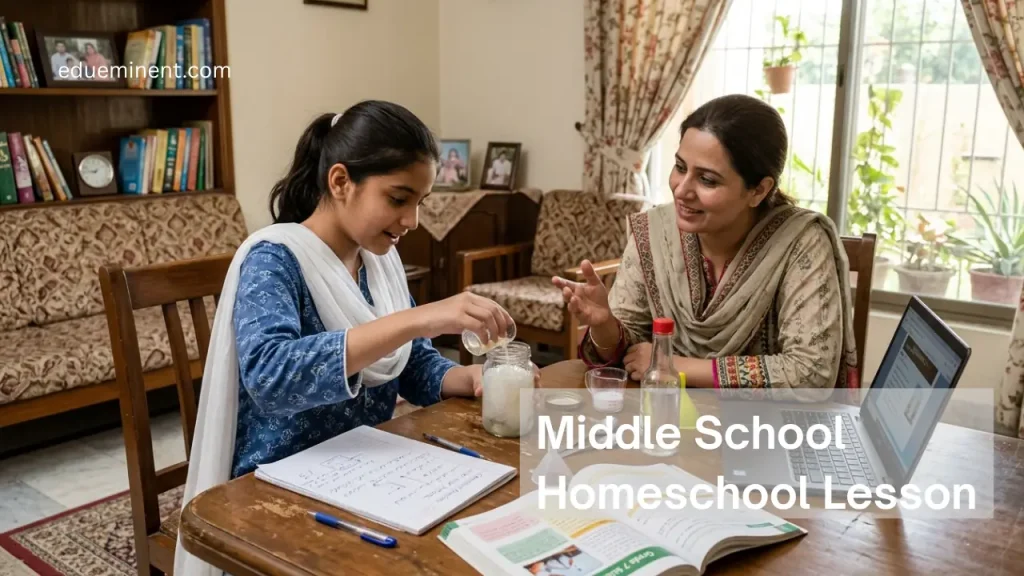
Middle school science works best when it includes real hands on experimentation rather than reading about science exclusively. Simple experiments using household materials, combined with a curriculum that explains the underlying concepts, give a much stronger foundation than textbook reading alone.
Encouraging a student to form a hypothesis, record observations, and explain results in their own words builds both scientific thinking and writing skills simultaneously.
Social Studies and History
History and social studies lend themselves naturally to projects, since connecting events across time periods and cultures is far more memorable than memorizing isolated dates.
Mapping trade routes, researching how a historical event connects to something happening in the world today, or creating a timeline that spans multiple civilizations all turn a subject that can feel abstract into something a middle schooler can actually engage with directly.
Foreign Language
A foreign language is one of the subjects parents most often outsource, whether through an online course, a co op class, or a tutor, and there is nothing wrong with doing so.
What matters at this stage is consistent exposure and practice rather than a parent personally achieving fluency, so a program with regular speaking practice tends to work better than a workbook alone.
Electives and Creative Subjects
Art, music, coding, and other electives often get pushed aside when a family feels pressed for time, but they play a real role in keeping a middle schooler engaged with school overall.
These subjects work well as shorter, more frequent sessions rather than long blocks, and they are often the easiest subjects to let a student choose entirely on their own, since interest matters more than sequence in most elective areas.
A student who spends thirty minutes a few times a week on a genuine interest, whether that is digital art, a musical instrument, or building a simple website, often carries that enthusiasm into the rest of the school day as well.
Teaching Subjects You Do Not Feel Confident In
Nearly every homeschooling parent runs into at least one subject that feels intimidating, whether that is algebra, a foreign language, or advanced science. This is one of the most common reasons parents hesitate to homeschool through middle school, and it deserves a direct, practical answer rather than vague reassurance.
The first option is a curriculum with strong built in instruction, such as video lessons or a structured online program, which shifts the direct teaching role away from the parent while the parent still manages pacing and accountability.
The second option is outside help, whether that is a subject specific tutor, an online class through a homeschool co op, or a community college course for an advanced eighth grader ready for high school level material.
There is no single learning approach that works for every child. If you are unsure whether homeschooling would suit your child, Is Homeschooling Right for My Child? looks at some of the practical and personal factors worth thinking about.
The third option, often overlooked, is learning alongside your child. Many parents work through a math or science concept the night before a lesson, staying just one step ahead, and find that this approach works perfectly well for middle school level material, even if it would not scale to advanced high school coursework.
None of these approaches require a parent to have a teaching degree or deep subject expertise. What they require is honesty about where the gaps are and a willingness to bring in support rather than trying to power through alone.
Fostering Independence While Still Teaching Actively
One of the central goals of homeschooling grades 6 to 8 is a gradual shift from a parent directing every lesson toward a student managing more of their own learning. This does not mean stepping back entirely, but it does mean deliberately handing over more responsibility as the three years progress.
Practical ways to build this independence include having your child use a planner to track assignments, gradually letting them choose the order they complete subjects in during a school day, teaching them to check their own work against an answer key before bringing it to you, and having them set a personal goal for a project or unit and check in on their own progress.
By eighth grade, many students are ready to manage most of their daily schedule independently, with a parent shifting into more of a mentoring and progress review role rather than a constant instructor.
This transition also includes practical life responsibility, not just academic independence. Encouraging a middle schooler to make their own phone calls when appropriate, manage their own school supplies, and take ownership of turning in completed work, even in a homeschool setting where there is no external deadline forcing the issue, builds habits that will matter well beyond any single subject.
Keeping a Middle Schooler Engaged and Motivated
Middle schoolers can be a genuinely tricky age to teach, since they are old enough to find busywork obviously pointless but not always mature enough to push through material that feels boring simply because it is required.
A few strategies consistently help with engagement at this stage. Hands on, experiment based learning tends to work far better than passive reading alone, particularly in science and history.
Connecting an assignment to a personal interest, whether that is having a student write a story in the style of a favorite book series or research a historical event connected to a video game or movie they already enjoy, can turn a reluctant assignment into genuine engagement.
Building in real choice, even something as small as choosing which of two books to read for a unit or which format to present a project in, gives a middle schooler a sense of ownership that pure compliance never provides.
Finally, celebrating genuine progress, not just perfect scores, helps a student stay motivated through the inevitable difficult stretches every school year includes.
Handling the Emotional Side of Teaching Your Own Child
Teaching your own child comes with an emotional layer that a hired tutor or classroom teacher simply does not carry. Frustration during a difficult math lesson can feel personal in a way it would not with a stranger, and a middle schooler going through the mood swings and independence seeking common at this age may push back harder against a parent than they would against a teacher.
A few practices help manage this. Taking a short break when frustration rises on either side, rather than pushing through a lesson that has clearly stalled, prevents small frustrations from becoming bigger conflicts.
Separating the relationship of parent and child from the relationship of teacher and student, even just through language, such as saying “let’s put teacher hat on for the next hour” can help both sides shift into a more productive mode.
Finding a support community, whether through a local co op, an online homeschooling group, or simply another homeschooling parent to talk to regularly, gives a parent somewhere to process the harder days rather than carrying all of it alone.
Common Mistakes to Avoid When Teaching at Home
A few patterns show up repeatedly among families who find the teaching side of homeschooling harder than it needs to be.
Trying to replicate a full school day exactly. A homeschool day does not need six or seven hours of formal instruction to cover the same material a traditional school day covers, since one on one teaching moves through content far more efficiently.
Refusing to outsource any subject. Believing that a parent must personally teach every subject, even ones they genuinely dislike or feel unqualified in, often leads to burnout and a worse experience for the student than simply bringing in outside help would have provided.
Skipping the model step and jumping straight to independent work. Handing a middle schooler a worksheet without first working through an example together frequently leads to frustration that has nothing to do with the student’s actual ability.
Correcting every single mistake at once. Overwhelming feedback, especially on writing, tends to discourage a student far more than it improves their work. Focusing feedback on one or two specific areas at a time produces better long term results.
Ignoring the need for breaks and movement. Middle schoolers, like most people, lose focus after sustained periods of concentration. Building in short breaks between subjects, along with physical activity during the day, actually improves the quality of academic time rather than taking away from it.
Treating every lesson as a test of the parent’s own ability. It is easy to internalize a difficult lesson as proof that homeschooling is not working, when in reality a single confusing lesson is simply part of the normal process of learning something new. Separating your own sense of competence from any one lesson going poorly makes the entire experience far less stressful for both you and your child.
A Sample Week for Teaching Middle School at Home
To make this concrete, here is what a realistic week might look like for a seventh grader, adaptable up or down depending on the specific student and subjects involved.
Monday through Thursday typically follow the core academic blocks, math first while focus is highest, followed by reading and writing, then a rotating content area between science and history.
Fridays often shift toward a lighter structure, with review of the week’s material, a hands on project connected to science or history, and independent reading or a personal interest project.
Electives such as a foreign language, art, or coding are often spread across two or three shorter sessions during the week rather than a single long block, since shorter, more frequent practice tends to build skill more effectively than one lengthy session.
This kind of structure gives a middle schooler predictability during the week while still leaving room for the natural variation that homeschooling allows, such as extending a science unit that has captured genuine interest or taking an extra day on a math concept that needs more practice before moving forward.
Frequently Asked Questions
How many hours a day should I actually be teaching my middle schooler?
Most families spend two to three hours in direct, focused instruction, with additional time for independent work, reading, and projects rounding out a typical day to around four or five hours total.
Do I need a teaching certificate to homeschool grades 6 to 8?
In most places, no formal teaching credential is required, though requirements vary by location. What matters far more is consistency, a workable curriculum, and a willingness to bring in outside help for subjects that feel outside your comfort zone.
What if my child refuses to do the work I assign?
This is common at this age and usually points to one of a few causes: the material is genuinely too hard, too easy, or disconnected from anything the student finds meaningful. Adjusting the difficulty, the format, or the level of choice involved often resolves the resistance faster than insisting on compliance.
How do I teach a subject I am not confident in myself?
Lean on a curriculum with strong built in instruction, bring in a tutor or online class for that specific subject, or learn the material alongside your child a day ahead of the lesson. All three approaches work well for middle school level content.
Should I follow a strict daily schedule or stay flexible?
A loose structure with predictable blocks tends to work better than either a rigid hour by hour schedule or no schedule at all. Predictability helps a middle schooler know what to expect, while built in flexibility prevents the whole day from falling apart when something takes longer than planned.
How do I know if my teaching approach is actually working?
Look for steady progress over weeks and months rather than judging any single day. Regular review of completed work, occasional quizzes or discussions to check understanding, and honest conversations with your child about what feels clear versus confusing all give a much better picture than a single grade ever could.
Is it normal to feel like I am doing this wrong?
Yes, and nearly every homeschooling parent feels this way at some point, particularly in the first year. Teaching at home is a skill that improves with practice, and a rough week or even a rough month does not mean the overall approach is failing.
Conclusion
Teaching at home during grades 6 to 8 is less about recreating a classroom and more about building a rhythm that fits your particular child and your particular family.
A short, clear lesson introduction, a modeled example, independent practice, and honest review of mistakes forms a pattern that works across nearly every subject, whether or not a parent feels like a natural teacher going in.
The subjects that feel intimidating do not have to be taught entirely alone, and the goal across these three years is not perfection but steady progress, both in academic skill and in the independence a middle schooler will need heading into high school. Start with one subject, build a rhythm that actually fits your week, and adjust as you go.
That approach, more than any single curriculum or method, is what makes teaching at home genuinely work.