This guide explains how parents can set practical homeschooling goals for grades 6-8. It covers academic progress, life skills, independence, social and emotional development, SMART goals, progress tracking, common mistakes, and age-appropriate examples for sixth, seventh, and eighth graders.
Before making a decision, it helps to understand the basics. Read What Is Homeschooling? to learn how home-based education works and what it involves.
A homeschool day without a goal behind it can quietly drift. The math gets done, a chapter gets read, a project gets finished, and yet at the end of the year a parent can look back and wonder what any of it actually built toward.
This is one of the most common frustrations families run into during the middle school years, and it usually is not a curriculum problem. It is a goal problem.
Setting clear homeschooling goals for grades 6 to 8 changes the entire feel of a school year. Instead of reacting to whatever chapter comes next, a family works toward something specific: stronger writing, real independence, a passed pre algebra course, a calmer relationship with schoolwork.
Research on adolescent motivation backs this up directly. Structured goal setting helps middle schoolers build stronger motivation and self-regulation, especially when the goals are specific and reviewed regularly rather than left vague.
Once you understand homeschooling, the next step is knowing where to begin. Our guide on How to Start Homeschooling covers the key steps for getting started.
This guide walks through exactly how to set homeschooling goals for grades 6 to 8, covering academic targets, developmental and life skill goals, social and emotional growth, and a simple system for tracking progress across the year without turning your home into a pressure cooker.
Why Goal Setting Matters More in Middle School Than Any Other Stage
Elementary homeschooling tends to run on routine. Read together, practice math facts, do a craft, repeat. High school homeschooling tends to run on requirements, since transcripts, credits, and college applications create their own built-in structure.
Middle school sits in an odd middle zone. The academic content is getting genuinely harder, the child is starting to want more independence, and yet there is rarely an external deadline forcing a family to define what success actually looks like. Without a deliberate goal, grades 6 through 8 can become three years of simply moving through workbooks.
Setting real goals during this window solves that problem in three ways. It gives a parent a clear way to measure whether the year actually worked. It gives a middle schooler something concrete to work toward, which research on adolescent development consistently links to stronger engagement and motivation.
And it creates a natural bridge into high school, where a student will need to plan coursework, manage deadlines, and eventually build a transcript largely on their own.
There is also a quieter reason goals matter so much during these three years. Middle school is when a child begins forming a real sense of themselves as a learner, meaning the beliefs they build now about whether they are good at math, capable of finishing hard things, or someone whose ideas are worth sharing tend to stick with them well into high school and beyond.
A clear, achievable goal that a student actually reaches gives them direct evidence that they can do hard things and follow through, which shapes that self view in a far more lasting way than a grade on a single worksheet ever could.
The Four Categories of Homeschooling Goals
Most families find it easier to set goals when they are sorted into a few clear categories rather than one long undefined list. Grades 6 to 8 goals generally fall into four groups.
Academic Goals
These are the goals tied directly to subject knowledge and measurable skills, such as completing pre-algebra, writing a five-paragraph persuasive essay, or finishing a research project on a historical era.
Developmental and Life Skill Goals
These goals focus on the habits that support learning rather than the content itself. Organization, time management, self-monitoring, and independent study all fall here, and they matter just as much as academic content because they determine whether a student can eventually manage high school-level work without constant supervision.
Social and Emotional Goals
Middle schoolers are learning to navigate peer relationships, handle disappointment, communicate their own needs, and build confidence in group settings. These goals are less measurable than academic ones, but they are no less important during this age range.
Life Readiness Goals
These are practical skills that prepare a student for the world beyond schoolwork, including basic financial literacy, digital responsibility, communication skills, and decision making. Many families weave these into electives or weekend projects rather than a formal subject.
A strong year usually includes goals from all four categories rather than academics alone, since middle school success depends on far more than test scores.
A helpful way to picture this is a simple table families can sketch out at the start of a semester, listing one or two goals under each category so nothing important gets left out simply because it was never written down.
Academic Goals by Grade: Sixth, Seventh, and Eighth
While every child moves at their own pace, it helps to have a general sense of what academic goals typically look like at each grade level within this stage.
Sixth Grade Academic Goals
Sixth grade often marks the shift from a general elementary overview to more subject-specific study. Common academic goals at this stage include mastering ratios, order of operations, and ordering negative numbers in math, writing structured paragraphs with a clear main idea, analyzing a short story or novel for theme and character development, and understanding basic scientific investigation, including forming a hypothesis and recording observations.
Many families also introduce a first world language or coding elective during sixth grade, since this is a natural point to add breadth without overwhelming a still developing academic routine.
Seventh Grade Academic Goals
Seventh grade typically deepens the reasoning skills introduced the year before. Common goals include applying pre-algebra concepts such as percentages and simple equations to real world problems, writing a multi-paragraph essay with supporting evidence, conducting independent research and citing sources correctly, and connecting historical events across time periods rather than studying them in isolation.
This is also the year many families shift from leading every lesson toward acting as a support system while the student begins making more choices about how to approach an assignment.
Eighth Grade Academic Goals
Eighth grade functions as the bridge into high school. Academic goals often include completing pre algebra or beginning Algebra 1, writing a full persuasive or analytical essay from an outline through a final draft, explaining ideas clearly in discussions and presentations by supporting a claim with evidence, and completing at least one substantial independent project from start to finish.
Since high school level coursework is close, this is also the year to introduce basic study strategies such as note taking systems and structured test preparation, so the transition feels familiar rather than sudden.
Developmental and Life Skill Goals for Middle School
Academic content only tells part of the story. The habits a student builds during grades 6 to 8 often matter more for long term success than any single test score, because they determine whether a student can manage the workload that high school and eventually college will demand.
Homeschooling can offer flexibility, but it also comes with challenges. Explore the Homeschooling Pros & Cons to understand both sides before deciding.
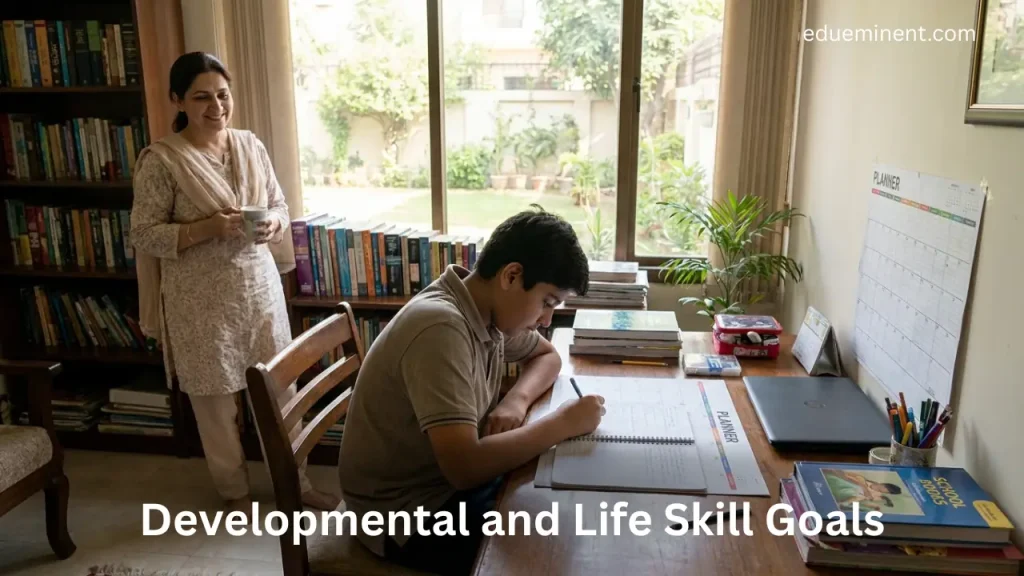
A useful way to think about this is a gradual handoff of responsibility across the three years. In sixth grade, the goal is usually to introduce routines, such as a simple weekly checklist that helps a student see how their work is organized.
In seventh grade, the goal often shifts to having the student plan a small project independently, such as choosing a topic and outlining research steps with a parent reviewing rather than directing.
In eighth grade, the goal becomes full independent planning, where the student manages their own weekly schedule and a parent shifts into more of a mentoring and progress review role.
Specific developmental goals worth setting during this stage include:
- Using a planner or checklist consistently without daily reminders
- Estimating how long an assignment will take and checking that estimate afterward
- Breaking a large project into smaller weekly steps
- Identifying which subjects need more focused time and adjusting a personal schedule accordingly
- Asking for help proactively rather than waiting until an assignment is overdue
- Reviewing personal mistakes on a test or assignment and correcting the underlying gap, not just the specific problem
These goals rarely show up on a report card, but they are often the difference between a student who thrives in high school and one who struggles despite strong academic ability.
Social and Emotional Goals Worth Setting
Middle school is a period of real emotional growth, and homeschooling families sometimes assume that because their child is not in a traditional classroom, social and emotional goals matter less. The opposite is closer to true. Because homeschooling removes the automatic daily peer contact a school provides, these goals need to be set deliberately rather than left to happen on their own.
Reasonable social and emotional goals for this age include building and maintaining a friendship that requires some effort to sustain, such as regular contact through a co op, sports team, or club rather than only occasional family friends.
Other worthwhile goals include practicing disagreeing respectfully during a group discussion or debate, managing frustration during a difficult assignment without shutting down, participating in a group project and contributing a fair share of the work, and identifying and naming personal emotions during a stressful moment rather than only reacting to them.
Group activities work particularly well for these goals because they combine academic content with genuine social practice. A homeschool co op class, a community theater production, a robotics club, or a team sport all give a middle schooler real, low stakes opportunities to practice the social skills that matter well beyond the school years.
Life Readiness Goals to Weave Into the Year
Grades 6 to 8 are an ideal window to start building practical life skills, since a student is old enough to genuinely understand the material but still has the flexibility of a homeschool schedule to practice it without the pressure of a packed school day.
Worthwhile life readiness goals include understanding basic budgeting concepts such as needs versus wants and simple saving, practicing safe and responsible use of digital devices and social platforms, learning to write a clear, professional-sounding email or message, cooking a simple meal independently from start to finish, and practicing basic first aid or safety awareness appropriate for the age group.
None of these need a dedicated textbook. Many families fold them into an elective hour, a weekend project, or even a shared family task like planning a grocery budget for the week.
How to Set SMART Homeschooling Goals
A goal that is too vague, such as “get better at writing,” is nearly impossible to measure or work toward with any real direction. The SMART framework, widely used in classrooms and homeschool planning alike, gives structure to goal setting without making it feel rigid or corporate.
Not every learning approach suits every child. Comparing Homeschooling vs Traditional School can help parents see how the two options differ in daily learning and structure.
Specific means the goal names exactly what will happen, such as “write a five-paragraph persuasive essay with a clear thesis” rather than simply “improve writing.”
Measurable means there is a clear way to know when the goal is met, such as completing a specific number of practice problems correctly or finishing a defined project.
Achievable means the goal fits the student’s current level, stretching them without setting them up for constant frustration.
Relevant means the goal connects to something that actually matters for the student, whether that is high school readiness, a personal interest, or a life skill.
Time-bound means there is a realistic deadline attached, whether that is a week, a unit, or a semester, so the goal does not quietly drift for the entire year.
An example of a SMART academic goal for a seventh grader might read: “Complete the pre algebra unit on percentages by the end of October, scoring at least eighty percent on the unit review.
An example of a SMART social goal might read: “Attend the homeschool co op science class every week this semester and contribute at least one idea during each group discussion.”
A Simple System for Tracking Goals Across the Year
Setting goals is only half the process. Without a simple way to check progress, even well-written goals tend to fade into the background within a few weeks.
A workable system does not need to be complicated. Many families use a one page goal sheet at the start of each semester listing two or three goals per category, so the total stays manageable rather than overwhelming.
A short weekly check in, even just five or ten minutes, works well for reviewing what moved forward and what needs adjusting. A monthly review is useful for bigger picture goals, such as project completion or a full unit of math, since these naturally take longer to assess than a weekly habit.
It also helps to build in flexibility from the start. If a goal turns out to be too easy or too difficult once you are a few weeks in, homeschooling gives you the freedom to adjust it immediately rather than waiting for a grading period to end, which is one of the real advantages of this approach over a fixed classroom pace.
Progress should be framed around steady growth rather than perfection. A middle schooler who improves from struggling with an essay outline to writing one independently by spring has met a meaningful goal, even if their writing is still developing in other ways.
Common Mistakes Parents Make When Setting Homeschooling Goals
A few patterns show up again and again among families who find goal setting frustrating rather than helpful.
Setting too many goals at once. A list of fifteen goals across every subject usually collapses within a month, simply because there is no way to track that much at the same time. Two or three goals per category per semester is far more sustainable.
Only setting academic goals. Families who focus entirely on subject content often find that organization, motivation, or social confidence quietly become the actual bottleneck, even though no goal was ever set to address them directly.
Comparing goals to a traditional school pace. Homeschooling allows a different rhythm than a classroom, and forcing a middle schooler to match a public school scope and sequence exactly, subject by subject, can undercut one of homeschooling’s biggest advantages.
Never revisiting goals. A goal written in September and never looked at again is functionally the same as no goal at all. Even a short monthly check-in dramatically improves follow-through.
Making every goal parent-driven. Middle schoolers in this age range are ready to have real input into their own goals. A student who helps choose or shape a goal tends to feel far more ownership over reaching it than one who is simply handed a list.
Tying goals only to grades or scores. A number on a worksheet tells you very little about whether a student actually understood the material or simply memorized it long enough for the test. Goals that ask a student to explain a concept out loud, teach it to a sibling, or apply it to a new problem tend to reveal far more about real progress than a percentage ever will.
Ignoring the student’s own interests when choosing goals. A goal attached to something a middle schooler already cares about, whether that is a video game they want to build, an animal they want to research, or a sport they want to improve at, tends to hold their attention far longer than a goal that feels disconnected from anything they find genuinely interesting.
Sample Homeschooling Goals for a Grade 6 to 8 Year
To make this concrete, here is a sample semester goal sheet spanning all four categories, which can be adapted up or down depending on grade level and the individual student.
Academic: Complete the assigned math unit with at least eighty percent accuracy on the review. Write and revise one full essay from outline to final draft. Complete one research project connecting a historical event to a present-day issue.
Developmental: Use a weekly planner independently without reminders for at least four weeks in a row. Break one large project into weekly milestones and follow the plan. Identify one subject that needs extra focus and adjust the weekly schedule accordingly.
Social and Emotional: Attend a weekly co op, club, or team activity consistently for the semester. Practice respectfully disagreeing during at least one group discussion. Name and describe a difficult emotion during a stressful moment rather than only reacting to it.
Life Readiness: Cook one full meal independently. Draft a simple monthly budget for a hypothetical allowance or savings goal. Write a clear, professional-sounding email requesting information or help.
Adjusting Goals for Different Kinds of Learners
Not every middle schooler responds well to the same style of goal, and part of the advantage of homeschooling is the freedom to adapt rather than force every child into an identical framework.
A highly self-motivated student often does well with longer term goals and more independence in choosing how to reach them, such as a semester long research project with only a few checkpoints along the way.
A student who struggles with follow-through usually benefits from shorter, more frequent goals with visible progress markers, such as a weekly checklist rather than a semester long target that feels too far away to matter day to day.
A student with a diagnosed learning difference may need goals that are broken into smaller steps than a typical grade level framework suggests, with success measured by growth from that student’s own starting point rather than a generic grade level benchmark.
A highly anxious student often benefits from goals framed around effort and process, such as “spend twenty minutes attempting the assignment before asking for help,” rather than goals framed purely around a correct outcome, which can add pressure rather than reduce it.
The goal categories outlined earlier in this guide, academic, developmental, social and emotional, and life readiness, stay the same across all of these situations. What changes is the size of each goal, how much independence the student is given in choosing it, and how progress gets measured.
A parent who stays flexible on these details while keeping the four categories in mind tends to get far better results than one who tries to apply one rigid system to every child in the family.
Conclusion
Homeschooling goals for grades 6 to 8 work best when they cover more than academics alone. Pairing subject specific targets with developmental habits, social and emotional growth, and practical life readiness gives a middle schooler a far more complete foundation heading into high school than test scores could ever capture on their own.
The exact goals matter less than the habit of setting them, checking them regularly, and adjusting them honestly when life gets in the way. A middle schooler who finishes eighth grade with stronger writing, a working planner habit, a few solid friendships, and the confidence to manage their own schedule has had a genuinely successful three years, whatever the specific numbers on any test happened to be.
If you have not set formal goals yet this year, start small. Pick one goal from each of the four categories, write them down where your family can see them, and check in after two weeks to see how they are actually going. That single step tends to change the entire feel of a homeschool year, far more than any new curriculum or workbook ever could.
Frequently Asked Questions
How many homeschooling goals should a middle schooler have at once?
Most families find that two or three goals per category per semester, roughly eight to twelve total, is enough to create real focus without becoming overwhelming to track.
Should goals be set by the parent or the student?
A blend works best at this age. Parents typically set the broad academic benchmarks required for grade-level progress, while middle schoolers, especially in seventh and eighth grade, benefit from choosing or shaping specific goals within that structure.
What if my child does not meet a goal by the deadline?
This is common and not a sign of failure. Review whether the goal was realistic in the first place, adjust the timeline or the goal itself, and treat it as useful information about pacing rather than a setback to dwell on.
Do social and emotional goals really need to be written down like academic ones?
Writing them down, even briefly, makes them far more likely to actually happen, since it turns a vague intention into something you can check on during a weekly or monthly review.
How do homeschooling goals connect to high school planning?
Goals set during grades 6 to 8, particularly around independent study and time management, directly prepare a student for the self-directed pace of high school, where they will need to plan coursework and manage deadlines with far less daily oversight.
Is it normal for goals to change partway through the year?
Yes, and this flexibility is one of the real strengths of homeschooling. A goal that felt right in September may need adjusting by January as a student grows or as interests shift, and updating it is a sign the system is working, not a sign of poor planning.
What is the best way to track progress on multiple goals?
A single page goal sheet reviewed weekly for quick habits and monthly for larger projects works well for most families, since it keeps tracking simple enough to actually maintain across a full school year.
Should goals look different for a sixth grader compared to an eighth grader?
Yes. A sixth grader usually benefits from more parent-led structure and shorter, more frequent goals, while an eighth grader is generally ready for longer term goals with more independent planning, since the aim across these three years is a gradual shift toward the self direction high school will require.