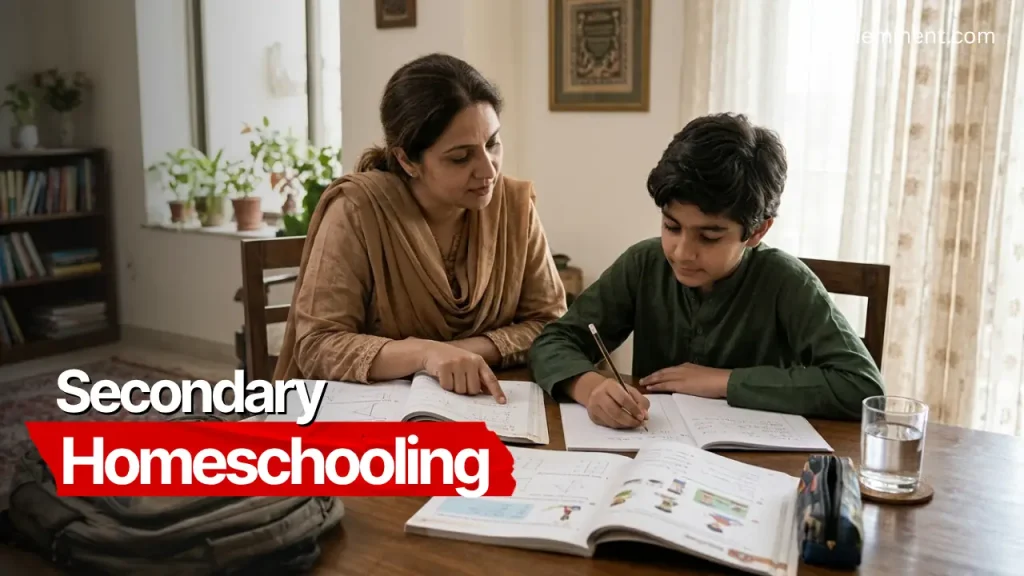
Secondary homeschooling helps Pakistani families educate children in Grades 6–8 at home through a structured curriculum, practical learning resources, and flexible schedules.
This guide explains curriculum options, legal considerations, budgeting, social development, progress tracking, and the steps parents should take to prepare their children for Grade 9 examinations.
Maybe your child is finishing grade 5, and you are not happy with the next school on the list. Maybe your child is already in grade 7 and the mornings have become a daily fight. Whatever your reason, you are probably asking one big question: can I really teach my child at home during the middle years?
The short answer is yes; many families do it. This guide to secondary homeschooling is written in simple words, so you and your child can read it together.
You will learn what the term means, what to teach, how to plan your week, how to track progress, and how to get ready for grade 9. We also point out where you should double-check things, because rules and exam details can change.
What Does Secondary Homeschooling Mean?
Secondary homeschooling means teaching your child at home during the years after primary school. A parent, a tutor, or an online programme leads the learning, instead of a regular school building.
Here is where it gets confusing. In many Pakistani schools, people say secondary school for grades 9 and 10 only. But in the Cambridge system and in many British-style schools, the first secondary stage starts at about age 11. Cambridge calls it Lower Secondary, and it is meant for learners aged 11 to 14. That lines up with grades 6 to 8.
So when we say secondary homeschooling in this guide, we mean the lower secondary years: grade 6, grade 7, and grade 8. Think of these as the bridge years. Your child leaves the simple lessons of primary school and gets ready for the serious exam years that follow.
Is Homeschooling Allowed in Pakistan?
This is the first question most parents ask, and it deserves a careful answer. We are not lawyers, so please treat this as general information and not legal advice.
Article 25A of the Constitution says the state must provide free and compulsory education to children aged 5 to 16. Education is a provincial subject, so each province makes its own rules on how this works.
One expat guide on homeschooling in Pakistan says that homeschooling is legal and that there are no specific laws or rules written for it. Even so, the situation can differ by province and can change over time.
What should you do? Ask your local education office or a trusted education lawyer if you want a firm answer for your city. Keep clear records of what your child studies, which we cover later. Good records protect you and help if your child ever joins a school or sits an exam. For the wider picture, you can also read our guide on what homeschooling is.
Why Families Choose Secondary Homeschooling
Every family has its own story. These are the reasons we hear most often:
- A child who feels lost in a crowded class and needs more one-on-one attention.
- Long school runs, heavy bags, and very early mornings that leave a child tired.
- A wish to teach values and faith at home alongside the school subjects.
- A family that moves often, so the child needs one steady school plan.
- A child who learns faster or slower than the class and needs a different speed.
- Health needs, or a child who has faced bullying or stress at school.
- The desire to use the Cambridge pathway without paying for a full campus school.
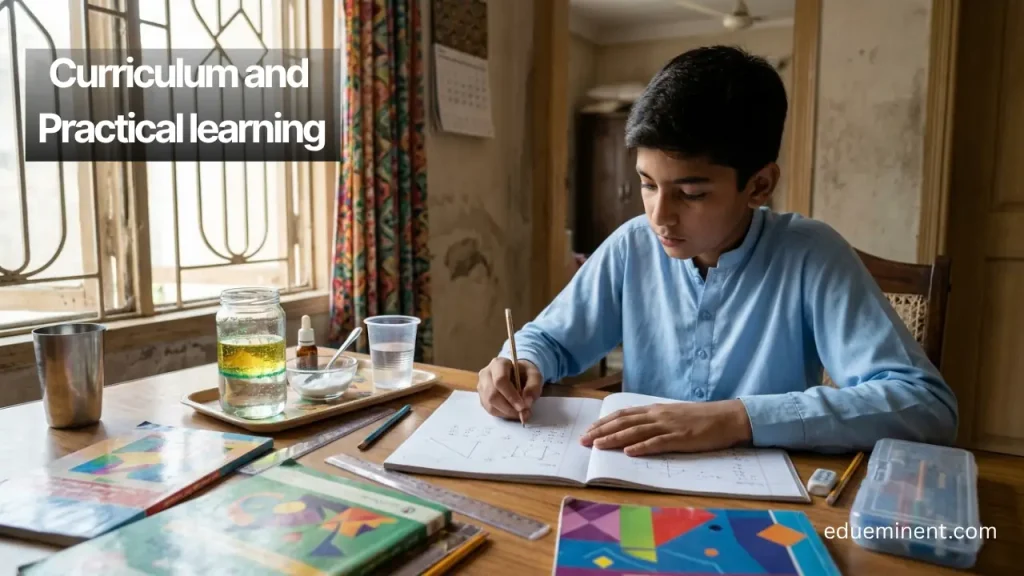
None of these reasons is wrong. But be honest with yourself. Homeschooling is not an escape from problems. It is a different way of solving them, and it asks for time, patience, and planning from you.
Is Secondary Homeschooling Right for Your Family?
Before you commit, take a few minutes for an honest check. Homeschooling works best when a few simple things are true at home. You do not need all of them on day one, but you should be able to work toward them.
- Time: at least one adult can be around for part of the day, or you can arrange tutors and online classes.
- Patience: you can stay calm when your child is slow, tired, or stubborn.
- Space: there is a quiet corner for study, even if it is small.
- Tools: a working device and a steady internet connection, if you plan to use online lessons.
- Support: your spouse or family agrees with the plan, so that you are not alone.
- Willingness to learn: you are ready to learn along with your child.
Also ask your child. A grade 6 child may not understand every detail, but a grade 8 child often has strong opinions. Children who help make the choice usually try harder. If your child is nervous, you can start with a trial term and keep the door open to return to school. That trial approach takes pressure off everyone.
What Should a Child Learn in Grades 6 to 8?
Before you buy a single book, decide what your child needs to learn. In most Pakistani and Cambridge style programmes, the core subjects are English, Mathematics and Science. Then come Urdu, Islamiat, Social Studies and Computer skills.
Cambridge Lower Secondary lists English, Mathematics and Science as its core, plus other subjects such as ICT and Global Perspectives.
The table below gives a friendly overview. It is a guide only. Always check your own board syllabus or programme for the exact topics.
| Subject | What it builds in grades 6 to 8 | A good home habit |
| English | Reading with understanding, longer writing, grammar, speaking | Read for 20 minutes daily and write a summary |
| Mathematics | Fractions, ratios, early algebra, geometry, problem solving | Solve a few problems daily and fix every mistake |
| Science | Basic biology, chemistry and physics, plus simple experiments | Do one small experiment each week with household items |
| Urdu | Reading, writing, comprehension and vocabulary | Read a short story and retell it aloud |
| Islamiat | Understanding faith, Quran study and good character | Learn through daily practice and family talks |
| Social Studies | History, geography and citizenship | Use maps, timelines and short projects |
| Computer skills | Typing, safe internet use, simple coding or office tools | Practise typing and one small project each month |
Notice that skills matter as much as facts. At this age, your child should learn how to read carefully, write clearly, ask questions, and manage time. These habits will help in every subject, and they matter a lot when exam years begin.
Choosing a Curriculum Path
Your curriculum is the map for the next three years. There are three common paths, and each has strengths and limits.
Path 1: The Local Board or National Curriculum
You follow the textbooks and syllabus used in Pakistani schools. This keeps your child close to what classmates learn, which makes it easier to join a school later. It is also usually the cheapest path. The challenge is that you must organise the lessons and tests yourself, or with a tutor.
Path 2: Cambridge Lower Secondary
Cambridge Lower Secondary is a programme for ages 11 to 14. It leads naturally into Cambridge IGCSE and O Level later. Cambridge offers progression tests that are marked by the school or the teacher, and Checkpoint tests that are marked by Cambridge.
Checkpoint covers English, mathematics, and science and is usually taken near the end of the programme. This path suits families who want an international route, though you may need an online school or a tutor to follow it properly.
Path 3: A Mix of Both
Many families blend the two. For example, they follow the local syllabus for Urdu, Islamiat and Social Studies, and use a Cambridge style plan for English, maths and science. This gives flexibility, but you must keep a clear plan so that nothing falls through the gaps. Our curriculum comparison guide explains the options in more detail.
| Path | Main strength | Main challenge | Best for |
| Local board | Low cost, easy to rejoin a school | You plan lessons and tests | Families who may return to school |
| Cambridge Lower Secondary | Smooth link to IGCSE and O Level | May need paid support | Families aiming for Cambridge exams |
| Mixed path | Flexible and balanced | Needs careful planning | Families who want both worlds |
Free and Paid Resources You Can Use
You do not have to build everything from nothing. Pakistan has useful free tools, and there are paid programmes if you want a teacher involved.
Free Resources
- Sabaq Foundation: a non-profit started in 2012 with free video lessons and tests, sorted by education board and class.
- Khan Academy Pakistan: free lessons matched to the national curriculum, with science for grades 4 to 8 in English and science for grades 5 to 8 in Urdu, plus maths for many grades.
- eLearn Punjab: described as the official collection of digitised Punjab textbooks, with videos, simulations and online practice.
- Ilm ki Dunya: a popular Pakistani site with study notes and free online help for many textbook topics.
A sensible plan is to use the free tools for practice and revision, and keep a real textbook as your main guide. Videos are great, but they can make a child feel busy without really learning. Always ask your child to explain the lesson back to you.
Paid Programmes and Online Schools
If you want a teacher, look at online schools and structured courses. Wolsey Hall Oxford offers Cambridge-approved lower secondary courses for ages 11 to 14 with no fixed live classes.
CambriLearn describes itself as an online private school with weekly live lessons and marked assessments. We compare more of these in our guides to online schools in Pakistan and homeschooling programmes for grades 6 to 8. Before you pay, ask for a trial class and a clear fee list.
How to Build a Weekly Schedule That Works
A good schedule gives your child comfort. They know what comes next, so there are fewer arguments. The good news is that home learning is often faster than classroom learning, because there is no waiting for twenty other children. Many families find that a few focused hours a day are enough, though the right amount depends on your child and your programme.
Here is a sample day. Change it to fit your home, your child, and your family prayers and meals.
| Time block | Activity | Notes |
| Morning, first block | Mathematics | Do the hardest subject when your child is fresh |
| Morning, second block | English or Urdu | Reading, writing or comprehension |
| Short break | Snack, movement, fresh air | Keep screens off during the break |
| Late morning | Science or Social Studies | Alternate these on different days |
| After lunch | Islamiat, Computer or a project | Lighter and more hands-on subjects |
| Afternoon | Sports, art, reading for fun, family chores | Real-life skills count as learning too |
A few rules help the schedule survive real life. Start at the same time each day. Keep one day for projects, trips, or catching up. Leave some space in the week for sick days and surprises.
And be ready to change the plan if something is not working. For more help, our homeschool planning guide shows how to organise subjects and goals in one place.
How to Teach the Core Subjects at Home
You do not need to be an expert in every subject. You need to be a good guide. Here is how families usually handle each area.
Mathematics
Maths is where many parents feel nervous. Start by checking what your child already knows. Use a placement test or a few old exam-style questions. Then move in small steps, and do not rush to the next topic until the last one feels solid. If you get stuck, use video lessons or a tutor for that topic only.
Science
Science is more fun at home than most people expect. Use the kitchen and the garden. Grow beans, test which materials float, make a simple circuit with a battery and a bulb. After each activity, ask your child three questions: what did we do, what happened, and why do you think it happened?
English
English grows through reading and writing. Pick books that your child actually enjoys, then add a short writing task each day. A diary, a letter, a news report, or a story all work. Read your child’s writing and point out one thing done well and one thing to fix. Too many corrections at once can crush confidence.
Urdu and Islamiat
These subjects are a natural strength of home learning. Daily family conversations, storytelling, and shared reading can build language and character. Use the official textbooks for your board so that your child is ready for exams later, and add family discussions to make the lessons come alive.
Social Studies and Computer Skills
Make history and geography visual. Draw maps, build timelines, and visit local museums, old buildings, or markets. For computer skills, teach safe internet habits first, then typing, then simple tools such as documents and slides. Sit nearby during online time and talk openly about what is safe.
How to Track Progress and Keep Records
Records are the part of homeschooling that parents skip, and later they regret it. If your child joins a school, an online programme, or an exam centre, someone will want proof of what was studied. A simple system is enough.
- Make a folder for each subject and keep samples of work, with dates.
- Write a short weekly note: what was taught, what went well, and what needs more time.
- Give a monthly test or quiz and record the marks.
- Do a term review with your child. Look at the folder together and set one goal for the next term.
- Use an external check when you can, such as Cambridge Checkpoint tests or an online placement test, so you are not the only judge.
Be gentle but honest when you review. If your child is behind, that is not a failure. It is information. It tells you where to spend more time. Our guide on setting homeschooling goals for grades 6 to 8 can help you turn that information into a plan.
Friends, Sports and Social Life
Social life is the biggest worry for most families, and it is a fair one. Middle school is the age when friendships matter more every year. A child who learns at home needs real friends and real activities.
- Join a homeschool group, many of which meet through Facebook or WhatsApp.
- Sign up for a weekend sports club, swimming class or martial arts.
- Attend a Quran class, art class or a science club.
- Organise small group projects with other homeschooling families.
- Keep up with cousins, neighbours and family friends.
- Try volunteering, such as helping at a charity drive or a mosque programme.
Do not leave this to chance. Put social activities on the weekly schedule, just like maths. A child who has friends and plays will learn better, too.
Keeping Your Child Motivated and Independent
Between grade 6 and grade 8, children change a lot. A grade 6 child may still need you sitting beside them. By grade 8, the same child should be able to follow a weekly plan alone and ask for help when needed. Your job is to slowly hand over the steering wheel.
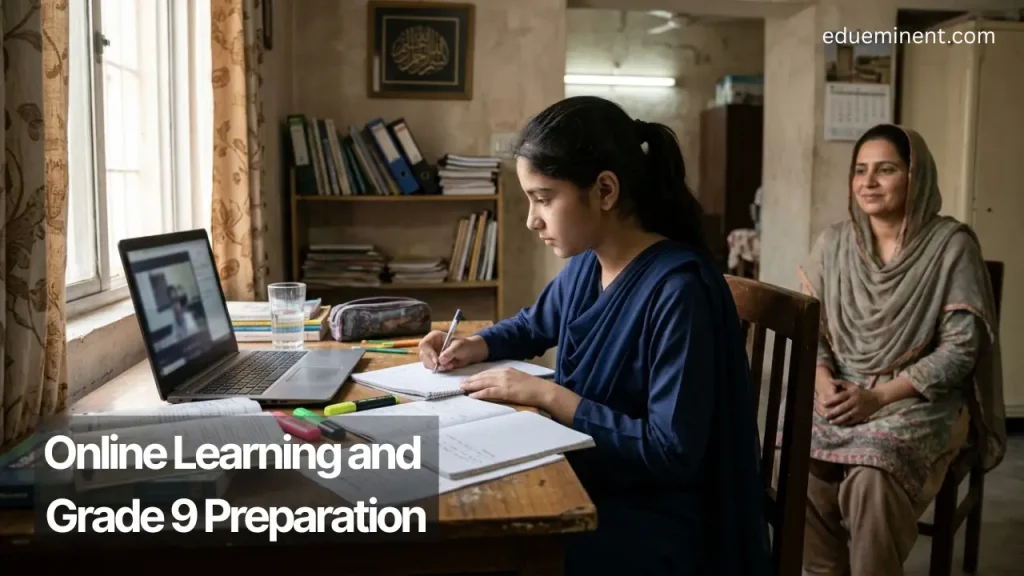
Here are some simple ways to build motivation:
- Let your child help choose some topics, books,s or projects.
- Set small weekly goals and celebrate when they are met.
- Use a planner or checklist, so your child can see progress.
- Praise effort and improvement, not only marks.
- Allow mistakes. Ask what the mistake can teach.
- Rest. A tired child cannot learn well, and a day off is not a disaster.
Also look after yourself. Many parents burn out because they try to be teacher, cook, cleaner, and friend all day. Share the load when you can. A tutor for one hard subject, or help from a spouse or grandparent, can make a big difference.
Common Mistakes to Avoid
- Copying school hours exactly, even though home learning needs less waiting time.
- Buying too many books and courses at once.
- Skipping records, then struggling to prove what was studied.
- Ignoring weak subjects, usually maths or English, until grade 9.
- Letting screens become the main teacher.
- Comparing your child with other children instead of with their own progress.
- Forgetting friends, sport and play.
- Waiting until grade 9 to learn how exams and registration work.
If you recognise one of these mistakes in your home, relax. All of them can be fixed with a small change. The point is to notice early.
What Does Secondary Homeschooling Cost?
Costs vary so much that it would be unfair to give one number. Instead, think about the main cost groups, and ask each provider for exact prices in writing.
- Books and stationery: textbooks, workbooks, notebooks, and science supplies.
- Courses or online school fees: monthly or yearly fees, plus registration or admission charges.
- Tutors: for one or two hard subjects, if needed.
- Technology: a laptop or tablet, headphones, a printer, and a steady internet connection.
- Exams and tests: placement tests, Checkpoint tests, and later registration fees.
- Activities: sports, clubs, and trips for social life.
A parent-led plan with free tools is usually the cheapest. A full online school is usually the most expensive. Many families start small, then add paid help only where it is needed. Our homeschooling cost guide goes deeper into budgeting.
Getting Ready for Grade 9 and Exams
Grade 9 is where exam years begin, so Grade 8 is your final chance to build a strong base. Think about where your child is heading. Some families choose Matric through a Pakistani board. Others choose Cambridge O Level or IGCSE.
Do not guess. Ask early about the following:
- Which exams your child will sit, and in which months.
- How private or homeschooled candidates register, and what documents are needed.
- Which subjects are compulsory for the path you choose.
- Where the exams will be held, and how far ahead you must apply.
- How the results will be accepted later for college and university.
Rules and fees can change, so confirm every detail with the exam board, an exam centre, or a trusted school. We cover this topic further in our guides on O Level homeschooling for grades 6 to 8 and homeschooling and university admission.
Your First 30 Days: A Simple Starting Plan
Starting is the hardest part. Use this plan to begin calmly, without rushing into big purchases.
- Week 1: Talk with your child. Ask what they enjoy, what feels hard, and what they want from home learning. Decide on your main reason for homeschooling.
- Week 1: Choose your curriculum path and check your local rules. Join one homeschool community to ask questions.
- Week 2: Test your child in English, maths, and science to find the starting level. Gather the books and tools you need.
- Week 2: Set up a study corner and a simple weekly schedule. Add social activities from the start.
- Week 3: Begin lessons with a light load. Keep a daily note of what worked and what did not.
- Week 4: Review. Change the schedule if needed, and decide whether you need a tutor or an online course for any subject.
Remember that the first month is a trial. It will feel messy, and that is normal. If you want a longer overview, start with our main homeschooling guide for grades 6 to 8.
Final Thoughts: Start Small and Stay Flexible
Secondary homeschooling is not about being a perfect teacher. It is about knowing your child, choosing a clear path, and showing up each day with patience. The middle years are a special time. Your child is growing in mind, body, and character, and you get a front-row seat.
Begin with a small plan. Pick your curriculum, set up a simple schedule, keep your records, and build in friends and play. Review every month, and change what is not working. If you would like a next step, read our guide to homeschooling resources in Pakistan and choose two or three tools to try this week.
Frequently Asked Questions
What is secondary homeschooling?
It means teaching your child at home during the secondary years. In this guide, it covers grades 6 to 8, which match the Cambridge Lower Secondary stage for ages 11 to 14. A parent, tutor, or online programme leads the lessons.
Can I homeschool grades 6 to 8 in Pakistan?
Many families do. Article 25A guarantees free and compulsory education for children aged 5 to 16, and one expat guide says there are no specific homeschooling laws. Rules can differ by province, so check with your local education office or a legal expert.
Which curriculum is best for secondary homeschooling?
There is no single best choice. The local board path is low-cost and easy for returning to school. Cambridge Lower Secondary leads smoothly into IGCSE and O Level. Many families mix the two. Pick the path that fits your child’s plans.
How many hours a day should my child study?
It depends on your child and your programme. Many families find that a few focused hours are enough, because there is no waiting time as in a big class. Watch your child’s energy, and adjust the plan so that learning stays steady and not exhausting.
How will my child make friends?
Through planned activities. Join homeschool groups, sports clubs, classes and community programmes, and keep up family friendships. Put social time on the weekly schedule so that it does not get forgotten.
Can my child sit Matric or O Level exams after homeschooling?
Often yes, but the rules for private or homeschooled candidates depend on the board and exam centre. Ask about registration, documents, and dates well before grade 9, and keep good records of your child’s work.
Is free online learning enough?
Free tools like Sabaq Foundation and Khan Academy Pakistan are very helpful for practice and revision. But they do not give a teacher, a report card, or a plan. Use them with a textbook and your own schedule, or add a tutor or online school if you need more structure.