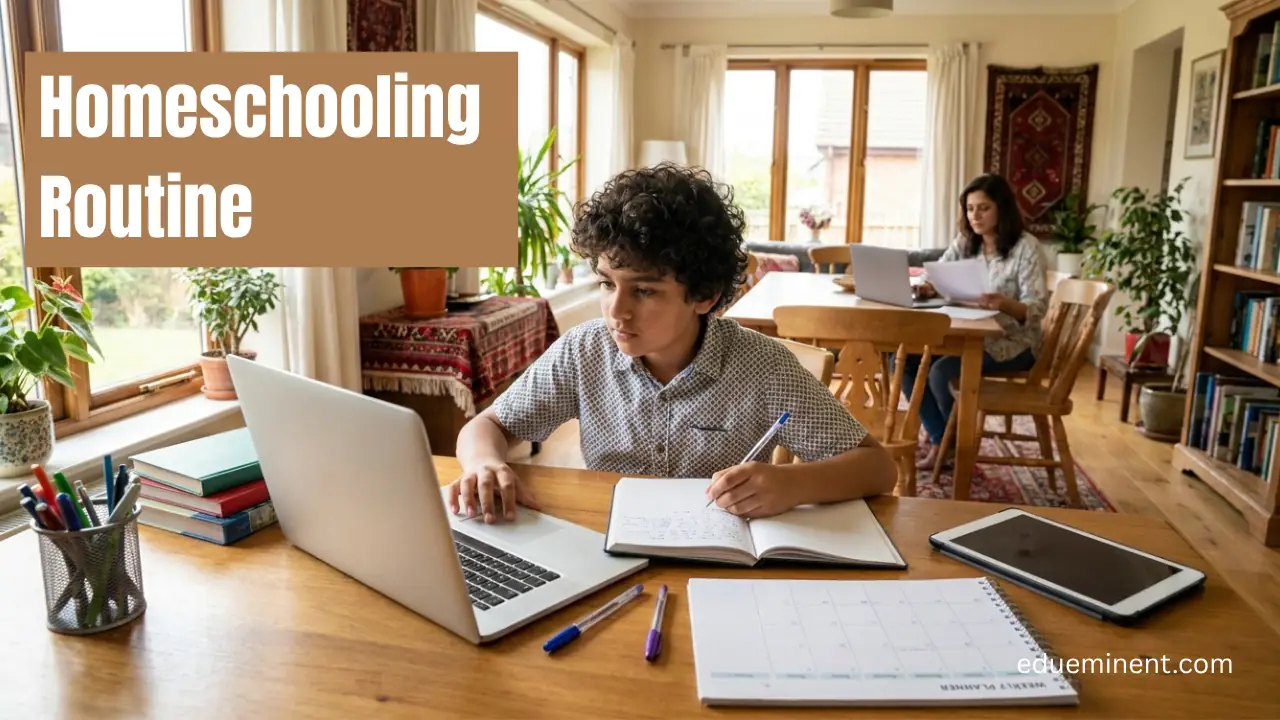
This guide explains how to create a practical homeschooling routine for students in grades 6 to 8. It covers flexible schedules, academic blocks, breaks, independent study, weekly planning, student responsibility, and common mistakes, helping families build a routine that supports learning without becoming overly rigid.
Every homeschooling family eventually hits the same wall. The first few weeks go fine on excitement alone, and then real life shows up. Someone gets sick, a sibling has a meltdown, or a parent has a work deadline, and suddenly the beautiful color-coded schedule from week one falls apart completely.
Before choosing this approach, it helps to understand exactly what homeschooling is and how it differs from traditional education. A clear overview can help parents decide if it suits their family.
This is normal, and it is also fixable. The families who homeschool successfully through middle school are not the ones who never have a bad day. They are the ones who build a routine flexible enough to survive a bad day without collapsing entirely.
This guide breaks down how to build a homeschooling routine specifically for grades 6 to 8, the age where kids can handle more independence but still need enough structure to stay on track. You will get a real framework, a sample weekly routine, and honest guidance on what to do when things stop working.
Middle school is a particularly important age to get this right. Younger kids often go along with whatever structure a parent sets, while high schoolers are close enough to adulthood that a loose routine can still work because they largely manage themselves.
Grades 6 to 8 sit right in the middle, old enough to push back on a routine that feels pointless or babyish, but not yet independent enough to run their own day without any framework at all. Getting the routine right at this stage tends to make the rest of the homeschooling years noticeably smoother.
Starting can feel confusing at first, especially when choosing subjects, resources, and a daily routine. A simple guide on how to start homeschooling can make the process much easier.
Why a Routine Matters More Than a Rigid Schedule
New homeschooling parents often ask whether they need a strict schedule. The better question is whether they have a reliable routine, since the two are not the same thing.
A schedule ties activities to specific clock times. Math at nine, reading at ten, science at eleven. A routine is looser. It defines the order and rhythm of the day without locking everything to the minute.
Most experienced homeschooling families eventually land on a routine rather than a rigid schedule, because a routine bends when life gets messy while a strict schedule tends to break.
Without any routine at all, homeschool days tend to slip. A subject gets skipped once, then again, and within a couple of weeks core academics have quietly disappeared.
That slow drift is one of the most common reasons new homeschooling families give up in the first year, not because homeschooling itself failed, but because the lack of a dependable rhythm let the days fall apart.
Structure also does something less obvious but just as important. It removes a huge amount of daily negotiation. A family without a routine tends to relitigate the plan every single morning, arguing over what comes first, how long each subject should take, and whether today is really a school day given everything else going on.
A family with an established routine skips almost all that friction, since the day’s order is already decided and simply gets executed, with small adjustments as needed rather than a full renegotiation.
The Difference Between a Schedule and a Routine
It helps to picture these two approaches side by side. A schedule says science happens from eleven to eleven forty-five every day, no matter what. A routine says science happens after math and before lunch, whatever time that ends up being on a given day.
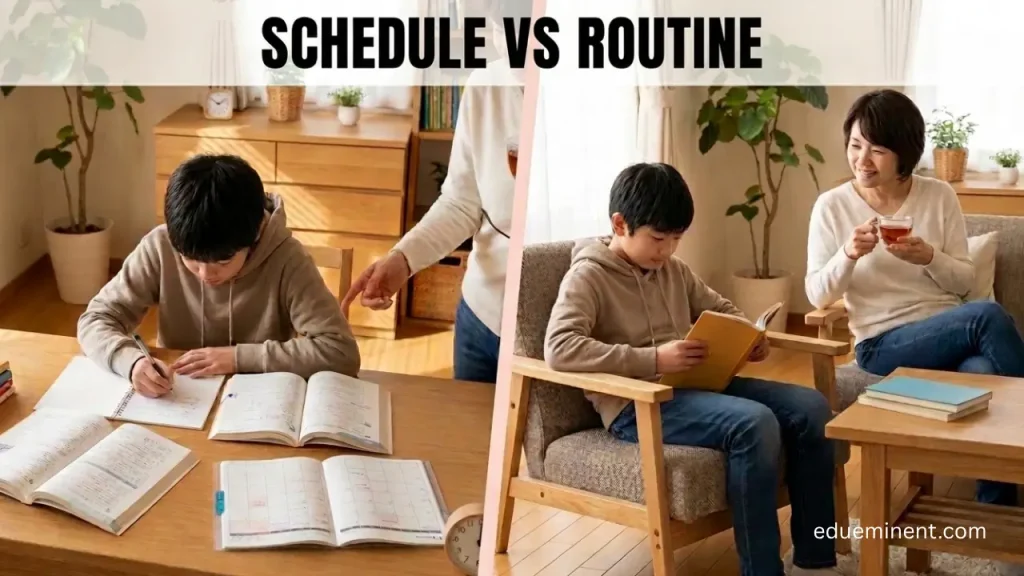
For grades 6 to 8, a routine-based approach usually works better than a strict schedule. Middle schoolers are old enough to understand a general order of operations for their day, and a routine gives them predictability without punishing the family every time something runs a few minutes long.
That said, some structure still matters. A routine with absolutely no anchor points, where anything could happen at any time, tends to feel chaotic rather than flexible, especially for a tween who benefits from knowing roughly what to expect.
If you are wondering what homeschooling actually looks like day-to-day, it is useful to understand how lessons, schedules, assessments, and learning activities are managed. This guide explains how homeschooling works in practical terms.
The goal is a routine with a few fixed anchor points, like a consistent start time and a consistent lunch break, with everything in between allowed to flex.
Think of anchor points as the load-bearing walls of the day, and everything else as furniture that can be rearranged. A consistent wake-up time, a consistent start to academics, and a consistent lunch break give the day its basic shape.
The exact minute each subject begins, how long a break runs, or whether science happens before or after social studies on a given day can all shift without threatening the overall structure.
Building Blocks of a Solid Middle School Homeschool Routine
A strong homeschooling routine for grades 6 to 8 usually has four core building blocks: a morning routine, a focused academic block, an afternoon block for electives and independent work, and a closing routine that signals the school day is done.
Each block serves a different purpose. The morning routine gets a middle schooler mentally ready to focus. The academic block covers the subjects that genuinely need a parent’s direct attention, like math and writing.
The afternoon block handles subjects that require less hands-on teaching, along with electives and personal projects. The closing routine creates a clear boundary so schoolwork does not quietly bleed into the entire evening.
Thinking in blocks rather than exact time slots is what makes a routine resilient. If the morning block runs fifteen minutes long one day, the rest of the day simply shifts, rather than the whole plan falling apart because eleven o’clock came and went without the science lesson starting on time.
A closing routine is worth calling out specifically, since many families skip it entirely and later regret it. Something as simple as putting away materials, a quick verbal recap of what got done, and a clear statement that school is over for the day creates a mental boundary that protects the rest of the evening.
Without that boundary, unfinished schoolwork has a way of creeping into dinner time, bedtime, and the next morning, which slowly erodes the very flexibility that made homeschooling appealing in the first place.
Morning Routine: Starting the Day Right
The first thirty minutes of a homeschool day matter more than most families expect. A calm, consistent start sets the tone for everything that follows.
A simple morning routine for a middle schooler might include getting dressed, eating breakfast, a short check-in about the day’s plan, and maybe five or ten minutes of reading aloud or a quick review of yesterday’s work.
Some families use a short morning meeting, sometimes called a morning basket, to cover things like a daily plan, a current events discussion, or a shared read-aloud before splitting off into individual subjects.
The specific activities matter less than the consistency. A middle schooler who knows that breakfast is always followed by a quick planning check-in, which is always followed by math, has a mental map for the day before it even really starts.
Like any form of education, homeschooling has both advantages and challenges. Looking at the pros and cons of homeschooling can help parents make a more balanced and informed decision.
That predictability reduces the friction and negotiation that often eats up the first hour of a homeschool day in families without a set morning rhythm.
Academic Block: Structuring Core Subjects
The academic block is where the real teaching happens, and it deserves the most planning in the entire routine.
Put the subjects that need your direct involvement first, while everyone’s attention is freshest. For most families, that means math and language arts come before lunch, since these subjects benefit most from parent-led instruction, real-time correction, and focused practice.
Science and social studies, which often involve more independent reading or project-based work by middle school, can shift later in the day or even later in the week without much loss.
A useful guideline for grades 6 to 8 is forty-five to sixty minutes for math, forty-five minutes for language arts, and thirty to forty-five minutes each for science and social studies. That adds up to roughly three to four hours of focused academic time, which lines up with what most middle school homeschooling families report as their actual daily total.
Within each subject block, build in a clear stopping point rather than an open-ended expectation to finish. A math lesson capped at fifty minutes, even if the last problem is unfinished, protects both the child’s focus and the rest of the day’s routine.
Extending one subject indefinitely because a lesson feels incomplete is one of the fastest ways to derail everything scheduled after it.
It also helps to rotate which subject gets the freshest attention over the course of a week rather than always defaulting to the same order. A student who finds writing especially draining might benefit from tackling it first on some days instead of always saving it for after math, simply to avoid always facing the hardest subject when energy is already dipping.
Small adjustments like this cost nothing to try and can meaningfully change how a subject feels to a middle schooler who has been quietly dreading it.
Block Scheduling vs Loop Scheduling
Two common approaches to homeschool routines are block scheduling and loop scheduling, and understanding both gives you more flexibility in building your own.
Block scheduling assigns each subject a fixed daily block: math every day at the same point in the routine, science every day at another point. This works well for subjects that build sequentially, like math, where daily practice genuinely matters for retention.
Loop scheduling works differently. Instead of assigning every subject a daily slot, subjects rotate through a loop, and you simply pick up where you left off each day, regardless of the actual calendar date.
This works well for subjects like art, music appreciation, or a rotating science topic, where missing a day here or there does not meaningfully hurt progress, and where trying to force a strict daily slot creates unnecessary pressure.
Most successful middle school routines end up blending both approaches. Math and language arts run on a block schedule because consistency matters for those subjects, while electives, enrichment topics, and some science or history topics run on a loop that flexes naturally around busier weeks.
Choosing between the two is less about picking the theoretically better method and more about matching the approach to how your family actually functions. A parent who thrives on predictability and finds decision fatigue exhausting often prefers more subjects on a block schedule, since there is less daily choosing involved.
A parent who gets bored easily or has a child who resists rigid repetition often prefers leaning more heavily on loop scheduling, since it naturally introduces variety without requiring active effort to mix things up.
Afternoon Routine: Electives, Independent Work, and Projects
The afternoon portion of a homeschool routine tends to look different from the morning, both in structure and in how much direct supervision is needed.
By middle school, a lot of afternoon work can shift toward independent study, since sixth to eighth graders are developmentally ready to manage a task list with less constant oversight.
A typical afternoon might include an elective subject like coding, a foreign language, or art, along with independent reading, a longer-term project, or review work for a subject that needed extra practice earlier in the day.
This is also a natural place in the routine for extracurricular activities, since many homeschooling families finish core academics by early afternoon, leaving room for sports practice, music lessons, or a co-op class without the day running unreasonably long.
The afternoon block is generally the most flexible part of the whole routine, which makes it the right place to absorb schedule changes when the morning runs long or an unexpected appointment comes up.
It is worth resisting the urge to overfill the afternoon simply because it feels less structured than the morning. A common trap is scheduling back-to-back electives, projects, and outside activities so tightly that the afternoon becomes just as rigid as the morning, only with different subjects filling the slots.
Leaving some genuinely open time in the afternoon, even just thirty minutes with no assigned task, gives a middle schooler room to pursue a passing interest, finish something they got absorbed in, or simply decompress before the day ends.
Building in Breaks and Buffer Time
A homeschool routine without any breaks tends to fail quietly, even if it looks efficient on paper.
Short breaks of ten to fifteen minutes between subject blocks give a middle schooler’s brain time to reset, which actually improves focus during the next subject rather than wasting time.
A longer midday break for lunch and some physical movement matters even more, especially since middle schoolers have been sitting and concentrating for a couple of hours by that point.
Buffer time deserves special mention because it is the single most commonly skipped ingredient in a homeschool routine. A day planned down to the exact minute, with zero room for a lesson running long or a bathroom break turning into ten minutes instead of two, is not a realistic routine.
It is a plan that only works on a perfect day, and perfect days are rare. Leaving fifteen to twenty minutes of unassigned buffer somewhere in the middle of the day gives the whole routine room to absorb the ordinary chaos of teaching a real child.
Weekly and Monthly Routine Rhythms
A homeschool routine is not just about the shape of one day. It also includes a rhythm across the week and across the month.
Many families find it useful to vary the intensity of different days. A common pattern runs four full academic days with a lighter Friday reserved for field trips, catch-up work, projects, or co-op classes. Other families do the opposite, running a lighter Monday to ease back in after the weekend and a heavier midweek stretch when energy and focus tend to be highest.
At the monthly level, it helps to build in a review week every four to six weeks, where the pace slows slightly to catch up on anything that slipped, review material that needs reinforcement, or simply take a breather before pushing into the next unit.
Middle schoolers also benefit from a short weekly planning check-in, often done on a Sunday evening or Monday morning, where they look ahead at the coming week’s assignments and flag anything they are unsure about. This small habit builds the kind of planning independence that becomes essential once they reach high school.
Giving Middle Schoolers More Responsibility Within the Routine
Grades 6 to 8 are the ideal window to start shifting some ownership of the routine from parent to student.
A sixth grader might still need a parent to walk through the day’s plan out loud each morning. An eighth grader can often manage a written checklist independently, checking off subjects as they go and flagging anything they got stuck on for later review.
This gradual handoff is not just convenient for the parent. It is genuinely valuable preparation for the more self-directed pace of high school and eventually college.
Practical ways to build this responsibility into the routine include a written daily or weekly checklist the student manages themselves, a designated time each day when the student works independently without a parent hovering nearby, and a regular check-in, even a short one, where the student reports what they completed and what still needs attention.
Middle school is exactly the right stage to practice this kind of independence, since the stakes are lower than in high school but the skill matters just as much.
Sample Weekly Routine for Grades 6 to 8
Seeing a full week laid out often makes the routine concept click faster than any explanation on its own.
Monday through Thursday, a typical academic day:
- Morning routine and quick planning check-in, thirty minutes
- Math, fifty minutes
- Language arts, reading and writing, fifty minutes
- Break, fifteen minutes
- Science or social studies, on an alternating loop, forty minutes
- Lunch and physical activity, forty-five minutes
- Elective or independent project work, forty-five minutes
- Independent reading or review, twenty minutes
Friday, a lighter day:
- Weekly review and planning check-in for the following week, thirty minutes
- Catch-up work for anything unfinished during the week, up to ninety minutes
- Field trip, co op class, or a longer project block, remainder of the day
This structure lands around four hours of focused work on a typical weekday, with Friday used more flexibly for catching up, deeper projects, or outside activities. Families can easily adjust the exact subject order or block length while keeping the same underlying rhythm.
What to Do When the Routine Stops Working
Every homeschool routine eventually needs adjusting, and treating that as a normal part of the process rather than a failure makes a real difference.
Give any new routine at least two full weeks before deciding it is not working. The first few days of any new routine tend to feel rough simply because everyone is adjusting, and that early friction is not reliable evidence that the structure itself is wrong.
If problems are still showing up consistently after two weeks, that is a much stronger signal worth acting on. When a routine genuinely stops working, look for the specific point of breakdown rather than scrapping the whole thing.
Maybe the academic block is too long for current attention spans, maybe a particular subject consistently runs over and throws off everything after it, or maybe the child has simply outgrown a routine that was built for a younger version of them a year or two ago. Adjusting one piece at a time is usually more effective than rebuilding the entire day from scratch.
Common Mistakes When Building a Homeschool Routine
A handful of mistakes show up again and again with families building a middle school homeschool routine for the first time.
The most common mistake is copying a traditional school day almost exactly, with a rigid bell schedule and back-to-back subjects with no buffer.
This usually collapses within the first few weeks, since it ignores both the efficiency gained from one-on-one teaching and the reality that home life includes interruptions a classroom does not have to deal with.

Another frequent mistake is building a routine around an idealized version of the day rather than the family’s actual rhythm. A schedule that assumes six hours of active parent-led instruction is unrealistic if a parent genuinely only has three hours of focused teaching time available before other responsibilities pull them away. A workable routine has to match real available time, not an aspirational version of it.
A third mistake is treating the routine as permanent once it is built. Middle schoolers change quickly over the course of two or three years, and a routine that worked well in sixth grade often needs real adjustment by eighth grade as workload, attention span, and independence all shift. Revisiting the routine every few months, rather than setting it once and never touching it again, keeps it useful as your child grows.
A final, quieter mistake worth naming is measuring a routine’s success purely by how closely the day matched the plan on paper. A day that deviates from the written schedule but still covers solid math practice, real reading, and a finished writing piece was successful, even if the order and timing looked nothing like what was originally written down. Treating the plan as a servant of the learning, rather than the other way around, keeps the whole routine in proper perspective.
Final Thoughts
A homeschooling routine is not something you get perfect on the first try, and it is not supposed to look like a public school schedule shrunk down to fit a kitchen table.
The families who make homeschooling work through grades 6 to 8 are the ones who build a rhythm with enough structure to keep academics moving and enough flexibility to survive a rough Tuesday without falling apart.
Start with a simple structure: four core blocks and a couple of fixed anchor points; run it for a few weeks, and adjust based on what you actually observe rather than what you planned on paper. That willingness to adjust, more than any specific schedule template, is what turns a good idea into a routine your family can actually sustain.
Frequently Asked Questions
How long should a homeschool routine take to feel normal?
Most families need two to four weeks before a new routine starts to feel automatic rather than effortful. Give any new routine at least two full weeks before judging whether it is working.
Should I use a strict schedule or a flexible routine for middle school?
A flexible routine with a few fixed anchor points, like a consistent start time and lunch break, tends to work better than a strict minute-by-minute schedule for grades 6 to 8, since it can absorb normal disruptions without falling apart.
What is the difference between block scheduling and loop scheduling?
Block scheduling assigns each subject a fixed daily slot, which works well for subjects like math that benefit from daily consistency. Loop scheduling rotates subjects through a cycle without a fixed daily slot, which works well for electives and subjects where missing an occasional day does not hurt progress.
How much independence should an eighth grader have in their daily routine?
By eighth grade, many students can manage a written checklist and complete a meaningful portion of their day independently, checking in with a parent at set points rather than needing constant supervision.
What should I do if my homeschool routine keeps falling apart?
Give it at least two weeks before making major changes, then look for the specific point where things break down, such as a subject that consistently runs long or an academic block that is too long for current attention spans, rather than rebuilding the entire day at once.
Do I need a morning basket or morning meeting to have a good routine?
No, it is optional. A morning basket works well for families who enjoy a shared start to the day, but a simple, consistent morning routine without a formal basket works just as well as long as it is predictable.