
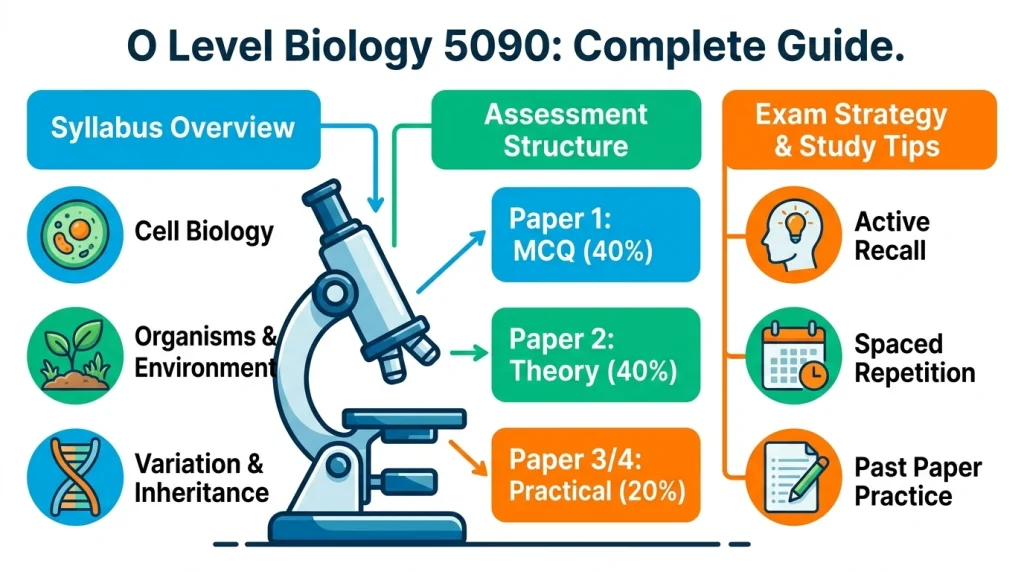
Choosing the right approach to master Cambridge O Level Biology (5090) is crucial for students aged 14–16 aiming to excel in their exams. With 19 major topics ranging from cell structure to ecosystem dynamics, combined with practical assessments (ATP) and multiple exam papers, understanding where to start can feel overwhelming.
O Level Biology 5090 is one of the most important science qualifications for students pursuing further studies in medicine, engineering, environmental science, or any science-related field. But with complex concepts like photosynthesis and respiration, intricate organ systems, and the challenge of balancing theoretical knowledge with practical understanding—how do you approach this subject effectively?
This comprehensive guide breaks down the entire Cambridge 5090 syllabus into digestible, interconnected sections. You’ll understand not just what to memorize, but why these concepts matter, how they connect, and how examiners test them. We’ve included exam strategy tips, common mistakes students make, study timelines, and resources to help you ace Cambridge Biology with confidence.
Whether you’re in an international school in the UAE, studying at a Cambridge curriculum school, or preparing independently, this guide equips you with everything needed to understand the syllabus, ace your papers, and build a genuine passion for biology.
What Is O Level Biology 5090?
Cambridge O Level Biology (5090) is an internationally recognized secondary education qualification for students aged 14–16, typically completed in two years. Designed by Cambridge Assessment International Education (CAIE), it provides a comprehensive foundation in biological science, emphasizing both theoretical understanding and practical skills.
Unlike some curriculum systems that focus heavily on memorization, O Level Biology 5090 emphasizes conceptual understanding, analytical thinking, and the ability to apply knowledge to real-world situations. This means examiners aren’t just testing whether you know a fact they’re testing whether you understand why that fact matters and how it applies in different contexts.
The syllabus covers 19 major topics spanning from microscopic cellular processes to large-scale ecosystem interactions. It includes three written exam papers and, for students without laboratory access, an Alternative to Practical (ATP) component that assesses practical understanding through theoretical questions.
Who Takes O Level Biology 5090?
• International schools worldwide (particularly popular in the UAE, UK, and Asian countries)
• Cambridge-affiliated schools
• Students preparing independently for the Cambridge examinations
• Students transitioning from other curricula to Cambridge system
The qualification serves as a gateway to advanced biology studies (A Level Biology), medical programs, or any science-based undergraduate degree at universities worldwide.
Core Topics & Syllabus Breakdown
The Cambridge 5090 syllabus is organized into six interconnected topic clusters, each building on previous knowledge. Understanding how these topics relate is essential for both exam success and genuine comprehension.
TOPIC 1: CELLS & ORGANISATION — The Foundation of Life
Cells are the basic unit of all living organisms, and understanding cell structure is non-negotiable for O Level Biology.
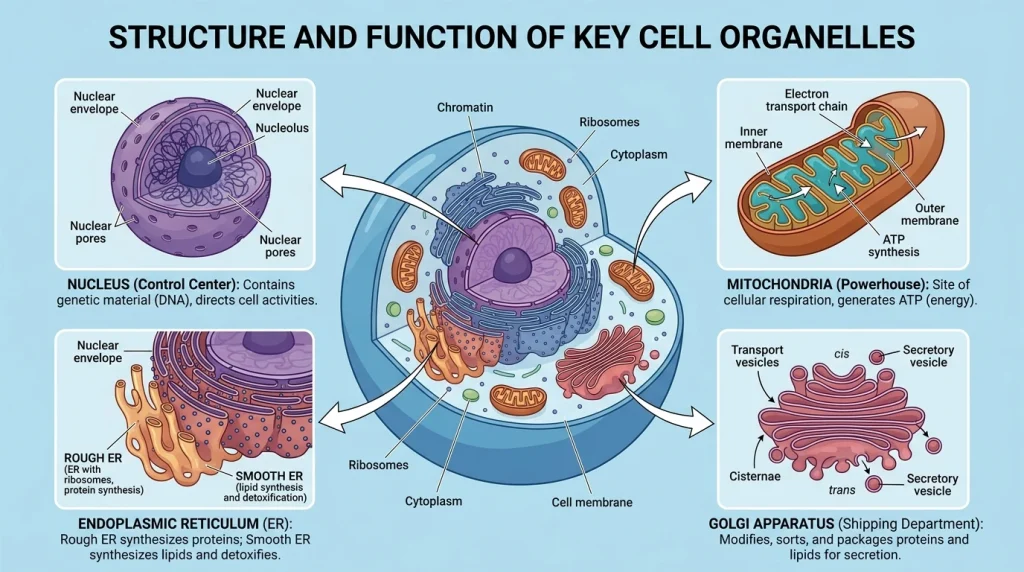
Prokaryotic vs. Eukaryotic Cells
Prokaryotic cells (bacteria) are simple, lacking a nucleus and membrane-bound organelles. Eukaryotic cells (found in animals and plants) are complex, with a defined nucleus containing DNA and numerous specialized organelles. This fundamental distinction appears repeatedly throughout the syllabus—in understanding disease (bacteria vs. viruses), photosynthesis (chloroplasts), and respiration (mitochondria).
Cell Organelles & Their Functions
Every organelle has a specific role. The mitochondria is where aerobic respiration occurs—critical for understanding energy production. The ribosome synthesizes proteins. The rough endoplasmic reticulum (RER) is studded with ribosomes for protein synthesis, while the smooth ER produces lipids. The Golgi apparatus modifies and packages these molecules. The nucleus contains DNA. Lysosomes break down waste. In plant cells, chloroplasts perform photosynthesis, and the cell wall provides structural support.
Specialized Cells
Different cell types are adapted for specific functions. Red blood cells lack a nucleus to maximize oxygen-carrying capacity. Nerve cells have long extensions (axons) to transmit signals. Pancreatic beta cells produce insulin. Understanding how structure relates to function is a high-yield concept that examiners frequently test through diagram labeling and explanation questions.
Cell Division
Two types exist—mitosis (producing identical daughter cells for growth and repair) and meiosis (producing sex cells with half the chromosomes for sexual reproduction). The distinction is critical: mistakes here cost easy marks.
Exam Tip
Cell structure questions appear in Paper 1 (MCQs) and Paper 2 (longer questions). Examiners often test your ability to label diagrams, relate organelle structure to function, and explain how different cell types are adapted for their roles. Practice identifying organelles in electron micrographs these are always included on exams.
TOPIC 2: NUTRITION & PHOTOSYNTHESIS — Energy Entry into the Biosphere
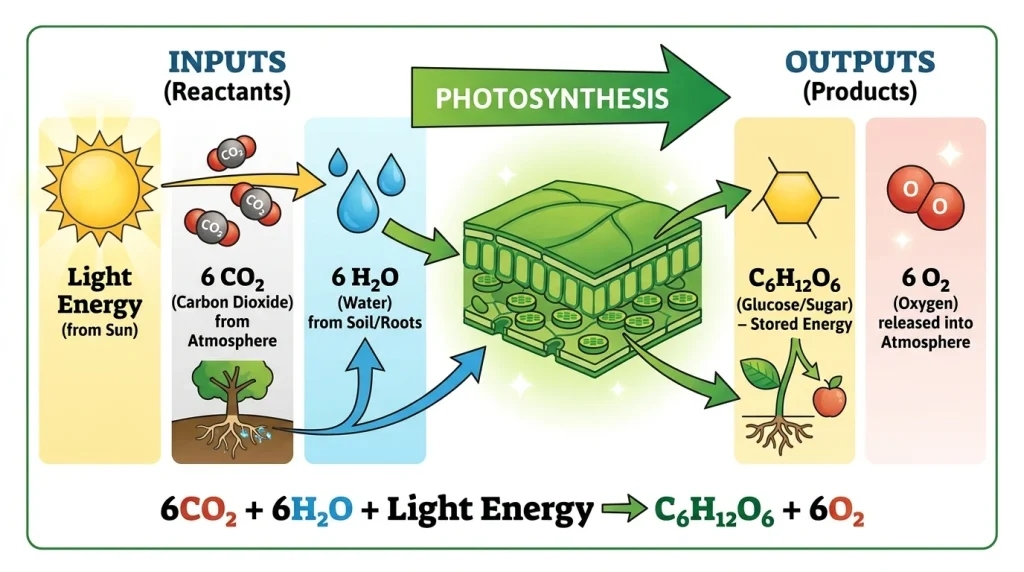
Photosynthesis and respiration are two sides of the same coin. Plants capture solar energy through photosynthesis; all organisms release that energy via respiration. Understanding this relationship is essential.
The Photosynthesis Equation
6CO₂ + 6H₂O + light energy → C₆H₁₂O₆ (glucose) + 6O₂
Light-dependent reactions occur in the thylakoid membranes and require light. They split water molecules, releasing oxygen, and produce energy-rich molecules (ATP and NADPH).
Light-independent reactions (Calvin cycle) occur in the stroma and use the energy from light reactions to build glucose from CO₂. This process doesn’t directly require light but depends on products from light reactions.
Why Plants Need Mineral Ions
Nitrogen is needed for amino acids and proteins. Phosphorus is essential for DNA and ATP. Magnesium is the central atom in chlorophyll. Iron is needed for electron transport. Deficiency in any of these produces visible symptoms (stunted growth, yellowing leaves, discolored veins).
Human Nutrition
Carbohydrates provide energy. Proteins build and repair tissues. Fats store energy and insulate. Vitamins and minerals regulate bodily processes. The digestive system breaks these down into absorbable forms. The liver and small intestine are where nutrient absorption peaks.
Exam Pattern
Questions often ask you to “explain why plants appear yellow when nitrogen-deficient” (lack protein for chlorophyll) or “predict how a plant grows without phosphorus” (stunted, weak roots). These questions test understanding, not just recall.
TOPIC 3: TRANSPORT & HOMEOSTASIS — Maintaining Internal Stability
Transport in plants involves two systems: xylem (transports water and mineral ions from roots to leaves) and phloem (transports glucose and other organic compounds from leaves to all parts).
Transport in Humans
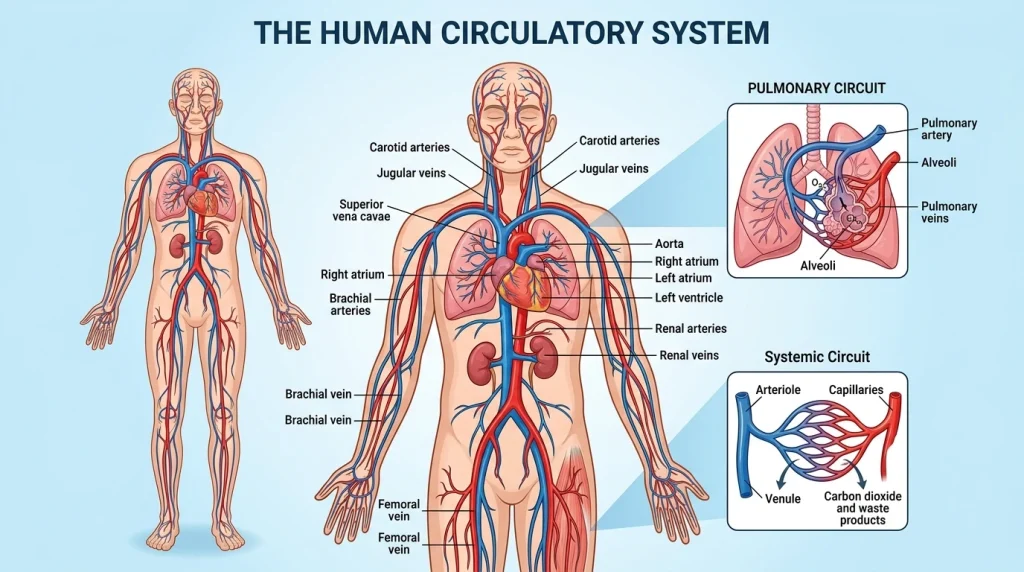
The circulatory system transports oxygen, nutrients, and hormones via blood. Arteries carry blood away from the heart under high pressure. Capillaries are where exchange occurs—nutrients enter tissues, waste exits. Veins return blood to the heart under lower pressure.
What Is Homeostasis?
Homeostasis is the maintenance of a stable internal environment despite external changes. This is tested extensively in exams.
Key Homeostatic Mechanisms
Temperature Regulation:
The hypothalamus detects temperature changes. If too hot, sweat glands activate (cooling via evaporation). If too cold, shivering produces heat. Hair erector muscles contract to trap air.
Blood Glucose Regulation:
The pancreas produces insulin (lowers glucose) and glucagon (raises glucose). This negative feedback loop maintains blood glucose within narrow limits.
Water Balance:
The kidneys adjust water reabsorption via ADH (antidiuretic hormone). When you drink too much water, ADH decreases, less water is reabsorbed, and dilute urine is produced.
The Kidney Explained
Ultrafiltration removes small molecules (glucose, urea, water) into the Bowman’s capsule. Selective reabsorption returns useful substances (glucose, ions, water) to the blood. The loop of Henle creates a concentration gradient, allowing water reabsorption. The collecting duct is where ADH acts to adjust final urine concentration.
Exam Focus
“Explain how the kidney produces dilute urine when you drink excess water” is a classic question. Your answer should trace the pathway: water intake ↑ → blood osmotic potential ↓ → ADH secretion ↓ → less water reabsorbed in collecting duct → dilute urine produced. This shows you understand the mechanism, not just the outcome.
[IMAGE 3 PLACEHOLDER: Human circulatory system with heart, arteries, capillaries, veins]
TOPIC 4: NERVOUS SYSTEM & COORDINATION — Rapid Response to Stimuli
The nervous system has two components: the central nervous system (CNS: brain and spinal cord) and the peripheral nervous system (sensory and motor nerves).
Neurons
Neurons transmit electrical signals. Three types exist:
• Sensory neurons: carry signals from receptors (e.g., skin, eye) to CNS
• Relay neurons: connect neurons within CNS
• Motor neurons: carry signals from CNS to effectors (muscles, glands)
Synapses
Synapses are gaps between neurons. Neurotransmitters (chemical messengers) cross these gaps, transmitting signals. This is why certain drugs (caffeine, nicotine, alcohol) affect behavior—they alter neurotransmitter function.
Reflex Arcs
Reflex arcs bypass the brain for faster responses. If you touch a hot object: receptor (pain) → sensory neuron → spinal cord → motor neuron → muscle contracts (hand withdraws)—all without conscious thought. This is faster than conscious response because the brain isn’t involved.
The Endocrine System
The endocrine system produces hormones (chemical messengers) for slower, longer-lasting responses. Adrenaline (from adrenal glands) prepares your body for “fight or flight” in emergencies. Insulin (from pancreas) lowers blood glucose. Thyroxine (from thyroid) regulates metabolism.
Nervous vs. Endocrine Comparison
| Aspect | Nervous | Endocrine |
| Speed | Fast | Slow |
| Signal Type | Electrical | Chemical |
| Duration | Short-term | Long-term |
| Effect Range | Localized | Widespread |
Both systems work together for complete bodily coordination.
Exam Strategy
Reflex arc questions are very common. Draw the pathway clearly. A common error: confusing sensory and motor neurons or forgetting the synapse step. Also, questions on “negative feedback” test whether you understand how systems self-regulate (e.g., high blood glucose → insulin release → glucose falls → insulin release stops = negative feedback).
TOPIC 5: INHERITANCE & DNA — How Traits Pass Through Generations
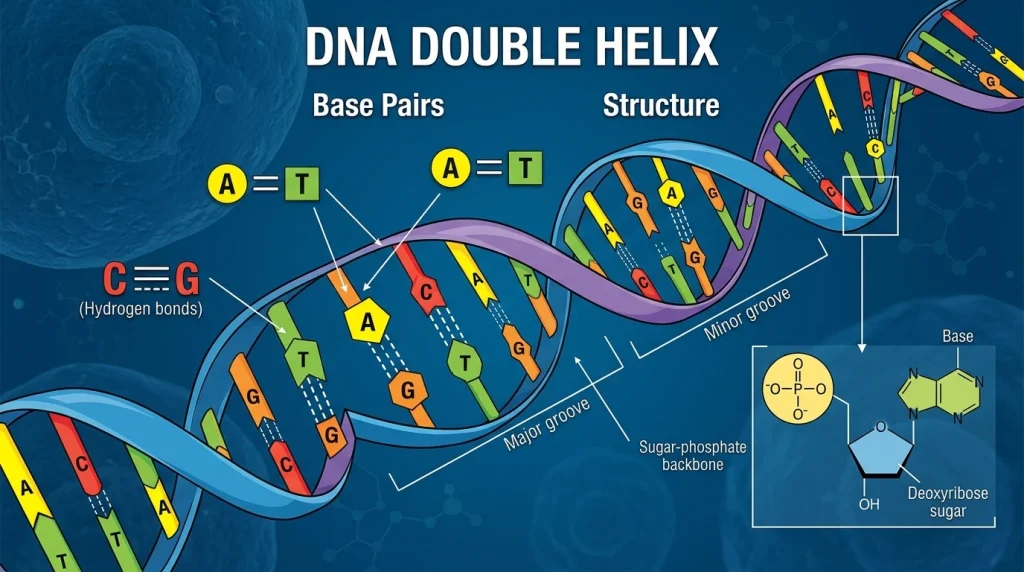
DNA is the molecule of inheritance. It contains genes (stretches of DNA coding for specific proteins). Chromosomes carry genes. Humans have 23 pairs (46 total) of chromosomes.
Alleles
Alleles are different versions of a gene. A gene might have an allele for brown eyes and one for blue eyes. Dominant alleles express their trait even if paired with a recessive allele. Recessive alleles only express when paired with another recessive allele. This is why two brown-eyed parents can have a blue-eyed child (if both carry recessive blue-eye alleles).
Cell Division Types
Mitosis produces two identical daughter cells with the same chromosome number. It’s used for growth and tissue repair. Meiosis produces four sex cells with half the chromosomes. During meiosis, crossing over (exchange of genetic material between homologous chromosomes) creates genetic variation.
Sex-Linked Inheritance
Genes on the X chromosome show different patterns in males (XY) vs. females (XX). Red-green colorblindness is an example—males need only one recessive allele to be colorblind, while females need two.
Genetic Variation
Genetic variation comes from sexual reproduction (crossing over, random assortment of chromosomes) and random mutations. This variation is the raw material for natural selection.
Exam Focus
Punnett square questions are extremely common. If asked about a dihybrid cross (two traits), draw a 4×4 grid carefully. A frequent error: forgetting the law of independent assortment (different genes assort randomly) or confusing mitosis with meiosis (hint: mitosis produces identical copies; meiosis produces variation).
TOPIC 6: ECOLOGY & ECOSYSTEMS — Organisms and Their Environment
An ecosystem consists of biotic factors (living organisms) and abiotic factors (non-living: temperature, light, water, soil).
Food Chains and Food Webs
Energy flows one direction: Producer (plant) → Primary consumer (herbivore) → Secondary consumer (carnivore) → Tertiary consumer (top predator) → Decomposer (bacteria, fungi, breaks down dead matter)
Energy Transfer
Only ~10% of energy passes between trophic levels. The rest is lost as heat during respiration and movement. This is why there are fewer organisms at higher trophic levels and why food pyramids narrow toward the top.
Nutrient Cycles
Unlike energy (which flows one way), nutrients cycle:
Nitrogen Cycle:
Atmospheric nitrogen → soil (via nitrogen-fixing bacteria) → plants (proteins) → animals → decomposers → soil. Plants can’t directly use atmospheric nitrogen; they need soil nitrates.
Carbon Cycle:
CO₂ in atmosphere → plants (photosynthesis) → animals → decomposers → soil → back to atmosphere via respiration and combustion.
Population Growth
Limited by carrying capacity (maximum population an environment can support). Factors include food, water, space, disease, predation. When resources run out, population growth slows.
Conservation
Biodiversity loss threatens ecosystem stability. Sustainable practices (rotation cropping, replanting forests, protecting habitats) maintain resources for future generations.
Exam Tip
Questions often ask “why there are fewer predators than prey.” Answer: energy loss between trophic levels (only ~10% transfers upward). Also common: “how would removing a species affect the ecosystem?” Consider food webs—removing one species affects all species connected to it.
Exam Format & Assessment
O Level Biology 5090 exams consist of:
Paper 1: Multiple Choice
• 40 questions
• 40 minutes
• Format: Covers all topics
• Strategy: Read each question twice, eliminate obviously wrong answers, mark difficult ones and return later.
Paper 2: Structured Questions
• 75 marks
• 1 hour 15 minutes
• Format: Longer structured questions testing deeper understanding
• Strategy: Draw diagrams where relevant. Use scientific terminology. Explain mechanisms (not just describe).
Paper 3: Extended Response
• 75 marks
• 1 hour 15 minutes
• Format: Continued from Paper 2, covering remaining topics
Alternative to Practical (ATP) – Paper 4
For students without lab access. Tests experimental design, identifying variables (independent, dependent, controlled), data interpretation, and practical techniques. Don’t memorize experiments—understand the principles.
Grading System
Uses the 9–1 scale (9 = highest, 1 = lowest). A grade 5 is a “strong pass,” 4 is a standard pass.
Study Strategy & Timeline
3-Month Study Plan (12 Weeks Before Exam)
Weeks 1–4: Learn Topics
• Read textbooks or watch videos for each topic
• Make notes using active recall
• Close the book and write what you remember
• Join study groups
Weeks 5–8: Practice Questions
• Practice Paper 1 (MCQ) questions by topic
• Do short-answer questions from past papers
• Review mark schemes to understand what examiners want
Weeks 9–12: Full Practice Papers
• Take complete past papers under timed conditions
• Simulate exam conditions
• Review your mistakes carefully
Revision Focus (High-Yield Topics)
Prioritize topics that appear most frequently in exams—photosynthesis, respiration, homeostasis, nervous system, inheritance, ecosystems. These topics account for ~50% of exam marks.
Final Week
• Light revision only
• Focus on areas you’re weak in
• Get adequate sleep
Common Mistakes to Avoid
1. Confusing Photosynthesis and Respiration
Photosynthesis makes glucose (stores energy). Respiration breaks down glucose (releases energy). Opposite processes, opposite equations.
2. Mitosis vs. Meiosis
Mitosis → 2 identical daughter cells (growth/repair)
Meiosis → 4 different sex cells with half chromosomes
Different purposes, different outcomes.
3. Diffusion vs. Osmosis
Diffusion = any particle movement from high to low concentration. Osmosis = water movement specifically. Many students mix these up.
4. Dominant vs. Recessive
Recessive traits only show in homozygous (two recessive alleles) genotypes. Dominant traits show in both homozygous (two dominant) and heterozygous (one dominant, one recessive) genotypes.
5. Forgetting the Kidney Structure
The loop of Henle is where the concentration gradient forms (essential for water reabsorption). Many students skip this—it’s tested frequently.
6. Homeostasis Confusion
Homeostasis isn’t just temperature. It includes glucose regulation, water balance, and pH. Understand each mechanism separately.
7. Energy Loss in Food Webs
The most commonly missed concept. Only ~10% of energy transfers between trophic levels. This explains population sizes and pyramid shapes.
CONCLUSION
O Level Biology 5090 is comprehensive and demanding, but it’s mastered through focused study, genuine understanding, and consistent practice. This qualification opens doors to advanced biology studies, medical programs, and science-based careers worldwide.
The key to success isn’t memorizing facts—it’s understanding how and why biological systems work. When you grasp that photosynthesis and respiration are complementary, that homeostasis involves feedback loops, and that energy flows through ecosystems in predictable patterns, the syllabus transforms from isolated topics into an interconnected, fascinating system.
Your Next Steps:
1. Choose a textbook or online resource aligned with the 5090 syllabus
2. Start with topics you find interesting to build momentum
3. Practice questions after each topic—don’t wait until exam season
4. Take full past papers 8–12 weeks before your exam
5. Review mark schemes carefully—understand what examiners value
6. Adjust your strategy based on your performance patterns
With determination, focused study, and this roadmap, you absolutely can excel in Cambridge O Level Biology 5090. The knowledge you gain will serve you well beyond exams—in university, in careers, and in understanding the living world around you.
Good luck with your studies!
Frequently Asked Questions
How long should I study biology daily?
Aim for 45–60 minutes daily during learning phase, 1–2 hours during practice phase. Quality over quantity—focused study beats passive reading.
Which topics are tested most?
Photosynthesis, respiration, homeostasis, nervous system, inheritance, and ecosystems account for ~60% of exam content. Master these first.
Is ATP easier than practical exams?
ATP tests the same concepts as practicals but through written questions instead of hands-on work. Understand experimental design and variable identification.
Should I memorize every detail?
No. Focus on understanding concepts. Examiners test application and explanation, not rote memorization. Know key terms, but prioritize understanding.
How important are past papers?
Extremely important. Past papers show exam patterns, question styles, and commonly tested concepts. Practice at least 5 complete papers.
Can I take O Level Biology without chemistry?
Yes. O Level subjects are independent. However, understanding some chemistry (atoms, molecules, bonds) helps in biology contexts.
How do I improve my exam technique?
Practice under timed conditions. Read questions carefully. Show your working in calculations. Draw clear, labeled diagrams. Explain mechanisms fully.
What if I find homeostasis confusing?
Break it into three parts: temperature regulation, blood glucose, water balance. Understand each separately with diagrams. Then see how they interconnect.
Is practising one topic repeatedly better than mixing topics?
Research suggests mixed practice is better (intermixed practice). Practice multiple topics in one session—it simulates exam conditions and prevents false confidence.
Should I join a study group?
Yes, if the group stays focused. Explaining concepts to others deepens your understanding. But avoid social chats masquerading as study sessions.
