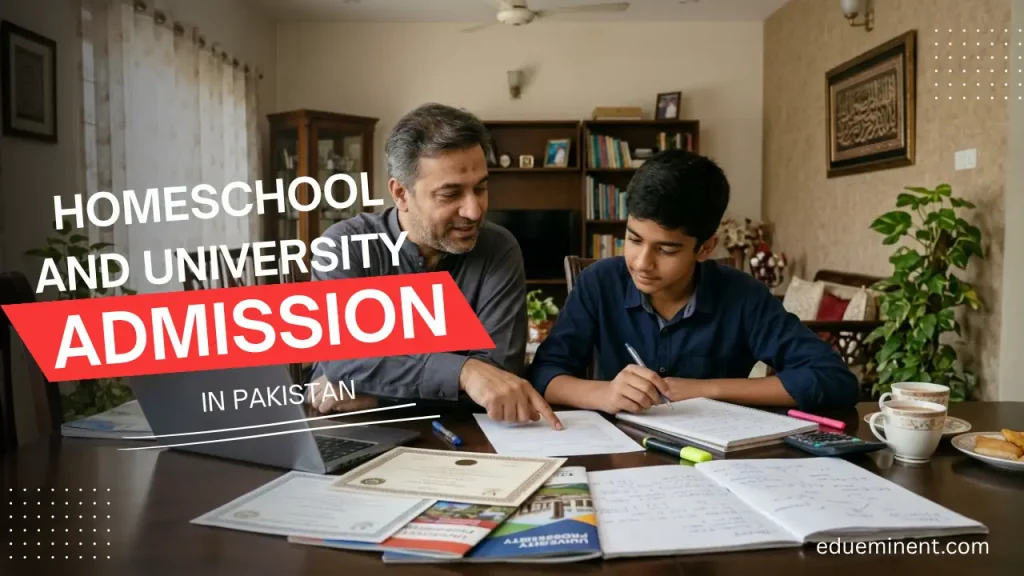
This guide explains how students can prepare for homeschool and university admission in Pakistan. It covers recognised qualifications, IBCC equivalence, entry tests, subject selection, scholarships, and essential documents. Parents of children in grades 6 to 8 can use its timeline to build strong academic foundations and plan.
University feels far away when your child is still in grade 6, 7, or 8. It isn’t, not really. The subject choices, the equivalence rules, and the entry test habits that decide a university seat are shaped years before anyone fills out an application form.
Parents who homeschool often hear a version of the same warning from relatives. “Will a university even accept a child who never went to school?” It’s a fair question to ask, and a much easier one to answer than it sounds, once you understand how Pakistani universities actually check a student’s background.
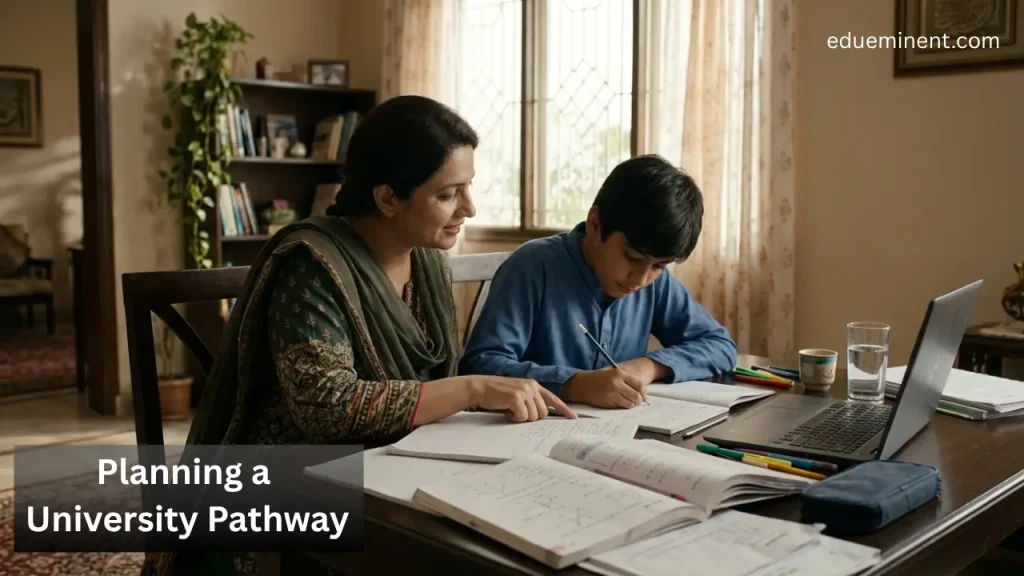
This guide explains what homeschooling parents of grade 6 to 8 children need to know about university admission long before the application stage arrives, so grade 9 choices are made with the end already in mind.
Parents often ask, what is homeschooling, and how does it differ from attending a conventional school? Homeschooling is an educational approach in which children learn primarily at home under parental guidance, with support from tutors or online programmes when needed.
Will Universities in Pakistan Accept a Homeschooled Student?
Yes, generally. Pakistani universities don’t ask whether a student attended a school. They ask for a recognised qualification, proof of equivalence where needed, and an entry test score where the program requires one.
That means the real question isn’t “will they accept homeschoolers”. It’s “does my child hold the right paperwork by the time they apply”.
A homeschooled student who sits Matric or O Level and A Level as a private candidate ends up holding the same certificates as a school-educated student, and universities generally treat the certificate the same way regardless of how the student prepared for it.
Where families run into trouble is usually paperwork they didn’t know they needed, not outright rejection because of homeschooling itself. That’s precisely the gap this guide is written to close.
Before choosing home-based education, parents naturally want to understand the legal position in their country. The question of whether homeschooling is legal in Pakistan requires careful consideration of applicable education laws, provincial requirements, and examination-board rules. Families should verify the latest requirements with the relevant education authorities and examination boards before making long-term decisions.
The Three Pillars of University Admission in Pakistan
Almost every undergraduate admission decision in Pakistan rests on three things working together. Understand these early, and the rest of this guide will make more sense.
| Pillar | What it means | Where it starts |
| Recognised qualification | Matric and Intermediate, or O Level and A Level, or an accepted foreign equivalent | Chosen around grade 8 or 9 |
| Equivalence certificate | IBCC converts O Level and A Level results into a percentage universities can use | Applied for after A Level results |
| Entry test | A subject-based test such as MDCAT, ECAT, NET or a university’s own test, often combined with academic marks. | Prepared for during Intermediate or A Level years |
Grades 6 to 8 sit before all three pillars, but the habits your child builds now- reading stamina, maths fluency, and a comfort with timed tests- feed directly into how well they handle every one of them later.
Why Grade 6 to 8 Choices Echo All the Way to University
It’s tempting to treat grades 6 to 8 as low-stakes years, since no university looks at a grade 7 report card; in one sense that’s true. In another, it misses the point entirely.
A child who reaches grade 9 with weak algebra will find A Level maths, and later an engineering entry test, much harder than it needs to be. A child who never wrote a structured essay before grade 9 will find A Level or O Level English a steep climb, and university admission essays even steeper.
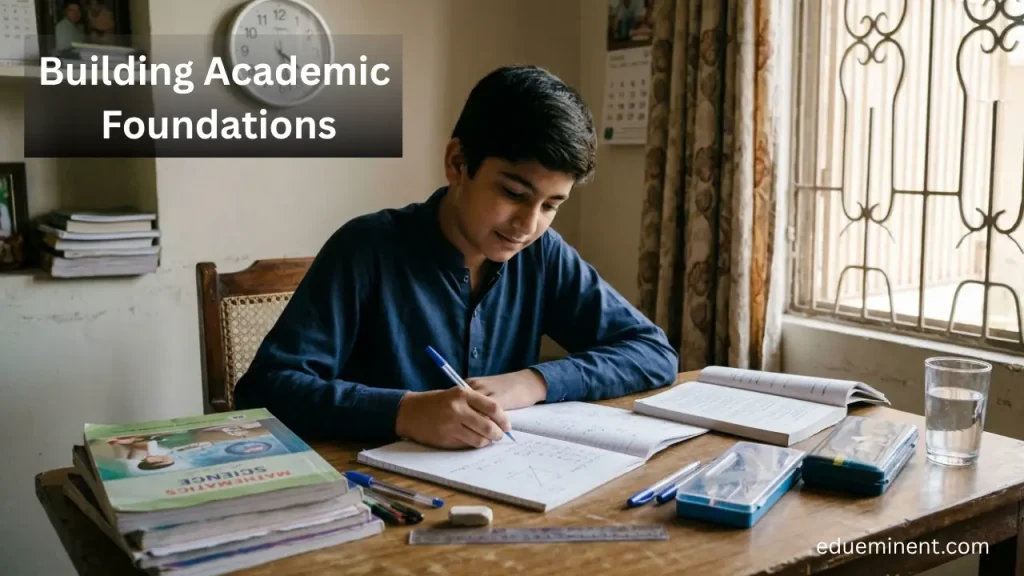
So the real work in grades 6 to 8 isn’t choosing a university. It’s building the reading, writing, and mathematical base that every later step- O Level or Matric, entry test preparation, and eventually a degree- will quietly depend on.
Skills Worth Building Before Grade 9
- Reading unfamiliar material quickly and pulling out the main argument, not just the facts.
- Writing a structured paragraph or essay under a time limit, without a parent editing every sentence.
- Solving multi-step maths problems that combine two or three topics in one question.
- Following a written instruction and completing a task independently, since university study assumes this constantly.
None of this requires expensive resources. It requires steady practice and honest feedback, which a homeschooling parent is often better placed to give than anyone realises.
Choosing a Schooling Path With University in Mind
By grade 8, most homeschooling families are weighing Matric against O Level and A Level. This choice matters for university admission more than many parents expect, because it changes which universities and which entry tests fit naturally.
| Question | Matric and Intermediate route | O Level and A Level route |
| Main entry test link | MDCAT, ECAT and most public university tests, built around FSc content | Same tests, but A Level content needs mapping to the FSc syllabus |
| Equivalence needed | Usually none within Pakistan, since it’s already the local system | IBCC equivalence certificate required before most university applications |
| Best suited to | Students staying fully within Pakistan’s public university system | Students aiming at competitive private universities, A Level friendly programs, or study abroad |
| Typical challenge | Fewer international options later | Equivalence percentage and syllabus gaps that need bridging before entry tests |
Neither path locks a family out of Pakistani universities. Both lead to full admission eligibility, provided the paperwork is done correctly and on time. The right choice depends on where your child is likely to study and how comfortable they are with English-medium, essay-heavy learning versus a more structured local syllabus.
Online teaching has become a flexible way for teachers, graduates, and subject specialists to earn from home. Exploring online tutoring jobs can help educators connect with students, teach subjects they know well, and manage their schedules more conveniently. With reliable internet and strong communication skills, tutoring can become a practical source of income.
Understanding IBCC Equivalence Before It Becomes Urgent
If your child follows the O Level and A Level path, the Inter Board Committee of Chairmen becomes one of the most important names in your homeschooling journey, even though most parents only hear about it in grade 11 or 12.
IBCC converts Cambridge or Edexcel grades into a percentage that Pakistani universities can slot into their own merit formulas. Broadly, each O Level grade and each A Level grade is assigned a mark; the marks are combined across a set number of subjects, and the result becomes an equivalence percentage that stands in for a Matric and Intermediate result.
Guides describing this process explain that A* and A grades convert to the highest marks, with each grade below losing a fixed amount, and that both O Level and A Level subjects are combined into one overall equivalence figure.
The exact scale can be checked directly on the IBCC website, since these figures are reviewed from time to time. Two things matter for a homeschooling family long before this becomes urgent.
First, IBCC equivalence generally expects a set number of subjects, commonly eight from O Level and a minimum from A Level, which is one more reason to lock in a sensible subject plan early rather than drifting into it.
Second, many competitive programs set a minimum equivalence percentage before a student can even sit the entry test, so grades matter as a gateway, not only as a tiebreaker.
Entry Tests: The Gate Most Families Underestimate
Ask any recent university applicant in Pakistan what surprised them most, and many will mention the entry test, not the school leaving exam. For competitive programs, the entry test often carries more weight in the final merit calculation than the school results themselves.
The Major Entry Tests to Know About
| Entry test | Used for | Typical weight in merit |
| MDCAT | Medical and dental colleges (MBBS, BDS) across Pakistan | Roughly half the merit aggregate, alongside Matric and Intermediate marks |
| ECAT | Engineering admissions, particularly UET campuses | A significant share of merit, alongside Matric and Intermediate marks |
| NET | NUST’s own entry test for most of its programs | Often the largest single component of NUST’s merit formula |
| University-specific tests | FAST, GIKI, COMSATS and several others run their own tests | Combined with academic marks, weighting varies by university |
| NTS NAT and GAT | Used by a range of public universities and some postgraduate programs | Varies widely by institution |
Reported eligibility rules commonly mention that MDCAT and ECAT eligibility depends on reaching a minimum equivalence percentage in the first place, often cited around sixty percent, before a student can even sit the test.
This is exactly why the equivalence conversation above isn’t a side detail. It can decide whether your child is eligible to attempt a competitive entry test at all.
Why Grades 6 to 8 Matter Here Too
Entry tests are timed, high-pressure, multiple-choice exams covering years of accumulated content. A student who built strong exam stamina and problem-solving habits from grade 6 onward walks into that room with a real advantage over one who’s never sat a serious timed paper before grade 11.
This is one more reason home mock exams in grades 6 to 8, even informal ones, aren’t wasted effort. They’re the earliest rehearsal for a testing culture your child will meet again and again on the way to university.
What Universities Actually Ask For From a Homeschooled Applicant
Strip away the anxiety, and the document list a homeschooled student needs is nearly identical to what a school-educated student needs.
- Matric or O Level certificate, or the equivalent, showing subjects and grades.
- Intermediate or A Level certificate, or proof of appearing, again showing subjects and grades.
- An IBCC equivalence certificate, if the qualification is O Level or A Level based.
- Entry test result, where the chosen program requires one.
- Identity documents such as CNIC or B form, and passport-size photographs.
- Domicile or other provincial documents, where a public university’s quota system requires them.
Notice that nothing here asks for a school leaving certificate or proof of classroom attendance. Universities check qualifications and test scores, not how a student reached them.
Keeping your own homeschool records is still wise, mainly because some private universities or scholarship programs occasionally ask for a fuller academic history, and it costs nothing to have one ready.
Planning Your Child’s Subjects With a Future Degree in Mind
Grade 8 is early enough to start thinking, loosely, about the kind of degree your child might eventually want, without pinning them down to a firm decision. Certain subject choices at O Level or Matric make specific university paths easier later, and knowing this in advance avoids a scramble in Grade 9.
A student leaning toward medicine generally needs Biology, Chemistry, and either Physics or Mathematics at the Intermediate or A Level stage, since MDCAT eligibility depends on this combination.
A student leaning toward engineering typically needs Physics, Chemistry or Computer Science, and Mathematics. A student leaning toward business or social sciences has far more flexibility, but strong English and Mathematics remain useful almost everywhere.
None of this needs deciding in grade 8. It only needs keeping in mind, so a child interested in medicine isn’t accidentally steered away from Biology at the point subjects are chosen for grade 9.
Foreign University Admission: A Different but Related Path
Some homeschooling families are aiming abroad rather than at a Pakistani university, and the paperwork picture shifts, though the underlying logic stays similar.
Foreign universities generally look at O Level and A Level results directly, often alongside standardised tests such as the SAT, and rarely ask for IBCC equivalence at all, since that step exists specifically to translate results into the Pakistani system.
If your child later returns to Pakistan with a foreign degree, a different equivalence process applies. The Higher Education Commission, not IBCC, handles equivalence for degrees earned abroad, and that process asks for the original degree, transcripts, and often the earlier school level equivalence documents as supporting evidence.
This sits well beyond grade 6 to 8 planning, but knowing the shape of it now helps you keep the right records as your child moves through school.
Scholarships, Financial Aid and the Homeschool Question
Money is a real part of the university planning conversation, and homeschooling families sometimes worry that a nontraditional education history will count against a scholarship application.
In practice, most scholarship committees, whether run by a university, a government programme or a private foundation, judge applicants on the same things they judge anyone on: academic results, entry test scores, financial need and sometimes an interview or essay.
Where homeschooling can genuinely help is in the essay or interview stage, since a student who has managed their own study schedule, chosen subjects deliberately and stayed motivated without a classroom around them often has a compelling story to tell.
Where it can work against a family is when records are thin, so a scholarship committee has little beyond the exam results to judge from.
Start a simple achievements file well before grade 9. Note competitions entered, community involvement, projects completed, and any responsibility your child took on, such as tutoring a younger sibling or running a small initiative.
None of this replaces academic results, but it rounds out an application in a way that pure exam scores can’t.
If you’re specifically targeting need-based aid, research each programme’s documentation requirements early, since some ask for income proof, utility bills, or a guardian’s employment letter that takes time to gather. Waiting until the application window opens to start collecting these is a common and avoidable source of stress.
Building a Simple University Readiness Timeline
A loose timeline, revisited every year rather than followed rigidly, keeps university admission from turning into a last-minute scramble.
| Stage | What to focus on | What to start thinking about |
| Grades 6 to 8 | Reading, writing and maths fluency, honest home testing, study stamina | Matric versus O Level and A Level, based on your child’s strengths |
| Grade 9 to 10 | Full subject study, private candidate registration, first real exams | Rough sense of degree direction, so subject choices don’t close doors |
| Grade 11 to 12 | Intermediate or A Level study, entry test preparation begins | IBCC equivalence process, target universities and their specific tests |
| Final year | Entry test sitting, equivalence application, university applications | Document checklist, deadlines, backup program choices |
Treat this as a compass, not a countdown. Revisit it once a year, and adjust based on how your child is actually developing, not on what the calendar says should be happening.
Talking to Your Child About University Without Adding Pressure
Grade 6 to 8 children are still young enough that heavy university talk can do more harm than good. The goal isn’t to have a twelve-year-old naming a career; it’s to keep the idea of further study present in the background without turning every test into a referendum on their future.
Frame conversations around interests rather than outcomes. Instead of asking “what do you want to study at university”, try “what have you enjoyed learning about this term”, and let genuine curiosity guide the direction rather than forcing a decision early.
Many successful university applicants changed their minds about their field two or three times between grade 8 and their final application, and that’s completely normal.
Watch for signs of pressure rather than motivation. A child who studies out of curiosity and a reasonable sense of purpose tends to sustain effort far longer than one who studies purely out of fear of falling behind.
If test scores start to matter more to your child’s mood than the actual learning, it’s worth stepping back and resetting the tone before grade 9 arrives with its own real pressures.
Older siblings, cousins, or family friends who’ve been through the entry test and university process can be more persuasive than any parent lecture. A short, honest conversation with someone who recently sat MDCAT or NET often does more to normalise the process than months of parental reassurance.
How Public and Private Universities Differ for Homeschooled Applicants
Not every university in Pakistan works the same way, and it helps to know the broad split before grade 9 subject choices are locked in.
Public universities, such as the provincial UETs, medical universities, and the larger general universities, tend to follow standardised, formula-driven admission. Matric or equivalent marks, Intermediate or equivalent marks, and an entry test score are combined using a published weighting, and merit lists are largely mechanical.
This system doesn’t care how a student was taught, only what the numbers say, which generally works in a homeschooled applicant’s favour since the process is transparent and consistent.
Private universities, particularly the more selective ones, often add a layer of holistic review on top of the numbers, sometimes including an interview, a personal statement or a portfolio depending on the program.
This is where homeschooling can become an asset rather than a neutral fact, since admissions staff at these institutions are often genuinely curious about how a self-directed student organised their own learning.
A smaller group of universities, often the most competitive ones, run entirely their own admission test and largely set academic percentages aside as a minimum threshold rather than a ranking factor.
Research each target university’s actual process rather than assuming they all work like the public system, since the differences can be significant enough to change how you prepare in the final two years before application.
Common Mistakes Homeschooling Families Make About University Admission
A handful of avoidable errors show up repeatedly among families aiming at university from a homeschool background.
- Assuming a university will reject a homeschooled applicant outright, and letting that fear delay planning instead of driving it.
- Choosing O Level electives in grade 9 without checking which subjects a target degree, such as medicine or engineering, actually requires.
- Waiting until A Level results arrive to look into IBCC equivalence, instead of understanding the process well in advance.
- Assuming entry tests are optional extras rather than a core, heavily weighted part of the admission formula.
- Treating grades 6 to 8 as unrelated to university, when the reading, writing and maths habits built there carry through every later stage.
- Losing track of records and certificates over several years of homeschooling, then scrambling to gather them at application time.
Frequently Asked Questions
Can a homeschooled student get into a Pakistani university?
Yes. Universities look at recognised qualifications, equivalence certificates where needed, and entry test scores, not at whether a student attended a classroom. A homeschooled student who completes Matric or O Level and A Level as a private candidate holds the same certificates as any other applicant.
Do homeschooled students need to explain their education to a university?
Generally no. Application forms ask for qualifications and results, not schooling history. Keeping your own homeschool records is still sensible for scholarship applications or the rare programme that asks for a fuller academic picture.
What is IBCC equivalence, and does my child need it?
IBCC equivalence converts O Level and A Level grades into a percentage Pakistani universities can use in their merit formulas. Your child needs it if they follow the Cambridge or Edexcel route, since Matric and Intermediate students already hold a locally issued percentage.
Which entry test does my child need to prepare for?
It depends entirely on the chosen field. Medicine generally requires MDCAT, engineering commonly requires ECAT or a university-specific test such as NET, and many other programs use their own entry test or NTS. Confirm the exact requirement with each target university, since rules can change.
Can grade 6 to 8 homeschooling actually affect university admission later?
Indirectly, yes. These years build the reading, writing, maths, and exam stamina that make O Level or Matric, and later entry test preparation, far more manageable. No university looks at grade 6 to 8 work directly, but the skills built then carry through every later stage.
Should my child choose O Level or Matric if we’re aiming at a Pakistani medical university?
Either path can lead to MDCAT eligibility, provided the required subjects, Biology, Chemistry and Physics or Mathematics, are studied and the equivalence or local percentage meets the minimum threshold. Choose based on your child’s strengths in English versus Urdu medium study, not on which path sounds more prestigious.
Do foreign universities require IBCC equivalence?
Usually not. Foreign universities generally assess O Level and A Level results directly, often alongside a standardised test such as the SAT. IBCC equivalence exists specifically for the Pakistani system, so it isn’t normally needed for admission abroad.
What records should we keep throughout homeschooling for university purposes later?
Keep every official certificate, exam result, and Statement of Entry safely, along with a simple year-by-year record of subjects studied. Universities mainly need the official certificates, but a clear personal record makes any additional documentation request far less stressful.
Final Thoughts: Start With the End Loosely in Mind
University admission in Pakistan doesn’t discriminate against homeschooling. It discriminates against missing paperwork, unmet subject requirements, and unprepared entry test attempts, all of which affect school-educated and homeschooled students equally.
The families who navigate this smoothly are usually the ones who started building strong foundations in grades 6 to 8, kept half an eye on the road ahead without rushing their child, and understood the equivalence and entry test system early enough to plan around it rather than react to it.
Keep building steadily, keep your records in order, and revisit your plan once a year. That’s really all university readiness asks of a family this early. If you’re still shaping your grade 6 to 8 approach, our companion guide on homeschooling exams in Pakistan is a good next stop.