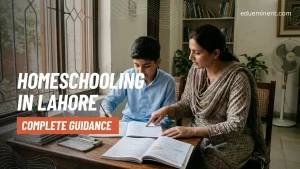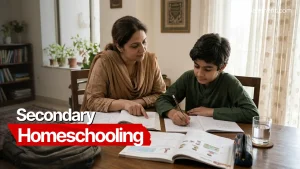
Homeschooling is a legal and flexible education option for families in Pakistan, although it is not specifically regulated by a dedicated homeschooling law. This guide explains legal considerations, curriculum choices, O Level and A Level pathways, IBCC equivalence, university admissions, benefits, challenges, and practical tips for parents.
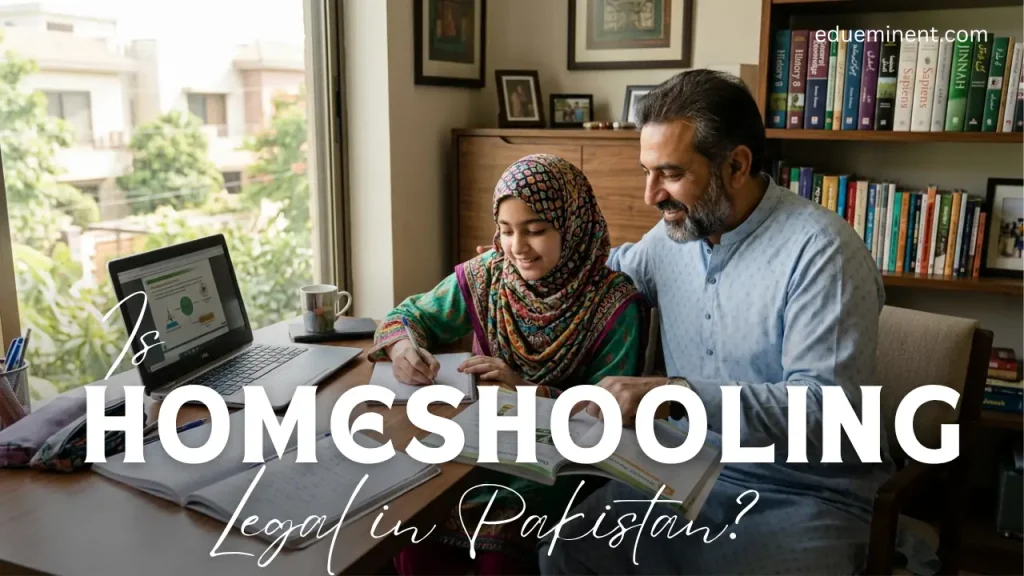
Many families across Pakistan are now asking one simple question. Is homeschooling legal in Pakistan? The short answer is yes. There is no law in Pakistan that stops parents from teaching their children at home instead of sending them to a regular school.
Homeschooling is slowly becoming a real and accepted choice for many Pakistani households, from big cities like Karachi and Lahore to smaller towns.
Some parents choose homeschooling because they are not happy with the local school system. Some choose it because their child learns better at a slower or faster pace. Others simply want more control over what their child studies every day.
Whatever the reason, it helps to understand what the law actually says, how the Constitution of Pakistan connects to education, and how homeschooled children can still get proper certificates that universities accept.
This guide explains everything in simple words. It is written so that even a student in grade six, seven, or eight can read it and understand the full picture. By the end, you will know your rights, the steps involved, and what to expect if your family decides to try homeschooling.
What Does Homeschooling Actually Mean
Homeschooling means teaching a child at home instead of sending them to a school building every day. The parent becomes the main teacher, or the family hires a private tutor, or the child studies through an online school program.
The child still learns subjects like English, Math, Science, Urdu, and Islamiyat, but the classroom is often the living room, a study corner, or even a laptop screen.
Homeschooling is not the same as being absent from school or dropping out. It is a planned and organized way of learning that follows a chosen curriculum, has lessons, assignments, and tests, just like a normal school, only without the daily commute to a building.
Think of it this way. A regular school gathers thirty or forty students into one classroom and teaches them all at the same speed. A homeschooling family builds a smaller classroom around one child, or a few siblings, and can slow down or speed up whenever it is needed.
Some days the lesson might happen at a kitchen table. Other days it might happen at a park, a museum, or in front of a computer screen during a live online class.
Around the world, homeschooling has existed for a very long time, long before public schools became common. In Pakistan, it has become more visible in the last fifteen years, partly because internet access improved, and partly because more parents started hearing success stories from other homeschooling families in their own city.
A Quick Look at How Homeschooling Started Growing in Pakistan
For many years, homeschooling in Pakistan was mostly limited to families who lived far from good schools, or to expatriate families who moved back to Pakistan from abroad and wanted to continue an international curriculum. Over time, more local families joined in for different reasons.
Some parents grew tired of overcrowded classrooms where a teacher could not give enough attention to every child. Some worried about the quality of teaching in certain schools.
Others wanted their child to focus more time on a specific talent, such as cricket, swimming, or music, without missing daily academic progress. All of these reasons pushed homeschooling from a rare choice into a growing trend that continues today across Punjab, Sindh, Khyber Pakhtunkhwa, Balochistan, and the northern areas.
Is Homeschooling Legal in Pakistan?
Yes, homeschooling is completely legal in Pakistan. There is no federal law, provincial law, or rule from the Ministry of Federal Education and Professional Training that bans parents from teaching their children at home. Pakistan simply does not have a specific homeschooling law, and that actually works in favor of families who want this option.
Because there is no law against it, and no law that specifically controls it either, parents in Pakistan are free to choose homeschooling without asking for special permission from any government office. This is very different from countries such as Germany, where homeschooling is banned, or parts of the United States, where parents must file paperwork every year.
What the Constitution of Pakistan Says About Education
The Constitution of Pakistan includes an important article about education called Article 25-A. This article was added in the year 2010 through the eighteenth amendment. It says that the state must provide free and compulsory education to every child aged five to sixteen years, in a manner decided by law.
Notice what this article actually says. It places the duty on the state to make education available. It does not say that every child must attend a government building or a private school specifically.
It does not mention homeschooling by name, but it also does not forbid it. This gap in the wording is exactly why homeschooling remains a legal and open choice for Pakistani families.
Why Pakistan Has No Separate Homeschool Law
After the eighteenth amendment, education became a subject handled mostly by the provinces rather than the federal government. This means Punjab, Sindh, Khyber Pakhtunkhwa, Balochistan, and Islamabad Capital Territory each created their own education acts to follow Article 25A.
These provincial education acts focus on setting up and running schools, not on how individual families choose to teach their own children. None of these acts specifically mention or restrict homeschooling. Because lawmakers never wrote rules about it, the practice remains unregulated, meaning it is neither officially approved with guidelines nor officially banned.
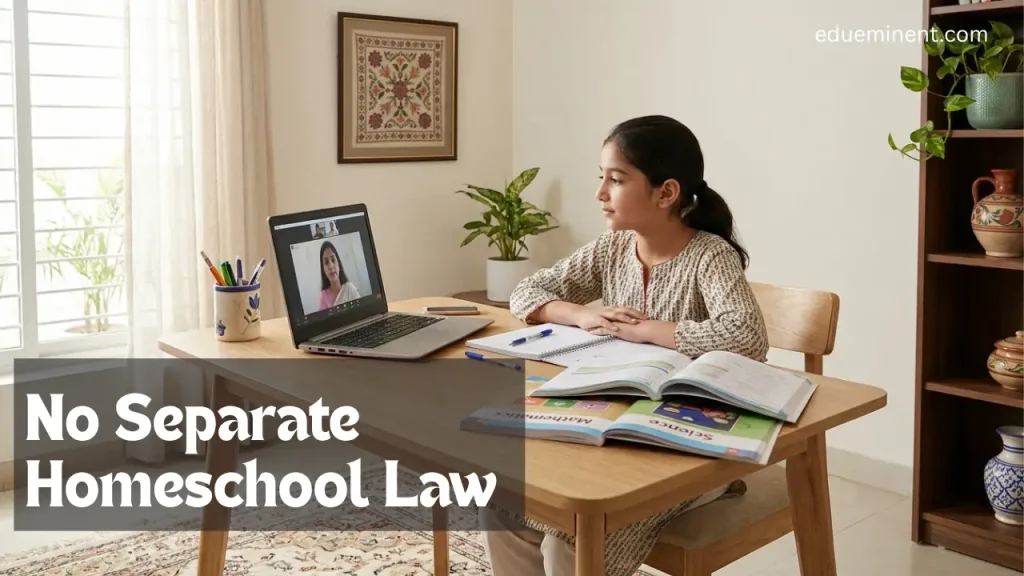
This lack of regulation is actually common in many developing countries. It usually means the government has bigger priorities, such as building more schools and improving literacy rates, and has simply not gotten around to writing specific homeschool rules yet.
It also helps to understand what these provincial acts actually try to do. They mostly focus on things like registering private schools, setting minimum standards for classrooms and teachers, and making sure children in a certain age group are enrolled somewhere.
A family teaching its own child at home simply falls outside the scope of what these acts were written to control, since the acts were built with institutions in mind, not individual households.
This is different from countries such as Germany or Sweden, where homeschooling is almost completely banned, and parents can face fines or even lose custody rights for refusing to send their child to school.
It is also different from parts of the United States, where every state has its own detailed homeschool law, sometimes requiring yearly testing, portfolio reviews, or notice letters sent to a local school district. Pakistan sits at the opposite end of that spectrum, offering almost complete freedom simply because no law has been written either way.
What Education Experts and the Media Say About Homeschooling in Pakistan
Local newspapers and education portals have started paying closer attention to this topic in recent years. Several reports describe a steady increase in the number of Pakistani families choosing homeschooling, especially in bigger cities where private tutors, online schools, and Cambridge exam centers are easier to access.
Education writers often point out the same idea repeatedly. Homeschooling is not officially regulated by the Ministry of Federal Education and Professional Training, and this absence of regulation is exactly what allows the practice to continue growing without legal obstacles.
At the same time, many experts encourage parents to treat homeschooling seriously, with real structure and real assessment, rather than treating it as an easy shortcut around school.
Do Parents Need Permission or Registration to Homeschool?
No. Parents in Pakistan do not need to register with any government department to start homeschooling. There is no application form, no inspection visit, and no yearly report required. A family can decide today to stop sending their child to school and begin teaching at home tomorrow.
This freedom also comes with responsibility. Since no government body checks on homeschooling families, parents themselves must make sure their child is actually learning enough. Nobody else will notice if lessons are skipped or if a child falls behind, so the responsibility sits fully with the parent or guardian.
How Homeschooled Students Get Official Certificates
One of the biggest questions parents ask is how a homeschooled child gets a real, recognized certificate. This matters a lot because certificates are needed for college, university, and even some jobs. Thankfully, there is a clear and well-used path for this in Pakistan.
The O Level and A Level Route
Most homeschooling families in Pakistan use the Cambridge International system, known as O Level for secondary school and A Level for higher secondary school. A child can prepare for these exams at home using books, online classes, or a tutor, and then sit for the actual exam at an approved exam center in Pakistan, such as the British Council or a registered school that allows private candidates.
The exam board does not require a student to be enrolled in a specific school. Private candidates, including homeschooled students, are welcome to register and take the papers on their own.
Getting an IBCC Equivalence Certificate
Once a student has O Level or A Level results, those grades need to be converted into the Pakistani system. This is done by an organization called the Inter Boards Coordination Commission, usually written as IBCC. This body takes Cambridge letter grades and turns them into marks similar to the local Matriculation and Intermediate system.
An IBCC equivalence certificate is required for admission to Pakistani universities, for competitive tests like MDCAT and ECAT, and for many government jobs. To apply, a student needs original certificates, detailed mark sheets, and identity documents such as a CNIC or Form B. For O Level, students usually need eight subjects including English, Urdu, Islamiyat, Pakistan Studies, and Mathematics. For A Level, at least three subjects are required.
This equivalence system means a homeschooled child is not left without options. They can still apply to LUMS, NUST, or any other Pakistani university once they complete this simple paperwork step.
How the Exam and Equivalence Process Actually Works, Step by Step
It can help to see the whole path from start to finish in simple steps, since this is often the part that confuses new homeschooling parents the most.
- The child studies subjects such as English, Mathematics, Science, Urdu, Islamiyat, and Pakistan Studies using a chosen curriculum, most often the Cambridge system.
- The parent or tutor prepares the child for exams over one or two years, using past papers, textbooks, and practice tests.
- The student registers as a private candidate at an approved exam center, such as a British Council center or a registered school in their city.
- The student sits for the actual O Level or A Level papers at the same time as regularly enrolled students.
- Once results arrive, the family applies for an IBCC equivalence certificate using original certificates, mark sheets, and an identification document.
- IBCC converts the Cambridge grades into a percentage using its official formula, where a grade of A star equals ninety marks, A equals eighty-five, B equals seventy-five, and so on down to E
- The final certificate can then be used for university admission, competitive tests such as MDCAT or ECAT, scholarships, and even certain government jobs
This whole process usually takes a few weeks once the exam results are in hand, though families are encouraged to apply early, since equivalence certificates are often needed months before a university application deadline.
Curriculum Options for Homeschooling Families in Pakistan
Parents in Pakistan have several curriculum choices when they decide to homeschool. Here are the most common ones.
- Cambridge curriculum, leading to O Level and A Level exams, which is the most popular choice among Pakistani homeschoolers
- American curriculum, which can lead to a US-style high school diploma and later the SAT for college admission abroad
- Online schools that provide full-time teachers, live classes, and grading, so parents do not have to teach every subject themselves
- Private tutors who visit the home or teach online for one or more subjects, often used alongside self-study
- A mixed approach, where parents teach younger children directly and shift to a formal online program as the child grows older
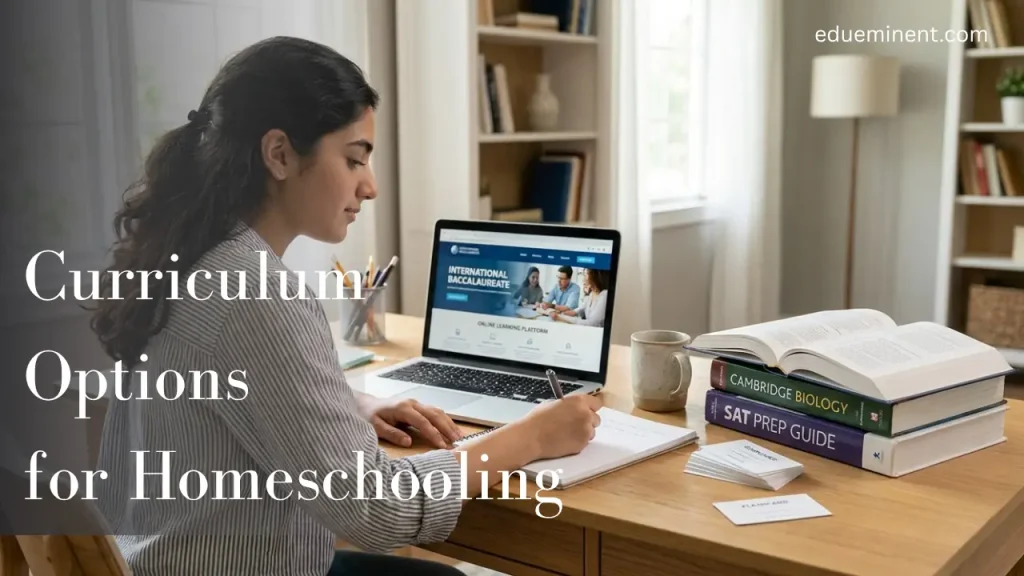
There is no single required curriculum by law, so families are free to pick whatever fits their child’s goals, whether that means staying in Pakistan for further studies or applying to universities abroad.
Benefits of Homeschooling in Pakistan
- The lessons can move at the child’s own pace instead of the pace of a whole classroom.
- Parents can add extra focus on subjects the child struggles with, such as Math or English.
- Families can include religious and cultural teaching alongside regular subjects in a way that suits them.
- There is more free time for sports, arts, or hobbies since there is no long school commute.
- Children who are athletes, performers, or have health needs can study around their schedule.
- Parents have full control over the learning environment and the values their child is exposed to daily.
Challenges and Things to Consider Before Homeschooling
Homeschooling is legal and can work very well, but it is not free of challenges. Parents should think carefully about the following points before making the decision.
- There is very little social pressure from friends, teachers, or relatives who may not fully understand this choice yet in Pakistan.
- Socialization needs planning, since a homeschooled child does not automatically meet classmates every day.
- Parents carry the full weight of choosing a curriculum, teaching, and checking progress.
- There is no official support system, counselor, or helpline from the government for homeschooling families.
- Costs can add up if the family chooses online schools, private tutors, or international exam fees.
None of these challenges make homeschooling illegal or impossible. They simply mean a family should plan, join homeschooling communities, and arrange activities like sports clubs, mosque programs, or language classes so the child still grows socially, not just academically.
Common Myths About Homeschooling in Pakistan
A lot of confusion around homeschooling comes from myths rather than facts. Clearing these up helps parents make a decision based on reality instead of rumors.
Myth: Homeschooling is illegal in Pakistan
This is false. As explained earlier, there is no law banning homeschooling anywhere in Pakistan. Families are free to choose it at any time.
Myth: A homeschooled child cannot get into a good university
This is also false. Once a student completes the IBCC equivalence process, their certificate is treated the same as any other applicant’s certificate by Pakistani universities.
Myth: Parents must be trained teachers
There is no rule requiring a parent to hold a teaching degree. Many parents successfully teach their own children using good textbooks, structured online programs, or by hiring tutors for harder subjects like Mathematics or Physics.
Myth: Homeschooled children never make friends
Socialization takes more planning in a homeschool setup, but it is far from impossible. Sports clubs, tuition centers, mosque programs, and homeschooling groups all give children regular chances to build friendships.
Is Homeschooling Right for Every Family?
Homeschooling being legal does not automatically mean it is the right choice for every household. It works best when at least one parent or guardian can commit real time to planning lessons, tracking progress, and staying organized. It also works better when the family has access to the internet, good books, and either a private tutor or an online school for subjects that are harder to teach alone, such as Chemistry or Advanced Mathematics.
On the other hand, homeschooling can be harder for families where both parents work long hours with no one available to guide daily lessons, or where there is no reliable internet connection for online classes.
In such cases, a good local school combined with strong home support after school hours might be a more practical choice. There is no single right answer here. The best approach is the one that matches a specific family’s time, resources, and the individual child’s learning style.
Homeschooling Compared to Traditional School
The table below gives a quick side-by-side look at homeschooling and regular school in Pakistan.
| Point | Homeschooling | Traditional School |
| Legal status in Pakistan | Legal; no ban exists | Legal and common |
| Government registration | Not required | School must be registered |
| Daily schedule | Flexible, set by family | Fixed school timing |
| Certificate for university | Needs IBCC equivalence for O/A Level | Board certificate issued directly |
| Social interaction | Parents must plan it separately | Built into daily school life |
| Cost | Depends on tutors or online school | Depends on school fee |
Tips for Parents Who Want to Start Homeschooling
- Decide on your main goal first, such as a local university path or a foreign university path, since this affects the curriculum you choose
- Pick a curriculum that matches that goal; for example, Cambridge O Level and A Level for most Pakistani university admissions.
- Set a daily or weekly timetable so learning stays consistent, even without a school bell.
- Keep records of every subject, test score, and project, since universities may ask for these later.
- Join a local or online homeschooling group to share ideas, resources, and social activities with other families.
- Arrange regular activities outside the home, such as sports, arts classes, or community events, to build social skills.
- Register early for O Level or A Level exams at an approved center once the child is ready.y
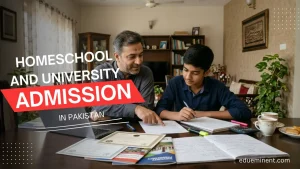
Homeschooling and University Admissions in Pakistan
Universities in Pakistan do not ask whether a student went to a traditional school or was homeschooled. What they actually ask for is a recognized certificate, such as an IBCC equivalence certificate for O Level and A Level students, or an HSSC certificate for local board students.
This means a homeschooled child stands on equal footing once they have their equivalence certificate in hand. Some students also choose to take the SAT or ACT if they plan to apply abroad, since many foreign universities are familiar with homeschool transcripts when paired with these standardized test scores. Keeping detailed academic records from an early age makes this whole process much smoother later on.
Parents should also keep a simple folder, physical or digital, that stores every report card, project sample, certificate, and test score from the very start of homeschooling. Universities sometimes ask for this kind of record during interviews or scholarship reviews, and having it ready in advance saves a lot of stress later.
Homeschooling for Athletes and Children With Special Talents
Pakistan has produced many strong athletes in sports like cricket, squash, hockey, and tennis, and quite a few of them trained intensively from a young age. A packed school timetable can sometimes clash with early morning practice sessions, travel for matches, or long training camps. Homeschooling gives these young athletes a way to keep up with academics without giving up their sport.
The same idea applies to children who are talented in music, art, chess, or other activities that require serious daily practice. A flexible homeschool schedule allows lessons to be arranged around practice time, competitions, or performances, instead of forcing a choice between academics and talent.
The Role of Technology in Modern Homeschooling
Homeschooling in Pakistan today looks very different from what it looked like twenty years ago, mainly because of the internet. Families now have access to video lessons, online quizzes, digital libraries, and live classes with qualified teachers based anywhere in the world.
Many online schools offer complete packages where a child logs in for scheduled classes, submits homework digitally, and receives grades from real teachers, similar to a normal school but without the physical building. This has made homeschooling far more manageable for busy parents who cannot personally teach every subject themselves, especially advanced subjects like Physics, Chemistry, or Computer Science.
Final Thoughts
So, is homeschooling legal in Pakistan? Yes, without any doubt. The Constitution focuses on making sure children receive an education, not on forcing every child into the same type of classroom. Because no specific law regulates homeschooling, parents in Pakistan have the freedom to teach their children at home, choose their own curriculum, and still lead their child toward a recognized certificate through the O Level, A Level, and IBCC equivalence path.
Like any big decision, homeschooling works best when parents plan, stay consistent, and make sure their child still gets enough social time with other kids. For families willing to put in that effort, homeschooling in Pakistan is not just legal; it is a genuinely workable path toward a good education.
Frequently Asked Questions
Is homeschooling legal in Pakistan in 2026?
Yes. Homeschooling remains fully legal in Pakistan. There is still no federal or provincial law that bans it, and no new law has been introduced to change this.
Do I need a teaching qualification to homeschool my child?
No. There is no legal requirement for a parent to hold any teaching degree or certificate to homeschool in Pakistan. Many families also hire tutors or enroll in online schools if they prefer trained teachers to handle lessons.
Can a homeschooled child get admission to a Pakistani university?
Yes. A homeschooled child can apply to any Pakistani university after getting an IBCC equivalence certificate for their O Level and A Level results, just like a private candidate would.
Is homeschooling recognized by the Ministry of Federal Education?
The Ministry does not officially regulate or manage homeschooling, but it also does not prohibit it. This means families are free to practice it without seeking approval from the Ministry.
What curriculum is best for homeschooling in Pakistan?
The Cambridge O Level and A Level curriculum is the most widely used, mainly because it connects smoothly to the IBCC equivalence system and is accepted by almost every Pakistani university.
How do homeschooled children make friends in Pakistan?
Parents usually arrange this through sports academies, mosque activities, art or language classes, tuition centers, and growing homeschooling communities that organize meetups for children.