Learn how to start homeschooling for Grades 6–8 with a practical step-by-step approach. This guide covers legal requirements, homeschooling methods, curriculum selection, weekly schedules, learning spaces, socialisation, record-keeping, common challenges, and strategies to help parents create a flexible and effective middle-school education.
Deciding to homeschool a sixth, seventh, or eighth grader is a different experience than starting with a kindergartner. Your child already has opinions about learning, a sense of what school should feel like, and possibly some strong feelings about leaving a familiar classroom behind.
If you are wondering how to start homeschooling for grades 6 to 8, you are not alone. Thousands of families make this switch every year, often right in the middle of a school term, and most of them figure it out step by step rather than having everything planned from day one.
This guide breaks the process into clear stages you can follow in order: understanding your legal requirements, choosing a teaching approach, picking curriculum for middle school subjects, building a schedule that fits a busy tween, and setting up systems for records, socialization, and support. By the end, you will have a practical roadmap instead of a long list of things to worry about.
You do not need a degree in education or years of preparation to start. Most homeschooling parents learn the process one decision at a time, and the middle school years are actually a forgiving place to begin, since your child is old enough to help plan and communicate what is working.
Students exploring international education can choose from several recognised pathways, including Cambridge O Level, A Level, and IGCSE. The O Level provides a broad academic foundation, while A Level allows students to specialise in subjects related to their future university and career goals.
IGCSE offers another internationally recognised secondary qualification, with a curriculum designed to develop knowledge, understanding, and practical skills.
The International Baccalaureate (IB) is another popular option for students seeking a broad and internationally focused education. Unlike traditional subject-based pathways, the IB encourages independent learning, critical thinking, research, and a wider understanding of different subjects and perspectives. Students can choose the pathway that best matches their learning style, academic interests, and future plans.
When comparing O Level vs IGCSE, both qualifications are internationally recognised and share many similarities, but their subject structures, assessment approaches, and curriculum details can differ depending on the exam board and subjects selected.
Understanding these differences, along with the options offered by A Level and International Baccalaureate (IB), can help parents and students make a more informed decision about their academic pathway.
Why Families Choose to Homeschool During Middle School
Middle school is one of the most common times for families to switch to homeschooling, and the reasons tend to repeat themselves across very different households. Some parents notice their child losing confidence in a subject that used to feel easy.
Others are responding to bullying, social pressure, or a classroom environment that no longer fits their child’s needs. Many simply want more flexibility, more family time, or an education built around their child’s actual pace instead of a fixed calendar.
Common reasons parents give for starting homeschooling in grades 6 to 8 include:
- Wanting a curriculum that moves faster or slower depending on the subject
- Addressing anxiety, bullying, or social struggles at school
- Supporting a child with a learning difference who needs individual attention
- Making room for sports, arts, or other serious commitments
- Aligning education with family values or religious beliefs
- Wanting more family time before the demands of high school arrive
- Concerns about screen policies, testing pressure, or classroom size
Whatever your reason, it helps to name it clearly before you start planning, because your goal will shape almost every decision that follows, from the method you choose to how you spend your afternoons.
Step 1: Learn Your State’s Homeschool Laws and Requirements
Homeschooling rules in the United States are set at the state level, and they vary quite a bit from one place to another. Some states ask for very little, perhaps a simple notice that you are homeschooling.
Others require a formal notice of intent, a set number of instructional days or hours, specific subjects to be covered, or periodic assessments to show your child is progressing.
Before you buy a single workbook, spend an afternoon reading your state’s actual requirements on your state Department of Education website, or reach out to a national homeschool advocacy organization for a plain language summary.
Local homeschool groups on social media are also a good source, since parents in your area have already handled the paperwork and can tell you exactly what forms to file and when.
If your child is currently enrolled in public or private school, ask whether your district requires a formal withdrawal letter, since some states link this step directly to your notice of intent.
If you live outside the United States, homeschooling laws differ even more widely by country and sometimes by region, so this step matters just as much, if not more. Write down the specific requirements for your family in one place. You will refer back to this list more than once, especially in your first year.
Step 2: Get Clear on Why You Are Homeschooling
It sounds simple, but writing down your reason for homeschooling gives you something to return to on the hard days, and middle school will have hard days. Are you homeschooling to slow down and rebuild confidence after a rough school year?
To speed up and challenge a child who was bored? To free up time for travel, sports, or a family business? To teach from a particular worldview or set of values?
Some families write a short family mission statement, just two or three sentences describing what they want this season of education to look and feel like. Your answer does not need to be permanent. Many families revisit and adjust their reason every year.
What matters is that you and your child both understand, in simple terms, what this year of homeschooling is trying to accomplish. That clarity will guide your curriculum choices, your schedule, and how you measure success, long before you fill out a single lesson plan.
How to Talk to Your Child About the Switch
A sixth, seventh, or eighth grader is old enough to have real opinions about this change, and including them in the conversation early tends to make the transition smoother. Explain your reasons honestly, in age-appropriate terms, and be upfront about what will change and what will stay the same, such as continued contact with current friends.
Expect a mix of reactions. Some middle schoolers are relieved to leave a difficult social situation behind, while others feel anxious about losing routine or peer contact.
Give your child a chance to ask questions and, where reasonable, some say, be involved in early decisions, like which elective to try first or how the learning space will be set up. That small amount of ownership often reduces resistance once formal lessons begin.
Step 3: Let Your Child Deschool if They Are Coming From Traditional School
If your sixth, seventh, or eighth grader is switching from public or private school, resist the urge to start formal lessons on day one. Many experienced homeschooling families recommend a period of deschooling, often estimated at roughly one month for every year your child spent in a traditional classroom, though every family adjusts this to fit their own situation.
During this time, step back from grades, worksheets, and strict schedules. Read together, visit museums, cook, build things, or simply let your child rest and reset their relationship with learning.
Middle schoolers who spent years chasing grades often need this pause more than younger kids do, since they have learned to measure their worth by test scores and report cards. A seventh grader who spends three weeks reading for pleasure, exploring a hobby, and sleeping on a more relaxed schedule often walks into formal academics with far more energy than one who jumps straight from a school desk to a homeschool desk.
Deschooling gives your child room to remember that learning can be interesting on its own, which makes the shift into homeschool academics much smoother once you begin.
Step 4: Choose a Homeschooling Method That Fits Your Family
There is no single correct way to homeschool, and middle school is actually a great age to experiment, since your child can tell you clearly what is and is not working. A few common approaches include the following.
- Traditional or school at home: workbooks and textbooks that closely mirror a classroom sequence, good for families who want structure and a clear scope of what to cover.
- Classical education: a literature-heavy, discussion-based approach organized around history and foundational texts.
- Unit studies: one topic, such as ancient Egypt or the solar system, taught across several subjects at once.
- Online or virtual academy: a structured program with video lessons, digital assignments, and sometimes live teachers, which suits kids who want more independence.
- Unschooling or interest-led learning: following the child’s curiosity with minimal formal structure.
- Eclectic homeschooling: mixing pieces of several methods, which is what most experienced families end up doing after their first year or two.
For grades 6 to 8, methods that build independence tend to work well, since this age group is developmentally ready to manage more of their own workload with guidance rather than constant supervision.
Do not be afraid to try one approach for a semester and switch if it is not clicking. Most homeschooling families describe their method changing gradually as they learn what their child actually needs.
Step 5: Pick Curriculum for Core Middle School Subjects
Curriculum choice can feel overwhelming, so it helps to focus on covering the essentials well rather than buying every resource that looks appealing. The table below outlines what most middle school scope and sequence guides expect in each core subject.
| Subject | Grade 6 Focus | Grade 7 Focus | Grade 8 Focus |
| Math | Ratios, fractions, decimals | Pre-algebra concepts | Formal algebra 1 |
| Language Arts | Paragraph writing, grammar review | Essay structure, vocabulary | Literary analysis, research writing |
| Science | Life science | Earth and space science | Physical science |
| Social Studies | World geography | World history | Civics and government |
Math: Keep an eye out for gaps in fraction and decimal skills specifically, since these carry into every later math course, including algebra. If your child struggled with math in a traditional classroom, this is a common place where a fresh curriculum and one-on-one pacing make a real difference.
Language arts: This includes reading comprehension, grammar, vocabulary, and regular writing practice. Middle schoolers should be writing paragraphs and short essays consistently, not just filling out isolated grammar worksheets.
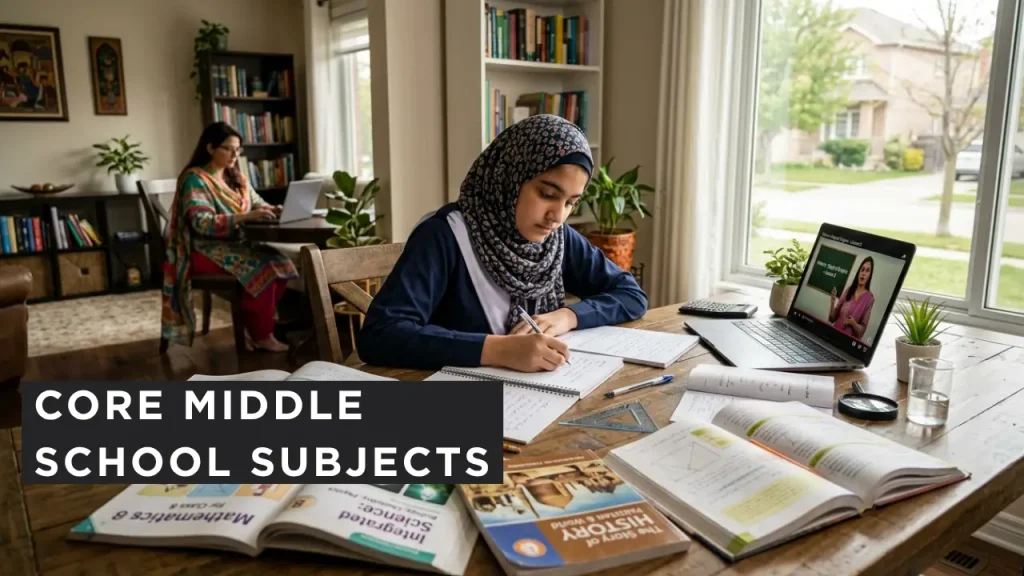
Science: Many families rotate through life science, earth science, and physical science across the three middle school years, with hands-on experiments to keep the material concrete rather than purely textbook-based.
Social studies: World history, geography, and an introduction to civics are common choices, often paired with primary source documents, maps, or historical fiction to make the material stick.
Electives: This is where middle school gets fun. Foreign language, coding, art, music, and practical life skills like budgeting or basic cooking all fit well here and give your child room to explore interests outside the core subjects.
A simple starting method many new homeschoolers use is picking one solid, complete resource for math, one for language arts, and then letting one subject be entirely interest-led. This keeps the essentials covered without overwhelming your first year, and you can always add structure to science and social studies once your family finds its footing.
Step 6: Build a Weekly Schedule That Actually Works
One of the biggest surprises for new homeschooling parents is how much less time schoolwork actually takes at home. A traditional school day runs six to eight hours partly because of transitions, group management, and instructions repeated to a whole classroom.
One-on-one or small-group instruction is far more efficient, and most middle schoolers can complete a full day of focused academic work in three to five hours.
Block scheduling, where each subject gets a dedicated chunk of time, works well for this age group because it mirrors the class period structure they may already be familiar with.
Build in short breaks, ideally fifteen minutes every ninety minutes or so, and protect time for independent reading, since middle schoolers benefit enormously from sustained, uninterrupted reading practice.
A sample weekly outline for a seventh grader might look like this:
| Time Block | Monday | Wednesday | Friday |
| 8:30 to 9:15 | Math | Math | Math |
| 9:15 to 9:30 | Break | Break | Break |
| 9:30 to 10:15 | Language Arts | Language Arts | Independent Reading |
| 10:15 to 11:00 | Science | History | Elective / Project |
| 11:00 to 11:45 | Elective (foreign language) | Elective (art or coding) | Field Trip or Co op |
Your schedule does not need to match a traditional school calendar either. Some families school four days a week and use the fifth for field trips or catch up work. Others spread lighter subjects across the whole week and tackle math and writing daily.
Test a schedule for two or three weeks, then adjust based on what you actually observe rather than sticking rigidly to a plan that clearly is not working.
Step 7: Set Up a Learning Space and Basic Supplies
You do not need a dedicated classroom to homeschool successfully, but a consistent, organized space helps middle schoolers focus and take their work seriously. A kitchen table, a corner of a shared room, or a small desk in a bedroom all work, as long as it has good lighting and minimal distractions during school hours.
Basic supplies for grades 6 to 8 typically include a reliable computer or tablet for online lessons and research, a printer for worksheets and projects, storage for books and materials, a planner or wall calendar your child can see and use themselves, and headphones if multiple children are working near each other.
Keep supplies within your child’s reach so they can gather what they need without asking you for every pencil and notebook. This small step builds the independence that middle schoolers are ready to practice, and it does not require a large budget to set up.
Step 8: Plan for Socialization and Extracurricular Activities
Socialization is one of the most common concerns new homeschooling parents hear about, and it is worth planning for directly rather than hoping it works itself out.
The good news is that most areas have active homeschool communities offering co-ops, park days, field trips, and classes built specifically for homeschooled students.

Look into local homeschool co-ops, where families take turns teaching classes or hire outside instructors for subjects like science labs or foreign language.
Many community sports leagues, scouting programs, and community centers welcome homeschoolers, and some states allow homeschooled students to join public school sports teams, band, or clubs under specific eligibility rules, sometimes called equal access policies.
Volunteering, supervised part-time work for older middle schoolers, and community classes at libraries or recreation centers all add regular social contact outside the home.
Rather than trying to replace every part of a traditional school social calendar, focus on quality connections. A few close friendships and regular group activities usually matter more to a middle schooler than being surrounded by dozens of peers all day.
Step 9: Keep Records and Track Progress
Even in states with light reporting requirements, it pays to build good record-keeping habits starting in middle school, since these years lay the groundwork for a future high school transcript.
Keep a simple log of subjects covered, books read, and major projects completed each year. Save samples of writing, tests, or creative work in a portfolio, either physical or digital, so you have evidence of progress over time.
If your state requires standardized testing or a periodic evaluation, mark those dates on your calendar early in the year so you are not scrambling to schedule them later. Beyond legal requirements, regular check-ins, whether weekly or monthly, help you notice when a subject needs more attention before your child falls seriously behind.
Grades are optional for many homeschoolers at this stage, but even an informal system for tracking mastery of key skills will make the eventual move into a formal high school transcript far less stressful.
Eighth grade in particular is a good time to start thinking ahead. Some states allow certain eighth grade courses, most often algebra or a foreign language, to count toward high school credit if properly documented. You do not need a full transcript system yet, but keeping clean, dated records from this point forward will save you a considerable amount of work later.
Common Challenges When Homeschooling Grades 6 to 8, and How to Handle Them
Every family runs into bumps during the first year of homeschooling a middle schooler. Knowing what is common ahead of time makes these moments easier to handle.
- Motivation dips: middle schoolers can lose steam partway through a project or semester. Short-term goals, small rewards, and variety in how a subject is taught can help reignite interest. Rotating between independent work, discussion, and hands-on projects within the same week often keeps a subject from feeling stale.
- Mood swings and pushback: the middle school years bring real hormonal and emotional changes, and homeschooling does not remove that. Expect some friction, and try to separate your child’s frustration from actual academic struggle. A short break, a change of location, or simply finishing a lesson later in the day can defuse a lot of tension.
- Subjects you cannot teach confidently: nobody is an expert in every subject, especially as math and science get more advanced. Online courses, tutors, co op classes, and community college dual enrollment for older middle schoolers are all reasonable solutions. Outsourcing one difficult subject does not mean you are homeschooling incorrectly.
- Juggling multiple children at different levels: combine subjects like history, science, or read-aloud time across grade levels where possible, and let older middle schoolers work independently while you focus one-on-one time with younger siblings. A shared timer or checklist system can help everyone stay on track without you supervising every minute.
- Screen time and technology distractions: middle schoolers often need devices for schoolwork, which makes limiting distraction harder. Clear expectations, monitoring tools, and designated offline blocks help keep this balanced, and involving your child in setting the rules tends to improve follow-through.
- Comparing your homeschool to others: it is easy to compare your family’s pace or curriculum choices to another homeschooling family online. Remember that every family’s goals and circumstances are different, and a method that works beautifully for one household may not fit yours at all.
- Parent burnout: homeschooling is a long-term commitment, and taking breaks, joining a support group, and lowering expectations on hard weeks all matter more than pushing through exhaustion.
Conclusion
Starting homeschooling for grades 6 to 8 is a genuine adjustment, both for your child and for you, but it is far more manageable when broken into clear steps.
Learn your legal requirements first, get clear on your reason for homeschooling, give your child room to deschool if needed, and then build outward from there through method, curriculum, schedule, space, social life, and records.
You do not need to have every year planned before you begin. Most homeschooling families learn as they go, adjust their approach each semester, and figure out what works through trial and error rather than a perfect plan on day one.
Give yourself the same grace you are giving your child during this transition, and take the first step today by checking your state’s homeschool requirements and connecting with a local homeschool group in your area.
Frequently Asked Questions About Starting Homeschooling in Grades 6 to 8
Is homeschooling legal in my state or country?
Homeschooling is legal throughout the United States, though the specific rules differ by state, ranging from a simple notice to more detailed reporting requirements. Outside the United States, legality varies significantly, so check your local Department of Education or equivalent authority before you begin.
Do I need to be a certified teacher to homeschool my middle schooler?
In most states, no formal teaching certification is required to homeschool. What matters more is your willingness to research curriculum, seek outside help for subjects you find difficult, and stay involved in your child’s progress.
How many hours a day should a sixth to eighth grader spend on schoolwork?
Most middle schoolers complete a full day of focused academic work in three to five hours, thanks to the efficiency of one-on-one instruction. The exact number depends on your curriculum, your child’s pace, and how many electives or extracurriculars you add.
How do I know if my child is on grade level?
Many curriculum publishers include placement tests you can use at the start of the year. Standardized assessments, if required or chosen voluntarily, also give a general benchmark, though day-to-day observation of your child’s reading, writing, and math work often tells you more.
Can my homeschooled child still play school sports or join clubs?
In many states, homeschooled students can participate in public school sports, band, or clubs under specific eligibility rules, sometimes called equal access laws. Check with your local school district and state homeschool association for the current policy in your area.
What if my child struggles with a subject like math or writing?
This is extremely common in middle school, homeschooled or not. Consider switching curriculum approaches, hiring a tutor for a few months, joining a co op class, or using an online program built for struggling learners. Catching a gap early is far easier than waiting until high school.
How much does homeschooling cost?
Costs vary enormously depending on your curriculum choices. Some families spend very little using free online resources and library books, while others invest in full curricula, online academies, or co op tuition. Set a budget before you shop and prioritize your core subjects first.
Can I switch back to traditional school later if homeschooling does not work out?
Yes. Most families can re-enroll a child in public school at any point, though some districts may request records, placement tests, or a brief transition meeting. Keeping the records described in step nine makes this process much smoother if you ever need it.