
This guide explains how many hours a day students in grades 6–8 typically spend homeschooling. It covers focused academic time, subject schedules, state requirements, breaks, extracurricular activities, tracking methods, and practical signs that a homeschool schedule may be too long or too short.
New homeschooling parents almost always ask the same question first. How many hours a day does this actually take? It is a fair question, especially when the only reference point most parents have is a six- or seven-hour traditional school day.
The honest answer for grades 6 to 8 is that most homeschooling families spend somewhere between three and five hours a day on focused academic work. That number surprises a lot of parents, since it is roughly half of a typical school day, but it makes sense once you understand why homeschooling takes less time to cover the same material.
This guide walks through exactly what those hours look like for a sixth, seventh, or eighth grader, how state requirements factor in, sample daily schedules you can copy, and the signs that tell you whether your current schedule is working or needs to change.
If you are coming from a traditional school background, as most homeschooling parents are, it can feel almost wrong that three or four hours could possibly cover the same ground as a full school day.
Many students go for O Level because it gives them a good base before moving on to higher studies. The IGCSE is also a common choice, especially for students who prefer a more flexible way of studying.
The Cambridge O Level is widely chosen by students who want an internationally recognised qualification. CAIE offers a range of subjects, so students can usually pick subjects that match their interests and future study plans.
That instinct is understandable, but it is based on comparing the wrong things. A school day includes far more than instruction, and once you separate actual teaching time from everything else built into a six or seven-hour school schedule, the math starts to make a lot more sense.
The Short Answer for Grades 6 to 8
For middle school age students, most homeschooling families land on three to five hours of focused instruction a day, five days a week. Some families run closer to three hours with a highly efficient, one-on-one approach. Others run closer to five or six hours if they include more independent reading, project work, or a heavier course load.
This range holds up across most homeschooling styles, whether a family follows a boxed curriculum, an online public school academy, or a more relaxed, interest-led approach.
The total time tends to grow slightly as a child moves from sixth grade toward eighth grade, since the material gets harder and the workload increases with pre-algebra, advanced writing, and lab-based work.
It is worth repeating that this is instructional time, not total time out of the day. A homeschooled middle schooler is not doing five straight hours without a break, any more than a traditional school student is in constant instruction for seven hours straight. Breaks, lunch, and transition time are part of the picture in both settings.
It also helps to separate two different questions that often get blended. One is how many hours a state requires you to document. The other is how many hours your specific child actually needs to master sixth, seventh, or eighth grade material.
Those two numbers can be different, and a responsible homeschooling schedule pays attention to both rather than treating the legal minimum as an automatic answer to the educational question.
Why Homeschooling Takes Less Time Than a Traditional School Day
The gap between three to five hours at home and six to seven hours at school is not a trick or a shortcut. It comes down to what actually eats up time in a traditional classroom.
A public or private school day includes time spent taking attendance, walking between classrooms, waiting for twenty-five or thirty classmates to settle down, repeating instructions for students who were not listening, and managing behavior issues that have nothing to do with the lesson itself. None of that instructional overhead exists in a one-on-one or small-group homeschool setting.
A homeschooling parent working directly with one or two children can move through a math lesson in fifteen minutes that might take a classroom teacher forty-five minutes to deliver to a full class, simply because there is no need to check that every student understood the same explanation at the same pace. This is the core reason homeschool hour totals run so much lower than a school day, even when the actual content covered is the same or greater.
There is also a difference in how attention works across the two settings. A traditional classroom teacher has to plan a lesson that works reasonably well for the middle of the class, which means some students are mildly bored while others are quietly struggling, for a portion of nearly every lesson. A homeschooling parent teaching one child does not need to split attention that way.
The lesson can move at exactly the pace that one student needs, which removes a huge amount of wasted time on both ends of the spectrum, for the fast learner waiting around and the struggling learner falling further behind.
None of this means traditional school is doing something wrong. A classroom teacher managing twenty-five or thirty students is solving a fundamentally different problem than a parent teaching one or two children, and the time totals reflect that difference rather than reflecting one approach being lazy or the other being excessive.
What a Typical Homeschool Hour Count Looks Like by Subject
Breaking the day down by subject helps make the total hour count feel less abstract. A common structure for a sixth- to eighth-grade homeschool day might include math for forty-five minutes to an hour, language arts or reading for forty-five minutes to an hour, science for thirty to forty-five minutes, social studies or history for thirty to forty-five minutes, and a rotating elective like a foreign language, coding, or art for thirty minutes.

Added together, that lands squarely in the three- to four-hour range for core academics, before extracurricular time or independent reading is added on top. Many families also count independent reading, journaling, or a hands-on project as part of the total learning time, even though it does not always feel like formal instruction.
Older middle schoolers in seventh and eighth grade often push toward the higher end of the range, closer to four or five hours, as they take on algebra one, more structured essay writing, and lab-based science units that need more setup and follow-through than earlier grades.
It is worth noting that these subject-by-subject numbers are a starting framework, not a rigid formula. Some days a science experiment runs long because a child gets genuinely interested and wants to keep exploring a question, and that extra time is usually well spent even though it pushes the day past the planned total.
Other days a math lesson wraps up in half the expected time because a concept clicks quickly. Treating the hour count as a flexible guide rather than a strict quota tends to work better than watching the clock too closely.
State Requirements and Legal Hour Minimums
Homeschool hour requirements are set at the state level, not nationally, and they vary a great deal. Some states set an annual total, often somewhere between 180 and 900 hours per year, while others set no formal hour requirement at all and simply expect instruction to occur.
A small number of states break requirements down by grade band, sometimes requiring slightly more daily hours once a student reaches seventh grade. Other states only ask for a general assurance that a child is receiving regular instruction, without specifying an exact number of hours or days.
Because these rules differ so much by location, it is worth checking your own state’s homeschool law before settling on a fixed daily schedule. Meeting your state’s legal minimum and giving your child a genuinely solid education are related but not identical goals.
A schedule can meet the legal hour requirement and still fall short academically, or comfortably exceed the requirement while still feeling manageable for your family.
A few states also require a specific number of instructional days each year, rather than or in addition to a total hour count, often somewhere close to the 180-day school year used by public schools.
Other states require periodic assessments, a portfolio review, or standardized testing at certain grade levels rather than tracking hours at all. Because homeschool law can also change from year to year, it is worth checking your state’s current requirements directly through your state department of education rather than relying only on secondhand summaries, even accurate ones like this guide.
Sample Daily Schedules for Grades 6 to 8
Seeing an example schedule often makes the hour question click faster than any explanation. Here is one common structure for a middle schooler working roughly four hours a day.
Morning block, structured subjects:
- Math lesson and practice problems, fifty minutes
- Language arts, reading and writing combined, fifty minutes
- Short break, fifteen minutes
- Science lesson or experiment, forty minutes
Afternoon block, lighter subjects and independent work:
- Social studies or history, thirty-five minutes
- Elective subject, such as a foreign language or art, thirty minutes
- Independent reading or project work, thirty minutes
A family running a leaner three-hour day might trim the elective time and shorten each core subject block by ten minutes, while a family running closer to five hours might add a second science or writing block, or extend independent project time for a specific interest like a science fair project or a research paper.
The exact order and length of each block matters far less than making sure the child is alert and focused during the harder subjects. Many families put math first thing in the morning, when attention is freshest, and save lighter subjects like art or independent reading for the afternoon.
It also helps to build in a small amount of buffer time rather than scheduling every minute back to back. A day planned down to the exact minute tends to fall apart the moment one lesson runs a little long, which then creates stress trying to catch up for the rest of the afternoon.
Leaving ten or fifteen minutes of slack somewhere in the middle of the day gives a schedule room to absorb the normal unpredictability of teaching a real child rather than a hypothetical one on a spreadsheet.
Factors That Change How Many Hours You Need
The three- to five-hour range is a starting point, not a fixed rule, and several factors can shift it in either direction for a specific child.
A student who needs more repetition to master a concept will naturally need more time in that subject, while a student who grasps material quickly may finish the same lesson in a fraction of the time.
Twins or siblings homeschooled together sometimes need slightly different schedules even at the same grade level, simply because they learn at different speeds.
The curriculum style matters too. A fully scripted, textbook-heavy curriculum tends to take longer to work through than a project-based or online video style program, since project-based learning often blends subjects together and counts activity time differently than a traditional worksheet-based lesson.
Outside commitments also play a role. A middle schooler training seriously for a sport, taking music lessons multiple times a week, or working through an intensive tutoring program outside the home may need a tighter, more efficient academic schedule to leave room for those other demands.
Family structure matters as well. A parent homeschooling three or four children of different ages at once will naturally structure the day differently than a parent working with a single middle schooler, often by grouping subjects like history or science together across age groups and handling math and reading separately at each child’s own level.
That kind of multi-child schedule can genuinely change the hour count for each individual student, usually in a way that adds some efficiency through shared lessons while still preserving individual attention where it matters most.
Signs You Are Doing Too Much or Too Little
It helps to have a few practical signs to check rather than chasing an exact number of hours.
Signs that a schedule is running too long include a middle schooler who seems constantly tired, frustrated, or resistant to starting schoolwork, frequent meltdowns partway through the day, or a family where academics regularly eat into evening hours because the daytime schedule keeps slipping.
Signs that a schedule may be too short include a child who consistently finishes assigned work in under two hours with clear gaps in understanding, standardized test scores that trend below grade level despite the child appearing capable, or a parent who feels uneasy that core subjects are being rushed just to get through the day.
The goal is not to hit a specific number on a clock. The goal is a schedule where your child is genuinely learning the material, without the day dragging on so long that it damages their motivation or your family’s overall quality of life.
How to Track Homeschool Hours
Many states require some form of record-keeping, even if they do not require a specific number of hours, so it helps to build a simple tracking habit from the start.
A basic log can be as simple as a spreadsheet or notebook page with the date, subjects covered, and rough time spent on each one. Some families use a dedicated homeschool planner app that timestamps each subject automatically, which removes the guesswork at the end of the week or year.
Keeping a running log also makes it far easier to notice patterns, like a subject that consistently takes longer than planned, or a day of the week where focus reliably drops. That kind of pattern recognition is difficult to catch in the moment but obvious once it is written down over a few weeks.
Some families also find it useful to log a short note about how the child seemed during each subject, not just how long it took. A quick word like focused, distracted, or frustrated next to a subject and a time stamp turns a simple hour log into something closer to a diagnostic tool.
Over a month, that kind of record can reveal that a child struggles most with a subject scheduled right after lunch, or that a certain day of the week consistently runs rougher than the rest, information that a bare list of hours alone would not show.
Building in Breaks, Extracurriculars, and Downtime
The three- to five-hour instructional window does not include everything a middle schooler does during the day, and it should not.
Short breaks between subjects, roughly ten to fifteen minutes every hour or so, help maintain focus far better than pushing straight through multiple subjects back to back. A longer midday break for lunch and physical activity also matters, especially for a tween who has been sitting and concentrating for a couple of hours already.
Extracurricular activities, whether sports, music, co op classes, or volunteer work, sit outside the core academic hour count but are still an important part of a well-rounded middle school experience.
Many families find that homeschooling actually frees up more time for these activities compared to traditional school, since a four-hour academic day finishing by early afternoon leaves a wider window for practices, lessons, or a part-time interest.
Downtime deserves a specific mention here too, since it is easy to fill every open hour of a shorter academic day with more structured activity and end up with a middle schooler who is just as scheduled as a traditional school student, only spread across a different set of activities.
Unstructured time, whether that means free reading, outdoor play, or simply time with no assigned task at all, plays a real role in how tweens process what they have learned and manage the normal stress of growing up.
A homeschool schedule that leaves genuine breathing room tends to hold up better over a full school year than one that is optimized down to the last available minute.
What Happens as Kids Move Toward High School
The hour count for grades 6 to 8 is meant to be a bridge, not a permanent number. As students move into high school, most homeschooling families gradually increase daily academic time toward four to six hours, to match the increased credit requirements and workload of a college preparatory course of study.
Building solid, focused habits during middle school makes that jump easier. A seventh or eighth grader who is used to sitting down, working through a subject with real focus for forty-five minutes, and moving on to the next task has already built the stamina that high school-level work requires.
That habit matters more in the long run than the exact number of hours logged in any single middle school year.
Many families use eighth grade specifically as a bridge year, gradually stretching the daily academic window by adding fifteen or twenty extra minutes every month or two, so the jump into a high school schedule feels gradual rather than sudden.
A student who moves from four hours a day in early eighth grade to four and a half or five hours by the end of the year is far better prepared for a five- or six-hour high school schedule than a student who jumps straight from four hours to six with no transition period at all.
Common Mistakes New Homeschool Parents Make With Scheduling
A few scheduling mistakes come up again and again with families new to homeschooling in the middle school years.
The most common mistake is trying to replicate a full six- or seven-hour school day at home, right down to a rigid bell schedule. This usually backfires, since it ignores the efficiency gained from one-on-one instruction and often leads to burnout for both the parent and the child within the first few weeks.
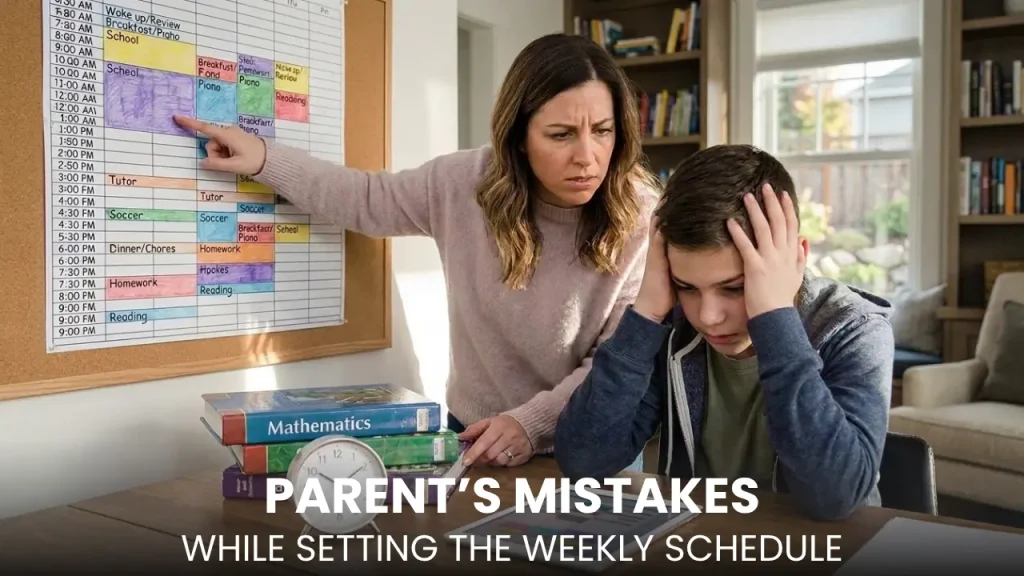
Another common mistake is underestimating how much time independent work actually takes for a child who is new to homeschooling. A student coming straight from a traditional classroom may need extra time at first to build independent work habits, even if the curriculum itself is not especially difficult.
A third mistake is ignoring state requirements entirely, either by assuming there are none or by assuming every state requires the same thing. Taking twenty minutes to actually read your state’s specific homeschool law early on avoids problems later, especially if a family ever needs to document hours for a school transfer or a legal review.
A fourth mistake worth naming is comparing your family’s schedule too closely to another homeschooling family’s schedule found online or in a parent group.
Two households can be doing an equally good job while running very different daily hour totals, since the right number depends on the specific child, the curriculum, and the family’s other commitments. Treating another family’s four-hour day as a rule your own three-hour day is failing to meet usually causes more stress than it solves.
Final Thoughts
There is no single correct number of hours for every homeschooled sixth, seventh, or eighth grader. What the research and experienced homeschool families consistently point to is a general range of three to five hours a day of focused academic work, adjusted up or down based on your child’s pace, your state’s requirements, and the curriculum you choose.
The best schedule is the one your family can actually sustain week after week, one that leaves your middle schooler genuinely learning the material without burning out either of you by dinner time.
Start with a reasonable estimate in that three to five hour range, track how the weeks actually go, and adjust from there rather than trying to get the number perfect on day one.
Frequently Asked Questions
Homeschooling is a form of education where parents or guardians teach their children at home instead of sending them to a traditional school. Families can follow a structured curriculum, use online resources, or create a learning routine based on the child’s needs and interests.
How many hours a day should I homeschool a 6th grader?
Most families spend around three to four hours a day on focused academic work with a sixth grader, slightly less than the four to five hours common for seventh and eighth grade as material gets more advanced.
Is homeschooling for fewer hours actually enough education?
Yes, in most cases. Homeschooling is typically far more efficient per hour than a traditional classroom, since there is no time lost to transitions, waiting for other students, or classroom management, so fewer total hours can still cover the same material.
Do all states require a specific number of homeschool hours?
No. Some states set an annual hour total, often between 180 and 900 hours, while others have no formal hour requirement and simply expect regular instruction to take place.
What happens if my homeschool day runs longer than five hours regularly?
It is worth reviewing the schedule. A consistently long day may mean the curriculum is a poor fit, the pacing needs adjusting, or there are too many breaks and distractions interrupting focused work time.
Should extracurricular activities count toward homeschool hours?
Some states allow certain activities like music lessons or organized sports to count toward total instructional hours, while others only count core academic subjects. Check your specific state’s homeschool law for the exact rule.
Does the number of homeschool hours change based on the curriculum I use?
Yes. A fully scripted, textbook-based curriculum often takes longer to complete than an online, video-based, project-based program, since the formats organize and count time differently.