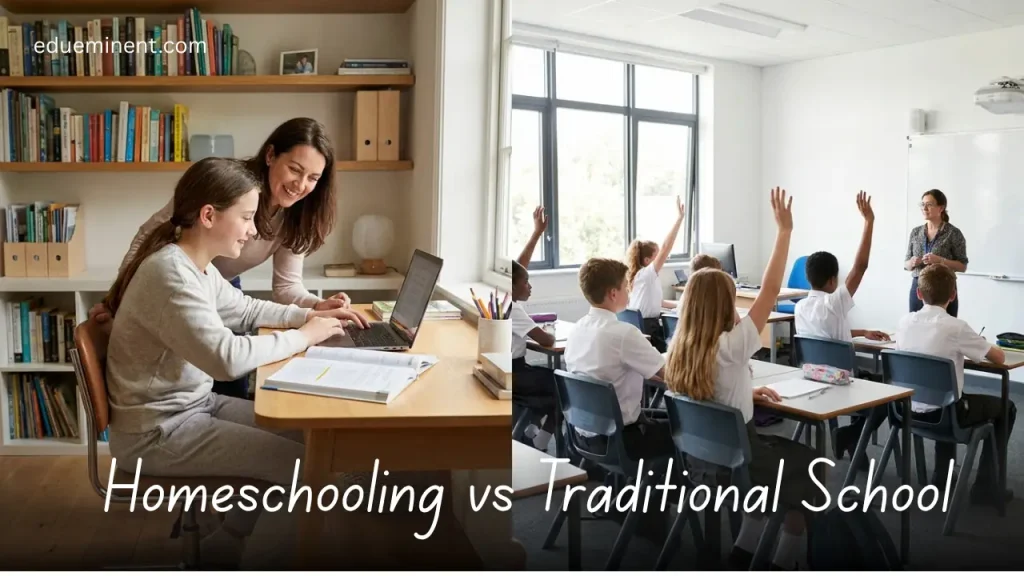
This guide compares homeschooling vs traditional school for students in grades 6 to 8. It explores academics, social development, flexibility, costs, extracurricular activities, teacher support, and high school preparation to help parents choose the learning environment that best matches their child’s needs.
Choosing between homeschooling and traditional school feels like a much bigger decision once a child reaches sixth grade. The subjects get harder, friendships shift, and kids start thinking about who they want to become.
Parents want to make the right call, but most articles compare the two options in general terms, without focusing on what matters for a sixth- to eighth-grader.
This guide breaks down homeschooling vs traditional school specifically for the middle school years. You will see how academics, social life, schedules, cost, and long-term outcomes compare, so you can choose what fits your child rather than a generic checklist.
Grades 6 to 8 are a strange in-between stage. Kids are old enough to handle real responsibility, but young enough that the wrong environment can knock their confidence for years.
That is exactly why this decision deserves more than a quick pros-and-cons list copied from a general parenting site. It deserves a close look at what actually happens day to day in each setting, at this specific age.
Choosing the right education pathway can make a big difference in how students approach their studies and future goals. An O Level program gives students a strong academic foundation while helping them develop independent learning and problem-solving skills.
For students following the Cambridge O Level route, subjects are structured around a clear and internationally recognised curriculum. Others may prefer IGCSE, which offers a flexible approach to a wide range of subjects and learning styles. Students can also explore programmes such as IB, which focuses more broadly on critical thinking, research, and learning beyond traditional classroom study.
What Homeschooling Looks Like in Grades 6 to 8
Homeschooling in middle school means a parent, guardian, or hired tutor takes on the role of teacher, often using a curriculum bought online, borrowed from a local co op, or built from scratch.
Some families follow a strict daily schedule that mirrors a school day. Others let the child move through subjects at their own pace and finish by early afternoon.
Middle school is actually the age group with the highest homeschooling participation rate in the United States, according to research from the National Home Education Research Institute.
Many parents say this is because the tween years bring social pressure, bullying concerns, and academic gaps that they want to address directly.
A typical homeschooled sixth- to eighth-grader studies core subjects like math, English, science, and social studies, plus electives chosen by the family such as coding, art, a foreign language, or a musical instrument. Testing, grading, and record-keeping vary by state, since homeschool laws are set locally rather than nationally.
Some states ask homeschooling families to file a simple notice of intent and keep basic attendance records. Others require standardized testing every year or a portfolio review by a certified teacher.
A small number of states have almost no oversight. Before committing to homeschooling for grades 6 to 8, it is worth checking your specific state’s requirements, since they shape how much structure and documentation your family will need to keep up with.
There is also more than one way to homeschool. Some families build their own curriculum from library books and free websites. Others buy a full boxed curriculum with a set daily plan.
A growing number enroll in an online public school academy, which is technically a public school but delivered entirely from home, often with a certified teacher checking in regularly. Each version changes how much work falls on the parent versus how much support comes from outside the home.
What Traditional School Looks Like in Grades 6 to 8
Traditional school, whether public or private, places students in a set building, with a set daily bell schedule, and a rotation of subject-specific teachers. A sixth grader might have six or seven different teachers across the day, each one an expert in their subject.
This structure gives middle schoolers built-in exposure to a wide group of peers, a fixed curriculum aligned to state standards, and access to school counselors, librarians, and specialists like a school psychologist or speech therapist if needed.
Traditional school also comes with a predictable rhythm: classes start and end at the same time every day, homework follows a known pattern, and state testing happens on a known calendar. For families who want consistency without building the schedule themselves, that structure is a major draw.
Middle school also introduces things that simply do not exist in most homeschool settings, like a locker to manage, a cafeteria social scene, and a full transition between six or seven classrooms in a matter of minutes.
These small logistics are actually a meaningful part of what traditional school teaches. Learning to manage time, materials, and a crowded hallway between classes builds a kind of organizational stamina that shows up again in high school and later in college or a first job.
Private school falls under the traditional school category too, though it usually comes with smaller class sizes, a specific academic or religious focus, and tuition costs that vary enormously depending on the school.
A private middle school might offer twelve students per class instead of thirty, which changes the individual attention question significantly compared to a large public school.
Academic Differences Between Homeschooling and Traditional School
Academically, both paths can work well, but they work differently.
Homeschooling allows true one-on-one teaching. If a child struggles with fractions, the lesson can slow down until it clicks, instead of moving on with the rest of a class of twenty-five or thirty students. Advanced learners can also speed ahead in a subject they are strong in, without waiting for classmates.
Traditional school offers structured pacing set by curriculum standards, so parents always know what a sixth, seventh, or eighth grader is expected to learn that year. Teachers are trained specialists in their subject, which matters more as content gets harder in middle school, particularly in math and science.
Research on academic outcomes is mixed and depends heavily on the quality of instruction in either setting. A homeschooled student taught by an engaged, organized parent using a strong curriculum often performs above average.
A homeschooled student without structure can fall behind just as easily as a student in an under-resourced traditional classroom. The honest takeaway is that the teaching quality matters more than the label on the school.
Middle school math and science are where this question gets tested the most. Sixth grade often introduces pre-algebra concepts, and by eighth grade many students are working through algebra one.
That level of math can be genuinely difficult to teach at home without either a strong personal math background or a solid online course, tutor, or co op class to lean on. The same is true for lab-based science, where access to real equipment and a trained teacher can matter more than in earlier grades.
On the traditional school side, class size becomes the limiting factor. A middle school teacher juggling five class periods a day and over a hundred and fifty total students simply cannot give the kind of individualized feedback that a homeschooling parent can give a single child.
That does not make the teacher ineffective; it just means the model spreads attention differently.
Social Life and Friendships: A Real Comparison
This is usually the question parents worry about most, and it deserves an honest answer.
Traditional school places a child among the same group of thirty peers for most of the day, five days a week. That builds daily, low-effort social contact, but it also exposes middle schoolers to peer pressure, cliques, and sometimes bullying, right at an age when social dynamics get intense.
Homeschooled kids are not automatically isolated, despite the old stereotype. Most homeschooling families build social time through co-ops, sports leagues, church or community groups, homeschool group field trips, and neighborhood friendships.
The difference is that this social time is chosen and scheduled by the family, rather than happening by default.
The tradeoff comes down to this. Traditional school gives constant, unfiltered social exposure. Homeschooling gives more control over who a child spends time with and how much, but it takes real effort from parents to make sure that social time actually happens every week.
It also matters what kind of social environment your specific child needs. A confident, extroverted eleven-year-old might genuinely thrive on the constant activity of a school hallway and cafeteria.
A more sensitive or anxious tween might spend more energy managing social stress in a large school than they have left over for actual learning. Neither reaction is negative, but it is worth being honest about which description fits your child before assuming one setting is automatically better for their social growth.
Middle school is also the age when online activity and group chats start becoming part of the social picture, in both homeschool and traditional school settings.
Homeschooling does not remove a child from that world, and traditional school does not automatically prepare them for it either. Digital habits and screen boundaries end up being a separate conversation that matters in both paths.
Schedule and Flexibility Compared
Traditional school runs on a fixed calendar set by the district. Families work around it, not the other way around.
Homeschooling flips that. Families can travel during off-season weeks, start school later in the morning for a child who is not a morning person, or take a slower week when life gets busy.
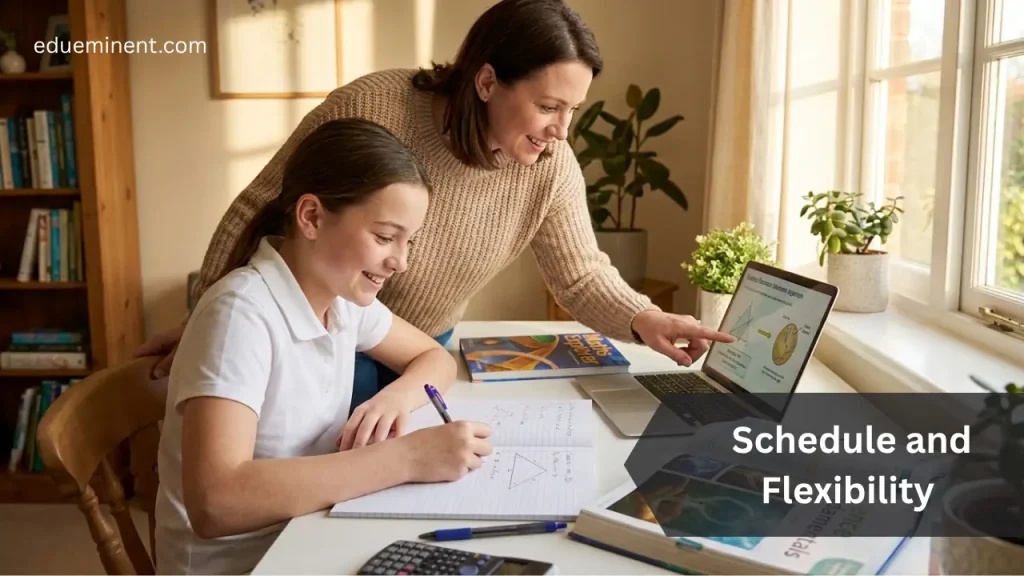
A homeschool day often takes less total time than a school day, since there is no wasted time on transitions, lining up, or waiting for the rest of a class to finish a task.
That flexibility is a real benefit for families with unusual work schedules, kids with medical needs, or families who want to travel during the school year. It does require a parent, or another adult, to be available and organized enough to actually run the day.
Flexibility cuts both ways, though. Without a set bell schedule, some families find that homeschool days drift, with lessons pushed later and later until the actual learning time shrinks.
The families who do best with a flexible schedule are usually the ones who still build in some kind of routine, even a loose one, rather than treating every day as fully open-ended.
Traditional school families, meanwhile, can still build flexibility around the edges. Many districts allow excused absences for family travel, and some schools offer independent study days or asynchronous options for older middle schoolers. The gap between the two models is real, but it is not always as absolute as it first appears.
Cost of Homeschooling vs Traditional School
Public school is free at the point of use, though families still pay for supplies, activity fees, sports, and sometimes technology.
Homeschooling costs vary widely. A basic homeschool setup using free or low-cost online resources can run under five hundred dollars a year. A more structured curriculum with textbooks, an online program, and extracurricular classes can run into the low thousands per student per year. Private school, for comparison, often costs far more than either option.
The higher hidden cost of homeschooling is time. One parent typically needs to either work part-time, work from home, or restructure their job to teach and supervise the school day, which is a real financial tradeoff even when the curriculum itself is inexpensive.
Taxpayer-funded public school represents a significant per-student investment from the district, even though families do not pay that cost directly out of pocket.
Homeschooling families give up access to that funded infrastructure, including school buildings, buses, cafeteria staff, and specialist teachers, in exchange for spending their own time and money more directly on their one child. Framed that way, the cost comparison is not just about dollars spent; it is about whose time and resources are doing the work.
Families weighing an online public school academy get something of a middle option here. Tuition is typically free since it operates as a public school, and a certified teacher is usually available for support, but the day-to-day supervision and structure still fall largely on a parent at home, similar to full homeschooling.
Extracurricular Activities and Sports Access
Traditional school makes extracurriculars simple. Sports teams, band, student council, and clubs are built into the school and require little extra planning from parents.
Homeschooled middle schoolers can still play school sports in many states, either through their local public school under a homeschool participation law, or through dedicated homeschool sports leagues and co-ops. Many areas also run homeschool-specific bands, drama programs, and science clubs.
It takes more research to find these options as a homeschooling family, but in most parts of the country, a motivated family can build an extracurricular schedule that looks similar to a traditional school student’s, just assembled from different sources rather than handed to them by one building.
One advantage homeschooling families sometimes notice is more time available for extracurriculars overall. Since core academics often wrap up by early afternoon, a homeschooled middle schooler may have more daylight hours left for sports practice, music lessons, or a part-time hobby that traditional school students fit in only after a full day at school followed by homework.
That extra time can be a real advantage for a child pursuing something at a competitive level, like gymnastics, music, or club sports.
Teacher Support and Individual Attention
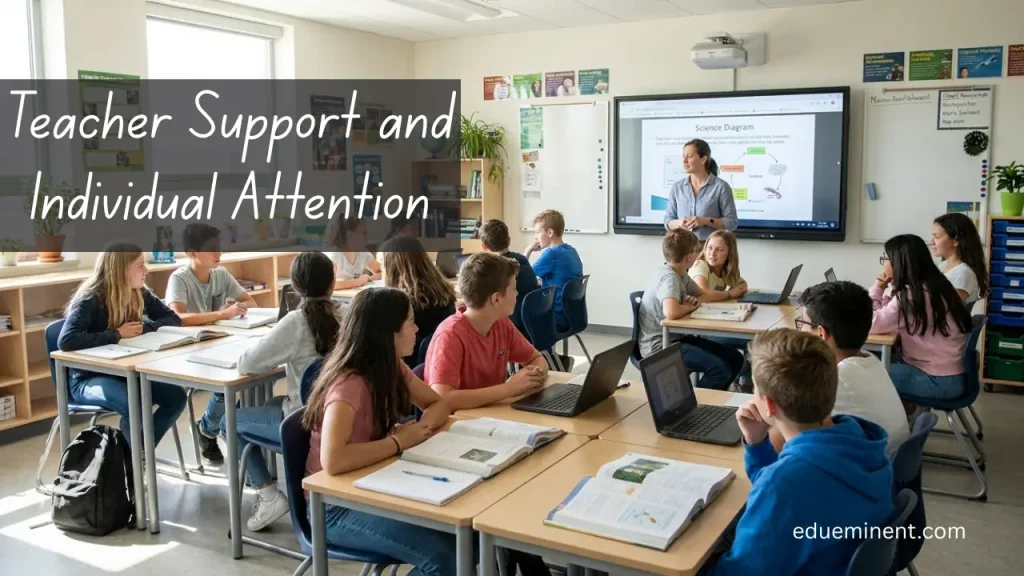
In a traditional classroom, one teacher manages twenty to thirty-five students at once. Even a great teacher cannot give each child constant individual attention, though they can offer expertise, structured feedback, and grading benchmarks compared against a wider group of peers.
In a homeschool setting, attention is close to one-on-one, which is powerful for kids who need extra explanation or for advanced kids who need to be challenged.
The tradeoff is that most homeschooling parents are not trained subject specialists, especially once middle school math and science get more advanced. Online classes, tutors, and co op teachers can fill that gap.
It also matters what kind of learner your child is. A child who learns well from listening to explanations, working independently, and asking questions when stuck often does very well in a one-on-one homeschool setting.
A child who learns better by watching a teacher model a concept on a whiteboard, working through it with classmates, and getting immediate feedback in a group setting may respond better to a traditional classroom style of teaching. Neither learning style is better, but matching the setting to the learner tends to matter more than which option sounds better on paper.
Getting Ready for High School: Which Path Prepares Kids Better
Both paths can prepare a child well for high school, but they build different skills.
Traditional middle school builds familiarity with a school building, a bell schedule, multiple teachers, group projects, and standardized testing, all of which mirror what high school looks like. That familiarity can make the jump to ninth grade feel smaller.
Homeschooling in middle school tends to build strong independent study habits, time management, and self-direction, since the student is doing more of the planning themselves.
Many homeschooling families transition their child into a traditional high school, an online high school, or continue homeschooling through graduation, and either route works when middle school has built solid academic habits.
The real preparation that matters for high school is not the label of homeschool or traditional school. It is whether the child leaves eighth grade able to read complex material, write a clear paragraph, manage a deadline, and ask for help when they are stuck.
Colleges and high schools are also increasingly familiar with homeschool transcripts, and most high schools have a clear process for evaluating incoming homeschooled students, often through a placement test or a review of a homeschool portfolio.
This used to be a bigger unknown decades ago. Today it is a routine, well-understood process in most districts, which removes one worry that used to weigh heavily on homeschooling families considering a return to traditional school for ninth grade.
Pros and Cons of Homeschooling in Middle School
Pros:
- One-on-one attention that adjusts to the child’s pace
- Flexible schedule that fits family travel, work, or health needs
- Ability to skip ahead in strong subjects and slow down in weak ones
- More control over social environment and peer group
- Time to build independent study skills early
Cons:
- Requires a consistent, organized adult to run the school day
- Social time must be actively planned, not automatic
- Parents may lack expertise in advanced subjects without outside help
- Extracurriculars and sports require more research to access
- Ongoing cost and time commitment falls on the family
Pros and Cons of Traditional School in Middle School
Pros:
- Built-in daily social contact with a large peer group
- Subject specialist teachers for every class
- Extracurriculars, sports, and clubs available on site
- Predictable schedule and known academic benchmarks
- Access to counselors, specialists, and support staff
Cons:
- Large class sizes limit individual attention
- Fixed pace does not adjust for a struggling or advanced student
- Exposure to peer pressure, cliques, and bullying risk
- Little flexibility for travel or an unusual family schedule
- Less room for a highly individualized course of study
How to Decide: Questions to Ask Before Choosing Part-Time
Before choosing a path for grades 6 to 8, it helps to answer a few honest questions as a family.
Does your child thrive with structure and a large peer group, or do they get overwhelmed and need a calmer, more individualized environment? Can a parent realistically commit consistent hours to teaching, or is a traditional classroom the more realistic option given work and family demands?
Is your local public school a strong academic fit, or are there real concerns about class size, safety, or curriculum quality that homeschooling would solve?
There is no universally right answer. Many families also choose a middle ground, such as homeschooling part time, using an online public school academy, or enrolling in traditional school with homeschool-style tutoring support after hours.
The best choice is the one that matches your specific child, your family’s schedule, and your local school options, not the choice that worked for another family online.
It also helps to remember that this decision is not permanent. Plenty of families homeschool through middle school and then move to traditional high school. Plenty of others do the opposite, starting in traditional school and switching to homeschooling partway through eighth grade because of a specific challenge that came up.
Treating grades 6 to 8 as one flexible stretch, rather than a single irreversible choice, takes a lot of pressure off the decision.
A useful exercise is to picture a normal Tuesday in each setting, in detail. What does the morning look like? Who is teaching the lesson? What happens at lunch? What does homework look like at seven in the evening?
Walking through an ordinary day, rather than an abstract list of pros and cons, tends to make the right fit for your family much clearer.
Final Thoughts
Homeschooling and traditional school are both legitimate ways to raise a capable, well-prepared teenager. The middle school years matter because this is when academic habits, independence, and social confidence really start to form.
If your family is still deciding, start by being honest about your child’s learning style, your own available time, and what your local school actually offers. That honest starting point, more than any pros and cons list, is what leads to the right decision for grades 6 to 8.
Frequently Asked Questions
Is homeschooling better than traditional school for middle schoolers?
Neither option is universally better. Homeschooling tends to work well for kids who need individual pacing or a calmer environment, while traditional school works well for kids who thrive with structure and a large peer group. The right choice depends on the child and the family’s ability to commit time to teaching.
Do homeschooled middle schoolers fall behind academically?
Not inherently. Academic outcomes depend far more on curriculum quality and consistency than on whether a child is homeschooled or in traditional school. A well-organized homeschool program can keep pace with, or exceed, traditional school benchmarks.
Can homeschooled kids in grades 6 to 8 still play sports?
In many states, yes. Some states legally require public schools to allow homeschooled students to try out for school teams, and many regions also have dedicated homeschool sports leagues.
How many hours a day does homeschooling take for a middle schooler?
Most homeschool families report finishing core academics in about three to five hours a day, since there is no time lost to transitions, lining up, or waiting for a full class to finish an activity.
Is it hard to switch a child from homeschooling back into traditional school?
It is usually manageable. Schools typically place a returning student based on age and a short academic assessment. The transition tends to go more smoothly when the homeschool years focused on core skills like reading comprehension, writing, and math fluency.
What is the average cost of homeschooling a middle schooler?
Costs range widely, from under five hundred dollars a year for a basic setup to a few thousand dollars a year for a full curriculum with online classes and extracurricular programs.