This guide explains how Pakistani families can choose and build a homeschool curriculum for Grades 6 to 8. It compares Matric and Cambridge pathways, covers core subjects, schedules, costs, exams, recordkeeping, socialisation, and practical strategies for creating a flexible middle school education at home.
If you are new to home education, it helps to understand what homeschooling actually involves. What Is Homeschooling? explains the basics and gives parents a clearer starting point.
Choosing a homeschool curriculum in Pakistan can feel confusing at first, especially with so many boards, systems, and providers to compare. If your child is entering grades 6, 7, or 8, this is exactly the stage where the right curriculum choice matters most, since it shapes the path toward matriculation, O Levels, or whichever route you have in mind for high school.
This guide breaks down everything Pakistani families need to know about building a homeschool curriculum for grades 6 to 8, including your legal standing, the main curriculum options available, how exams work for homeschooled students, and practical tips for building a routine that actually works at home.
What Homeschooling Looks Like in Pakistan
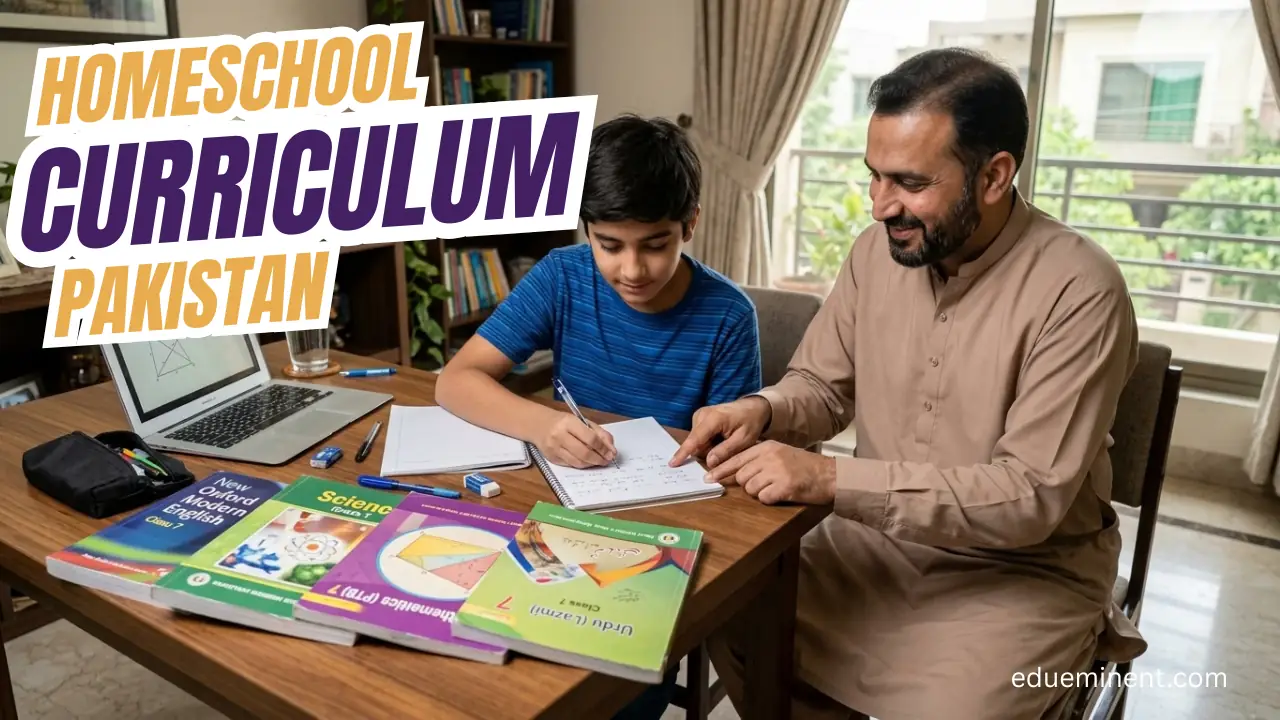
Homeschooling in Pakistan means a child’s education is directed primarily by a parent or guardian at home rather than through daily attendance at a school.
This concept is still relatively new in the country compared to more established homeschooling cultures abroad, but it is growing steadily among urban families in cities like Karachi, Lahore, and Islamabad, as well as among Pakistani families living abroad who want to keep their children connected to local culture and language.
Homeschooling in Pakistan can take several forms. Some families follow a fully independent model, teaching every subject themselves using textbooks and online resources.
Others hire private tutors for specific subjects while managing the rest of the schedule themselves. A growing number of families also enroll their children in online homeschool programs that provide structured lesson plans, teacher support, and assessments, while the actual learning happens at home.
Whatever model you choose, the goal for grades 6 to 8 remains the same: build strong foundations in core subjects while preparing your child for whichever examination system you plan to pursue later, whether that is the Matriculation system through a local board, the Cambridge O Level pathway, or another recognized qualification.
Is Homeschooling Legal in Pakistan
Yes, homeschooling is legal in Pakistan. There is no specific law that regulates, restricts, or prohibits parents from educating their children at home.
The Ministry of Federal Education and Professional Training does not mandate registration, reporting, or a fixed curriculum for homeschooling families, which means Pakistani parents have significant freedom in how they structure their child’s education.
This freedom comes with responsibility. Since there is no official oversight, it is up to parents to make sure their child’s education actually prepares them for university admission, professional exams, or whatever comes next.
Many families choose to align their homeschool curriculum with an established board or examination system for this reason, rather than creating an entirely custom program with no clear endpoint.
It is worth noting that while homeschooling itself is unregulated, the examination boards your child will eventually sit for, such as the Cambridge system or a provincial board like the Federal Board, Punjab Board, Sindh Board, or Khyber Pakhtunkhwa Board, do have their own rules for private candidates.
Understanding these rules early, even in grade 6, helps you plan backward and choose curriculum materials that actually match the exam your child will eventually take.
Comparing the Two Main Pathways: Cambridge and Matric
Since most Pakistani homeschooling families end up choosing between the Cambridge pathway and the Matric or SSC pathway, it helps to understand how they differ at the grade 6 to 8 stage, even though board exams are still a few years away.
The Cambridge pathway, built around Cambridge Lower Secondary and later Cambridge Checkpoint, tends to emphasize skill based learning, critical thinking, and applied problem solving across subjects like math, science, and English.
Coursebooks are widely available in Pakistan through local bookstores and international publishers, and many private tutors and online programs specialize specifically in preparing students for this route.
Families often choose this pathway when they want to keep options open for universities abroad, or when they simply prefer the structure and global recognition that comes with Cambridge qualifications.
The Matric or SSC pathway follows the curriculum set by provincial and federal textbook boards, closely mirroring what is taught in mainstream Pakistani government and private schools.
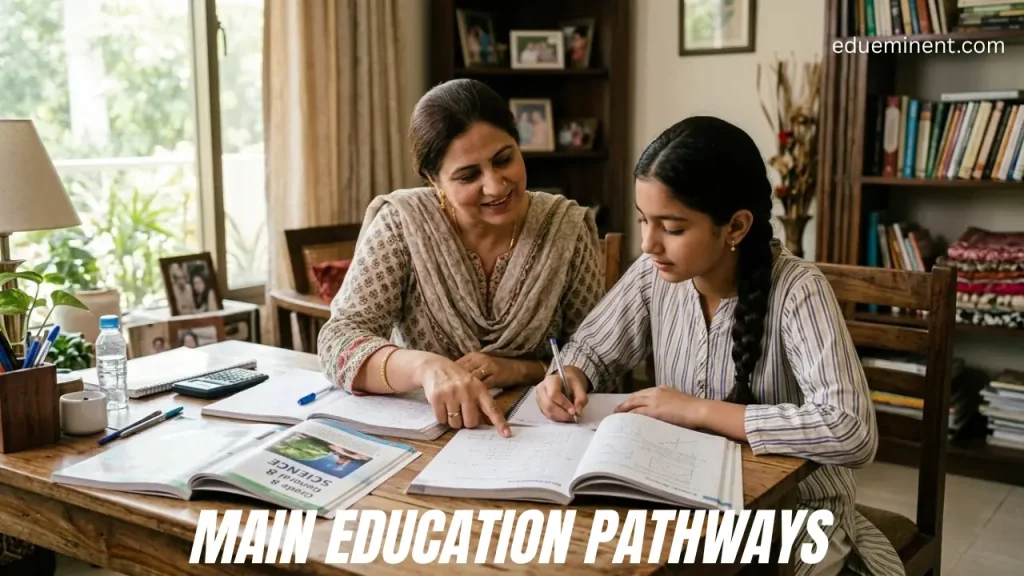
This pathway tends to be more affordable, since board approved textbooks are inexpensive and widely available, and it aligns directly with many Pakistani university admission pathways, particularly for professional programs like medicine and engineering that have historically drawn heavily from Matric and Intermediate graduates.
Families who plan to stay within the Pakistani university system, or who want their child’s education to closely match what their peers in traditional schools are learning, often lean toward this pathway.
Neither pathway is objectively better. Some families choose to blend both, using Cambridge materials for English and science because of their applied teaching style, while relying on Matric board textbooks for Urdu, Pakistan studies, and Islamic studies.
This hybrid approach is increasingly common among homeschooling families who want the best of both systems.
Understanding Your Curriculum Options for Grades 6 to 8
Choosing a curriculum is the biggest decision in homeschool planning, and Pakistani families generally have several strong pathways to consider.
The Cambridge or British curriculum, often called the O Level track once a child reaches the higher grades, is a popular choice among homeschooling families in Pakistan. Many families begin preparing for this pathway during grades 6 to 8 using Cambridge Lower Secondary or Cambridge Checkpoint materials, which build directly into the O Level subjects taken in later grades.
This route is widely recognized by universities in Pakistan and abroad, and Pakistan has an extensive network of Cambridge exam centers, making it a practical option even for families who homeschool entirely on their own.
The Pakistani board system, commonly referred to as the Matric or SSC pathway, follows the curriculum set by provincial and federal textbook boards.
Families who want their child to eventually sit board exams through the Federal Board or a provincial board such as those in Punjab, Sindh, Khyber Pakhtunkhwa, or Balochistan often use the official textbooks published by their respective textbook boards, supplemented with guides and practice material.
The Single National Curriculum, introduced to bring more consistency across public and private schools in Pakistan, is another option some homeschool families reference when selecting content and learning outcomes for core subjects, particularly for families who want their homeschool content to closely mirror what is taught in mainstream Pakistani schools.
American curriculum programs are used by a smaller group of families, often those with plans to move abroad or pursue a US-style diploma. These programs are widely available online and can be combined with Pakistani studies and Islamic studies to keep a well-rounded education.
Islamic studies-integrated curriculum is a priority for many Pakistani homeschooling families, and it is common to combine any of the pathways above with dedicated Quran memorization, Islamic studies, and Urdu language instruction as core parts of the weekly schedule rather than an afterthought.
Online homeschool programs designed specifically for Pakistani families have grown in recent years, offering structured lesson plans, live or recorded classes, and progress tracking. These programs can reduce the planning burden significantly for parents who are new to homeschooling and want more built-in structure during the middle school years.
How to Choose the Right Curriculum for Your Child
With so many options available, narrowing down the right curriculum for your grade 6 to 8 student comes down to a few key questions.
Think first about your long-term goal. If you know your child will eventually apply to a Pakistani medical or engineering university, aligning early with either the Matric pathway or the O Level pathway, both of which are accepted through IBCC equivalency, keeps your options open. If international study is more likely, the Cambridge or American pathway may make more sense from the start.
Consider your child’s learning style next. A child who thrives with structure and clear lesson plans may do better with a boxed curriculum or an online homeschool program, while a child who is naturally curious and self-directed might respond well to a more flexible, resource-based approach.
Factor in your own availability and comfort level as the primary teacher. Parents who are confident teaching math and science themselves may only need outside support for subjects like Islamic studies or a foreign language, while parents who are new to teaching altogether might prefer a curriculum with built-in answer keys, video lessons, or tutor support.
Finally, look at cost and access. Materials, books, and online program fees vary considerably, and it helps to compare a few options directly, request sample lessons where possible, and speak with other homeschooling parents in your area or online communities before committing to a full year of any single curriculum.
Core Subjects to Cover in Grades 6 to 8
Regardless of which curriculum pathway you follow, a strong middle school homeschool program in Pakistan should generally include the following core areas.
Mathematics: Students in grades 6 through 8 typically build from basic arithmetic and fractions into pre-algebra concepts, ratios, percentages, and introductory geometry, preparing them for algebra in the following grades.
English language: This includes grammar, vocabulary, reading comprehension, and writing skills such as essays, letters, and comprehension-based answers, which are heavily tested in both the Matric and O Level systems.
Urdu language: Urdu remains a core subject for most Pakistani students regardless of curriculum pathway, covering grammar, comprehension, and composition.
Science: Depending on the pathway chosen, science may be taught as a combined subject or split into physics, chemistry, and biology starting around grade 8, especially for families preparing for the O Level or Matric science pathway.
Islamic studies and Quran: Most Pakistani families include Quran recitation or memorization alongside Islamic studies as a regular part of the weekly schedule, often taught by a parent or a dedicated Quran tutor.
Social studies or Pakistan studies: This covers history, geography, and civics content relevant to the chosen curriculum board, often introducing Pakistan studies more formally by grade 8 or 9 depending on the pathway.
Computer studies: Basic computer literacy, typing, and introductory coding or digital skills are increasingly included as a core subject given how central technology has become to both academics and future careers.
You do not need to give every subject equal daily time. Many families teach math and English daily since these build sequentially, while rotating science, social studies, and computer studies across the week.
It also helps to think about how subjects connect to each other rather than teaching them in complete isolation. For example, a lesson on Pakistan studies covering major rivers and geography pairs naturally with a science lesson on ecosystems, while a history topic on a particular era can be reinforced through an English writing assignment asking your child to describe the period from a first-person perspective.
This kind of cross-subject connection tends to deepen understanding far more than treating each subject as a completely separate block of time, and it is one of the genuine advantages homeschooling offers over a rigid classroom timetable.
Registering as a Private Candidate for Exams
One of the most practical questions homeschooling parents in Pakistan ask is how their child will actually sit exams later on, and the answer depends on which pathway you choose.
For the Cambridge pathway, homeschooled students can register directly as private candidates through an authorized Cambridge exam center, and Pakistan has one of the largest networks of these centers in the world, making this a realistic option in most major cities.
For the Matric or SSC pathway, homeschooled students typically register as private candidates through their relevant provincial or federal board, such as the Federal Board of Intermediate and Secondary Education or a provincial board depending on your city of residence.
Requirements and deadlines vary by board, so contacting the board’s private candidate office directly, well before exam season, is an important step.
For students planning to pursue O Level results toward Pakistani university admission, the Inter Board Committee of Chairmen handles the equivalency process, converting Cambridge grades into a format Pakistani universities and boards recognize. This is the same process followed by school-enrolled O Level students, so homeschooled students are not disadvantaged in this regard.
Even though grades 6 to 8 do not involve major board exams yet, understanding this process early helps you choose curriculum materials that build directly toward the exam system your child will eventually use, rather than switching pathways later and losing time.
Building a Weekly Homeschool Schedule
A consistent weekly rhythm helps middle school students transition into more independent learning. Below is a sample structure that many Pakistani homeschooling families adapt to their own routine.
Morning block, five days a week: Mathematics for about forty-five minutes, followed by English language for another forty-five minutes, with a short break in between.
Midmorning block: Science on three days a week and social studies or Pakistan studies on the remaining two days, each for about forty minutes.
Quran and Islamic studies: A dedicated thirty- to forty-five-minute block, often scheduled either early morning before other subjects or right after the midday break, depending on what works best for your family’s routine.
Afternoon block: Urdu language most days, along with computer studies or a chosen elective two or three times a week.
Friday or weekend flexibility: Many families use Friday afternoons or a weekend day for review, catch-up work, extracurricular activities, or a family outing that reinforces subjects like science or social studies through real-world experience.
This structure typically fills around four to five hours of focused academic work per day, which tends to be sufficient for middle schoolers once you account for how much more efficient one-on-one teaching is compared to a full classroom day.
Cost Considerations for Homeschooling in Pakistan
Homeschooling costs in Pakistan vary widely depending on the pathway and resources you choose, so it helps to think in terms of general categories rather than fixed numbers.
Lower cost approaches typically rely on Pakistani board textbooks, which are widely available and affordable, supplemented with free or low-cost practice guides and resources shared within local homeschool communities.
Moderate cost approaches often involve Cambridge coursebooks and workbooks, which cost more than local textbooks but offer a globally recognized structure, along with occasional tutoring support for subjects like science or math.
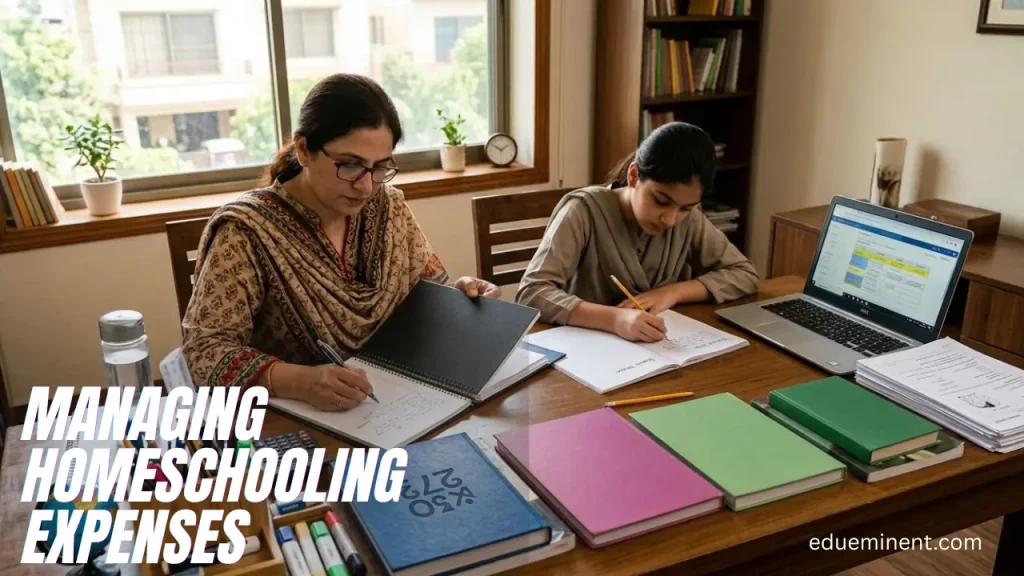
Higher cost approaches usually involve structured online homeschool programs with live classes, dedicated teacher support, and regular assessments, which reduce the planning workload for parents but come with ongoing subscription or tuition fees.
Many families find that a mixed approach works best financially, using affordable textbooks for subjects they feel confident teaching themselves while investing more in tutoring or structured programs for subjects that feel more challenging to teach at home, such as science labs or a foreign language.
Socialization and Community Support for Homeschoolers in Pakistan
A common concern among Pakistani parents considering homeschooling is whether their child will miss out on social interaction, and this deserves a direct answer. Homeschooled middle schoolers in Pakistan can build strong friendships and social skills, but it does take some planning since you are stepping outside the built-in social structure of a school.
Local homeschool communities and Facebook groups have grown significantly in Pakistan, connecting families in the same city who organize group classes, park meetups, and shared tutoring arrangements. Sports academies, martial arts classes, and swimming clubs offer regular physical activity along with peer interaction.
Quran academies and mosque-based programs provide both religious education and a consistent social circle for many families. Community classes in art, coding, or language learning, whether in person or online, also give homeschooled students a chance to interact with peers outside their immediate family.
Choosing two or three consistent activities each week tends to work better than trying to fill every day with social events, since consistency helps children build genuine friendships rather than one-off interactions.
Common Challenges Families Face
Every family runs into a few common obstacles during their first year of homeschooling in Pakistan, and knowing what to expect makes these easier to manage.
Choosing between too many curriculum options can lead to decision fatigue. Starting with one clear pathway, even if you adjust it later, tends to work better than trying to blend too many systems at once during your first year.
Balancing the role of parent and teacher is a common struggle, especially in households where one parent is managing homeschooling alongside other responsibilities. Setting clear start and stop times for schoolwork each day helps separate these roles more clearly.
Access to quality resources for certain subjects, particularly science experiments or foreign language instruction, can be harder to manage independently. Joining a local co op or investing in an online program for these specific subjects can fill the gap without requiring you to become an expert in everything.
Self-doubt is common among new homeschooling parents in Pakistan, especially since the practice is still relatively uncommon compared to traditional schooling. Connecting with experienced homeschooling families through local groups can provide reassurance, practical tips, and a sense of community during the adjustment period.
Tips for Homeschool Success in Grades 6 to 8
Start with a trial period of a few weeks before fully committing to one curriculum for the entire year, so you can adjust early if something is not working.
Keep a simple weekly log of subjects covered and work completed, even informally, since this becomes valuable later when registering for exams or applying to programs that ask about prior education.
Build in regular breaks throughout the day, since middle schoolers typically lose focus after thirty to forty-five minutes of continuous work.
Involve your child in some curriculum and schedule decisions, which tends to increase motivation, especially at an age where independence matters more to them.
Connect with local or online Pakistani homeschooling communities for curriculum recommendations, exam guidance, and general support.
Review your schedule and materials every few months and adjust based on what is genuinely working for your child rather than sticking rigidly to an original plan.
Conclusion
Even though homeschooling in Pakistan is not formally regulated, keeping simple records benefits your family as your child approaches board exams or university applications. A basic system does not need to be complicated to be useful.
Keep a running log of subjects covered, books used, and major topics completed, along with approximate dates. Save samples of your child’s written work and completed tests throughout each year, since these can support future exam registration or portfolio requirements.
Note any tutoring, online courses, or co op classes your child attends, along with rough timelines, since this history becomes useful when explaining your child’s educational background later. Store everything in a simple digital folder organized by subject and year so nothing gets lost as your child moves through the grades.
This habit takes only a few minutes each week during grades 6 to 8, but it becomes genuinely valuable once your child approaches exam registration or needs to explain their educational background for university or scholarship applications.
Building a homeschool curriculum in Pakistan for grades 6 to 8 does not have to be overwhelming once you understand your options. Since homeschooling remains legally unregulated in the country, the responsibility falls on you to choose a clear pathway, whether that is the Matric system, the Cambridge O Level route, or a blended approach, and to build a consistent routine around core subjects like mathematics, English, Urdu, science, and Islamic studies.
Give yourself room to adjust as you learn what works for your child, lean on the growing community of Pakistani homeschooling families for support, and remember that a strong middle school foundation sets the stage for whichever exam path your child eventually takes.
If you found this guide useful, explore our related articles on preparing for O Level exams as a private candidate and building an effective homeschool schedule to continue planning your family’s path forward.
Frequently Asked Questions
Is homeschooling legal in Pakistan?
Yes. There is no law that regulates, restricts, or prohibits homeschooling in Pakistan, and the Ministry of Federal Education and Professional Training does not require registration or reporting for homeschooling families.
Can homeschooled students in Pakistan sit board exams?
Yes. Homeschooled students can register as private candidates for Matric or SSC exams through their relevant provincial or federal board, or as private candidates through an authorized Cambridge exam center for O Levels.
Do I need a teaching qualification to homeschool my child in Pakistan?
No. There is no legal requirement for parents to hold a teaching qualification. Many families successfully homeschool using a combination of self-teaching, tutors, and online programs.
Which curriculum is best for grades 6 to 8 in Pakistan?
There is no single best option for every family. The right choice depends on your long term goals, whether that is a Pakistani university pathway, an international pathway, or a combination, along with your child’s learning style and your own comfort teaching each subject.
Will O Level results be accepted for Pakistani university admission?
Yes. O Level and A Level results are converted to Matric and Intermediate equivalency through the Inter Board Committee of Chairmen, a standard process used by both school enrolled and homeschooled students.
How can my homeschooled child stay socially active in Pakistan?
Local homeschool communities, sports academies, Quran academies, and community classes in art or language learning all provide regular opportunities for social interaction alongside academic learning.
How many hours a day should homeschooling take for a middle schooler?
Most students in grades 6 to 8 can complete a full day of focused academic work in about four to five hours, given the efficiency of one-on-one instruction compared to a full classroom day.