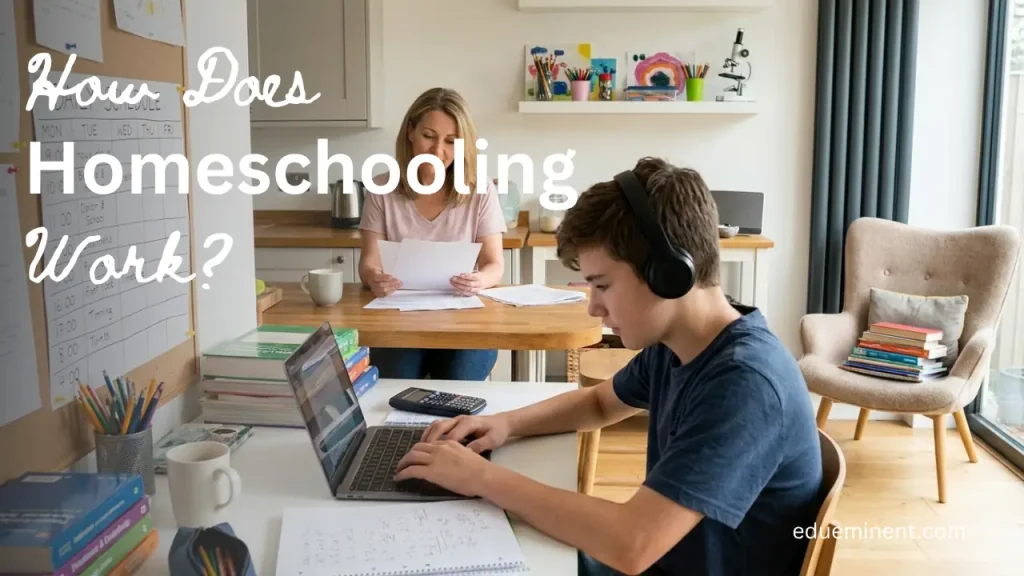
This complete guide explains how homeschooling works for families, from understanding legal requirements and choosing a curriculum to creating schedules, grading students, managing costs, and supporting socialisation. It also covers homeschool methods, co-ops, testing, returning to school, graduation, and preparing homeschooled students for college.
Millions of families now teach their kids at home instead of sending them to a public or private school. If you are curious about this choice, you probably have one big question. How does homeschooling actually work day-to-day?
This guide answers that question in plain, simple language. You will learn what homeschooling means, whether it is legal, how families get started, what a normal school day looks like, and how homeschooled students earn grades, take tests, and even get into college.
By the end, you will understand the full picture, not just the basics.
Choosing the right academic pathway can make a big difference in a student’s learning experience. Many students begin with O Level, where they build a strong foundation across different subjects before moving on to A Level studies.
The Cambridge O Level approach also encourages students to understand concepts rather than simply memorising information, which can be helpful when preparing for higher education.
For students looking for an alternative, IGCSE offers another internationally recognised route with a wide range of subject choices and assessment options.
What Is Homeschooling?
Homeschooling means a parent or guardian takes on the job of teaching their child instead of enrolling them in a public or private school building. The lessons can happen at the kitchen table, in a home office, at the library, or even outside in the backyard.
Homeschooling is not new. Families taught their own children long before public schools existed. What has changed is the number of families choosing it today.
According to the National Center for Education Statistics, about 3.4 percent of K12 students in the United States were homeschooled during the 2022 to 2023 school year. Other research groups estimate the number is now closer to 6 percent of all school-age children, which adds up to more than 3 million students nationwide.
Families choose homeschooling for many reasons. Some want more control over what their child learns. Some are worried about safety at their local school.
Others want to teach a specific faith, move at a faster or slower pace, or build a schedule that fits a busy family life, like travel or a chronic illness. There is no single type of homeschool family. Every household builds its own version.
Homeschooling also is not the same thing as distance learning offered by a school during an emergency, like a snow day or a temporary closure. True homeschooling is an ongoing, planned choice, led by the family, and it usually continues for a full school year or longer.
Is Homeschooling Legal?
Yes. Homeschooling is legal in every state in the country, along with Washington DC. However, each state writes its own rules, so what is required in one state can look very different from what is required next door.
Generally speaking, states fall into a few broad groups.
Low regulation states. A small group of states asks for almost nothing. Parents do not need to notify anyone, and there is no required testing or portfolio review. Texas is a well-known example. The state treats a home school as a type of private school, so families simply begin teaching without filing paperwork.
Moderate regulation states. Many states ask for a basic notice of intent, telling the local school district or state office that a child will be homeschooled. Some of these states also set a minimum number of instructional days, usually somewhere between 170 and 185 days per year, and list required subjects such as reading, math, science, and social studies.
Higher regulation states. A smaller group of states, including Pennsylvania and New York, add extra steps. These can include annual portfolio reviews, standardized testing at certain grade levels, or evaluation by a certified teacher.
Because rules change and vary so much, it is worth checking your own state department of education website, or a trusted homeschool advocacy group, before you begin. What is true for a friend in another state may not apply to you at all.
What Subjects Do Homeschoolers Study?
Most states list the core subjects a homeschool must cover, and these usually match what a public school teaches. Typical required subjects include reading and language arts, math, science, social studies or history, and sometimes health or physical education. A few states also require instruction in the state constitution or state history at certain grades.
Beyond the required list, families are free to add almost anything. Common additions for middle school age students include a foreign language, computer coding, art, music, personal finance, and typing. Because a homeschool is not tied to a fixed class period, a family can also spend extra weeks on a subject a child finds difficult, or move quickly through material a child already understands. This flexibility is one of the biggest differences between homeschooling and a traditional classroom, where the whole class typically moves at the same pace regardless of individual need.
Middle school, covering roughly grades 6 through 8, is often when families start paying closer attention to subject rigor. This is the stage where math moves from basic arithmetic toward pre-algebra and algebra, science shifts toward more structured lab work, and writing assignments grow longer and more detailed. Many curriculum providers design their grade 6 through 8 materials specifically to prepare students for a high school level workload.
How Do Families Get Started With Homeschooling?
Starting a homeschool feels overwhelming at first, but it usually breaks down into five clear steps.
Step 1: Learn Your State’s Homeschool Laws
Before buying a single workbook, find out what your state actually requires. Look for four things. Do you need to file a notice of intent, and if so, when? Are there required subjects? Is there a minimum number of instructional hours or days? Does the state require testing, a portfolio, or an evaluation at the end of the year?
Many states also offer more than one legal path to homeschool, such as an independent homeschool, an umbrella school, or a virtual charter school. Each path can carry different rules, so it helps to compare them before choosing.
Step 2: Choose a Homeschool Approach
Homeschooling is not one single method. Families pick an approach, or blend several, based on their child’s needs and their own teaching style. The most common approaches are covered in detail later in this guide.
Step 3: Pick a Curriculum
Curriculum simply means the books, lessons, and materials used to teach each subject. Some families buy a full, boxed curriculum that plans out the entire year subject by subject.
Others build their own mix using free online resources, library books, workbooks, and educational apps. Many families also enroll in an online school that provides lessons, grading, and even a real teacher through a screen.
There is no single right curriculum. What matters is that it covers the subjects your state requires and fits how your child learns best.
Step 4: Set Up a Schedule
Homeschool schedules look nothing like a public school schedule, and that is one of the biggest appeals for many families. Some households do schoolwork every weekday morning and finish by lunchtime.
Others school four days a week and use the fifth for field trips or catch-up work. Some families school year-round with short breaks scattered throughout instead of one long summer vacation.
The right schedule is simply the one that gets the required work done consistently while fitting the family’s life.
Step 5: Keep Records
Even in states with light regulation, keeping records is smart practice. Useful records include a log of attendance or hours worked, a list of subjects covered, samples of student work, and any test or evaluation results.
In states that require testing at specific grades, like Pennsylvania’s grades 3, 5, and 8, these records also prove the family met its legal obligations.
Good records also help later if a student transfers into a traditional school, moves to a state with stricter laws, or applies to college. A simple binder or a free digital tool works fine for most families. What matters is consistency, not fancy software.
What Are Homeschool Co-ops?
A homeschool co op, short for cooperative, is a group of homeschool families who meet regularly, often once a week, to share teaching duties and social time. One parent might teach science to the whole group, another might lead art class, and a third might run a physical education session, so no single parent has to cover every subject alone.
Co-ops solve two common concerns at once. They give students regular group learning experiences that feel closer to a traditional classroom, and they give parents built-in support from other families walking the same path.
Many communities have several co-ops to choose from, ranging from faith-based groups to purely academic ones, and some even rent classroom space in a church or community center for weekly meetings.
What Does a Typical Homeschool Day Look Like?
There is no single homeschool schedule, but many families follow a pattern that looks something like this for a middle school-age student.
Morning routine. Breakfast, chores, and a quick check of the day’s plan.
Core subjects. Two to four hours covering math, reading or language arts, science, and history or social studies. Because there is no waiting for a full classroom to move on, lessons often take less time than they would in a traditional school.
Independent work. Reading, writing assignments, or online lessons the student completes with little supervision.
Enrichment activities. Art, music, a foreign language, coding, or a hands-on science experiment.
Afternoon activities. Sports, co op classes with other homeschool families, volunteer work, or a part-time job for older teens.
One reason homeschooling often takes fewer hours than a public school day is that a parent working one-on-one, or with just a few children, spends far less time on transitions, attendance checks, and classroom management than a teacher does with twenty-five or more students.
Different Types of Homeschooling Methods
Families often ask which method is best. The honest answer is that the best method is the one that fits your child. Here are the most common approaches used across the country.
Traditional or school at home. This method mirrors a regular classroom, using textbooks, workbooks, and a set daily schedule for each subject. It appeals to families who want structure similar to a traditional school.
Classical education. This approach organizes learning around three stages tied to a child’s development, often called the grammar, logic, and rhetoric stages. It leans heavily on reading original texts, Latin or Greek roots, and formal writing and debate skills.
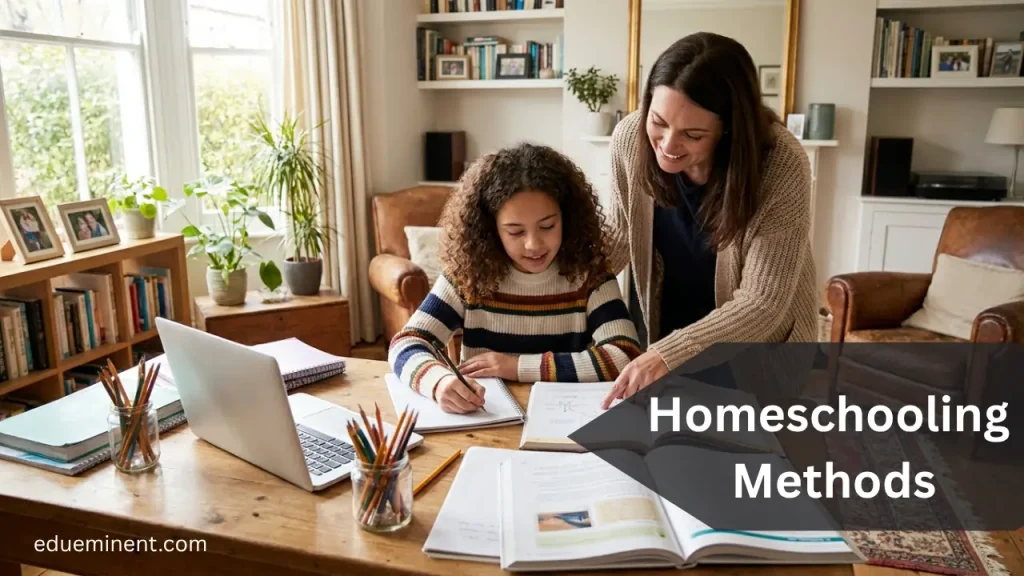
Charlotte Mason method. Named after a British educator, this style emphasizes living books over dry textbooks, nature study, art and music appreciation, and short, focused lessons rather than long drills.
Unit studies. Instead of teaching math, science, and history as separate subjects, unit studies build lessons around one theme, such as ancient Egypt or the ocean, and pull in reading, writing, math, and art connected to that theme.
Unschooling. This child-led approach lets a student’s own interests guide most of the learning, with the parent acting more as a facilitator than a lesson planner. Critics worry about gaps in required subjects, so many unschooling families still track state-required topics in the background.
Online or virtual school. Some families enroll their child in a full-time online school, sometimes a public virtual charter school, that provides a structured curriculum, real teachers, and even graded report cards, all delivered through a computer.
Most real families blend two or three of these approaches rather than following just one strictly. A parent might use a structured math curriculum for the sake of clear skill building, a unit study approach for history and science because it keeps a middle schooler engaged, and an unschooling mindset for free time and hobbies.
There is no rule that says a family has to pick only one label and stick to it forever. Many families also change methods from year to year as a child grows and their needs shift.
How Do Homeschooled Students Get Grades and Take Tests?
Grading in a homeschool looks different from a traditional classroom because there is no single required grading system. Parents often use a mix of these tools.
- Curriculum-based tests and quizzes that come built into a purchased curriculum.
- Standardized achievement tests, similar to those used in public schools, required in some states at certain grades.
- Portfolio review, where a certified teacher or evaluator looks through a folder of the student’s work across the year and confirms progress.
- Self-assessment and parent observation, especially common in early grades or in less regulated states.
For students who plan to attend a traditional high school later, or apply to college, parents typically assign letter grades and build a transcript, just as a school would. Many curriculum providers and online homeschool programs include grade tracking tools to make this easier.
Do Homeschoolers Get Socialization?
This is one of the most common questions people ask, and it deserves a clear answer. Homeschooled students are not isolated at home all day. Most families build in regular social time through several channels.
- Co op classes, where groups of homeschool families meet weekly to share teaching, often splitting subjects among parents with different strengths.
- Community sports leagues, scouting programs, and church or community youth groups.
- Homeschool-specific groups, including field trip clubs, park days, and academic teams like debate or robotics.
- Part-time enrollment, since many public schools allow homeschooled students to join specific classes, band, or sports teams.
Research summarized by groups like the National Home Education Research Institute suggests homeschooled students generally do not show worse social or emotional outcomes than their peers in traditional schools, and some studies point to stronger community involvement in adulthood.
How Much Does Homeschooling Cost?
Cost varies widely depending on the curriculum and activities a family chooses. A frequently cited estimate places average homeschool spending somewhere between 700 and 1,800 dollars per student per year, covering books, curriculum, supplies, and basic activities.
Costs can run higher if a family adds private tutoring, expensive online programs, extracurricular sports, or specialized therapies. Costs can also run much lower for families who rely heavily on free public library resources, free online curriculum, and secondhand books.
Unlike private school tuition, which can reach into the tens of thousands of dollars per year, homeschooling almost always costs far less than private school and, for many families, less than the hidden costs of public school too, once supplies, before and after care, and other fees are counted.
Some states also offer financial help. A growing number of states run education savings accounts or micro grant programs that reimburse families for approved curriculum, tutoring, or testing costs. Families should check with their state department of education to see whether any such program applies to them, since rules and funding amounts change often.
Pros and Cons of Homeschooling
No education choice is perfect for every family. Here is an honest look at both sides.
Advantages
- Flexible schedule that can wrap around travel, health needs, or a family business.
- Lessons paced to the child, moving faster through easy topics and slower through hard ones.
- More one-on-one attention than a classroom of twenty or more students allows.
- Freedom to include religious, cultural, or values-based instruction.
- Ability to remove a child from a school situation involving bullying or safety concerns.
Challenges
- The parent carries the full weight of planning, teaching, and grading, which takes real time and energy.
- Families often need to actively build a social routine instead of getting it automatically through a school building.
- Extracurricular access, like sports teams or a school band, can require extra effort to find or arrange.
- Cost, even though often lower than private school, still falls directly on the family instead of being covered by public tax dollars.
- Some parents feel less confident teaching certain subjects, especially advanced math or science, as children reach middle and high school.
Homeschooling vs Traditional School: Key Differences
| Feature | Homeschooling | Traditional School |
| Who teaches | Parent, tutor, or online instructor | Certified classroom teacher |
| Schedule | Set by the family | Set by the school district |
| Class size | Usually one child or a small group | Often twenty or more students |
| Curriculum | Chosen by the family | Set by the school or district |
| Socialization | Built through outside activities | Built into the school day |
| Cost | Paid by the family, often lower overall | Funded by public taxes, or tuition for private school |
| Oversight | Varies by state law | State and district requirements |
How Do Homeschoolers Graduate and Get Into College?
Homeschooled students absolutely do graduate and attend college, including highly selective universities. Most homeschool families create their own diploma once state and personal graduation requirements are met, and colleges accept homeschool diplomas the same way they accept diplomas from small private schools.
For college applications, families typically prepare a detailed transcript listing courses, grades, and credit hours, along with a course description document explaining what each class actually covered.
Standardized test scores, like the SAT or ACT, along with strong essays and extracurricular activities, often carry extra weight for homeschooled applicants since they help colleges compare a student against a national standard. Many colleges now have specific admissions guidance for homeschool applicants, reflecting just how common this path has become.
Final Thoughts
Homeschooling works differently for every family, but the basic pattern is the same everywhere. A parent or guardian takes responsibility for their child’s education, follows their state’s legal requirements, chooses a teaching approach and curriculum that fits, and builds a schedule around real life.
It takes real commitment, but millions of families across the country make it work, and many say the flexibility and closeness it builds are worth every bit of the effort.
If you are considering homeschooling, start small. Research your state’s laws, talk to local homeschool families if you can find them, and try one method for a semester before committing to a full year plan.
Ask your local library about homeschool resources, look into a nearby co op, and keep your first year simple while everyone adjusts. There is no single correct way to homeschool, only the way that works for your family.
Frequently Asked Questions
Do homeschooled kids have to follow a school calendar?
No. Families choose their own calendar, as long as they meet any state-required number of instructional days or hours. Many follow a schedule close to their local public school for social reasons, but it is not required.
Can both parents work while homeschooling?
Yes, though it takes more planning. Some families split teaching duties, use online programs that run largely independently, hire a tutor for part of the day, or join a co op that shares the teaching load among several parents.
Do homeschoolers need a teaching license?
In most states, no formal teaching license is required. A small number of states ask for a high school diploma or equivalent, and an even smaller number require additional qualifications.
Can a homeschooled student switch back to public school?
Yes. Students can enroll in public school at almost any point. Schools generally review the student’s records or give a placement test to determine the right grade level and course placement.
Is homeschooling the same as online school?
Not exactly. Online school, sometimes called virtual school, is one specific method within homeschooling. Many homeschool families never use a full-time online program at all, teaching instead with printed curriculum, library resources, or their own lesson plans.
How many hours a day does homeschooling take?
This varies by age and approach, but many families finish core academic work in three to five hours for middle school students, since one-on-one teaching moves faster than a full classroom.
Do homeschooled students take standardized tests like the SAT or ACT?
Yes, and many do. Homeschooled students register for the SAT or ACT the same way any other student does, through the official testing organization rather than through a school. Strong scores can help colleges evaluate a homeschool transcript alongside applicants from traditional schools.
What happens if a family moves to a new state?
The family simply follows the new state’s homeschool laws going forward. Keeping thorough records from the old state helps smooth the transition, especially if the new state has stricter testing or portfolio requirements.
Can a homeschooled child play school sports?
It depends on the state and the local school district. Many states have laws, sometimes called Tim Tebow laws, that require public schools to allow homeschooled students to try out for sports teams and other extracurricular activities. Rules and availability still vary widely by location.