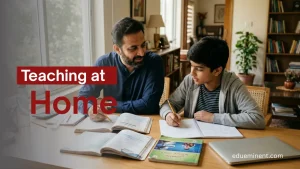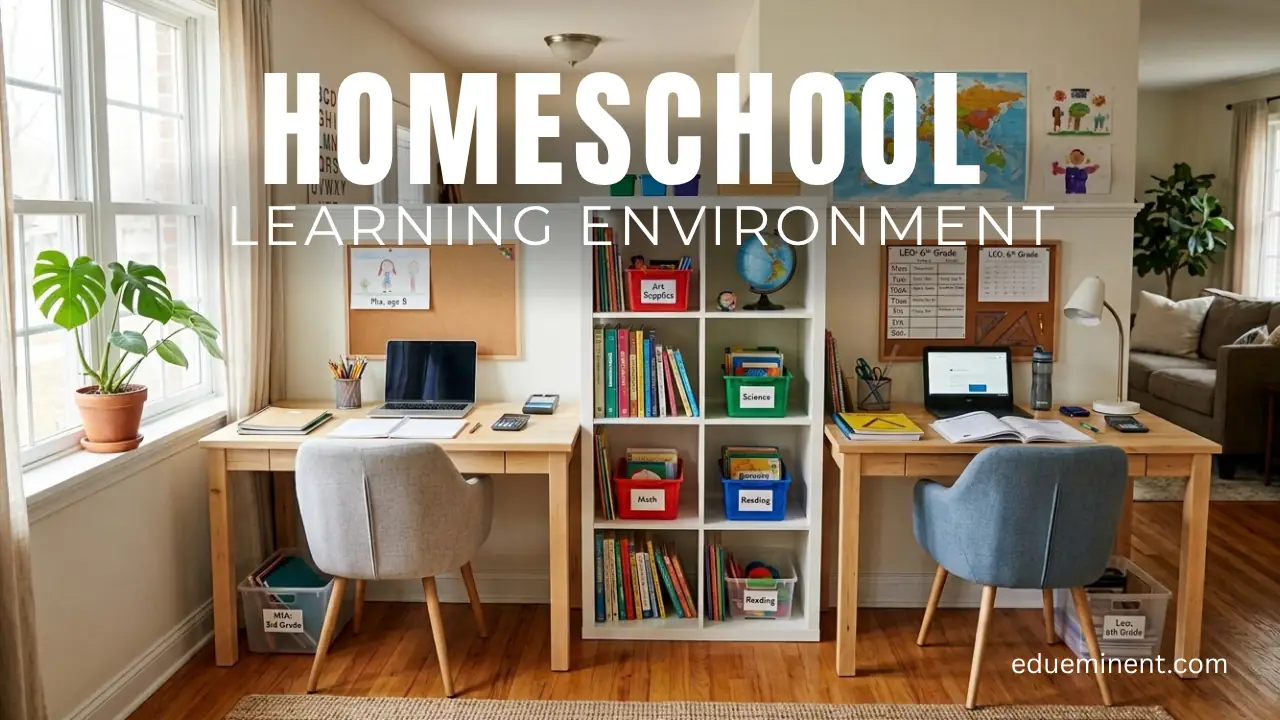
Creating an effective homeschool learning environment for grades 6–8 does not require a dedicated classroom or large budget. This guide covers workspace setup, furniture, lighting, organization, screen management, noise control, study zones, routines, and age-appropriate adjustments that support growing independence.
For some families, learning at home can be a practical alternative to the usual school routine. If you are exploring the idea, What Is Homeschooling? explains what it involves and how parents can approach education outside a traditional classroom.
Somewhere between finishing a math workbook at the kitchen table and watching your child stare blankly at a science reading assignment, most homeschool parents start asking the same quiet question. Is the actual space where my child learns part of the problem?
For families homeschooling a sixth, seventh, or eighth grader, the answer is very often yes, and the good news is that fixing it rarely requires a full renovation or a Pinterest worthy classroom.
Middle school is a genuinely different stage than the early elementary years. Your child now wants more independence, gets pulled in more directions by phones and siblings and their own growing social world, and is expected to sit with harder material for longer stretches at a time.
A learning environment that worked fine for a seven year old at the family table often quietly stops working somewhere around age eleven or twelve. Getting started with homeschooling can raise plenty of questions about subjects, schedules, resources, and teaching. How to Start Homeschooling offers a practical starting point for parents who are planning their first steps.
This guide walks through exactly how to build a homeschool learning environment that actually fits a middle schooler, covering the physical space itself, lighting and comfort, organization systems, managing distractions and screens, and how to adjust the environment as your child grows across grades 6 through 8. None of it requires an empty spare bedroom or a large budget, and most of it can be put together over a single weekend.
Why the Learning Environment Matters More in Middle School
In early elementary grades, a child’s environment barely affects how much they get done, mostly because the actual workload is light and short. Grades 6 through 8 change that equation considerably, since the assignments get longer, the reading gets denser, and the subjects genuinely start to compete for a limited amount of daily attention.
At the same time, a middle schooler’s brain is going through real developmental change. Tweens and young teens are building the executive function skills, meaning planning, focus, and self monitoring, that let them work independently for the first time in their lives.
A supportive physical environment either scaffolds that growth or quietly works against it every single day.
- A cluttered or shared space makes it harder for a middle schooler to start work, since visual clutter competes directly with mental focus.
- A space with easy access to phones, gaming consoles, or a television invites the exact kind of distraction a developing brain has the hardest time resisting on its own.
- A space that never changes can start to feel stale by seventh or eighth grade, especially for a child who is craving more independence and more say over their own surroundings.
- A space that is too rigid or too much like a traditional classroom can occasionally work against the very flexibility that drew a family to homeschooling in the first place.
Choosing the Right Location in Your Home
The most common mistake new homeschool families make is assuming they need a dedicated room, when in reality what matters far more is consistency and reduced distraction, not square footage or decor.
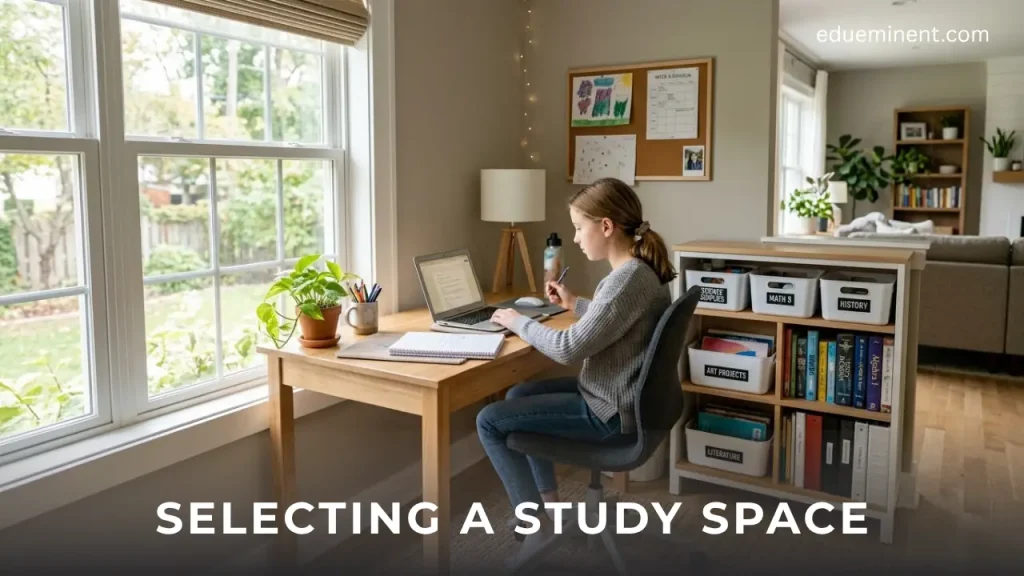
- A quiet corner of a living room, a section of a home office, or even part of a dining room can all work well, as long as the same spot is used regularly enough to become associated with focused work.
- A closed door, or at least a visual boundary like a bookshelf or curtain, helps signal to siblings and pets that this particular spot is currently in work mode.
- Proximity to you matters for check ins, especially early in the school year, but a middle schooler generally benefits from being just far enough away that they are not constantly monitored line by line.
- If more than one child is homeschooling at once, consider whether your middle schooler needs a slightly separated space from younger siblings, since the noise level and pace of an elementary aged child’s day rarely matches a preteen’s need for concentration.
If your home genuinely does not have a spare room, do not let that stop you. A rolling cart that holds school materials, paired with a consistent table or desk spot used every school day, accomplishes nearly everything a dedicated room would.
Furniture and Physical Comfort
Comfort might seem like a minor detail compared to curriculum choice, but an uncomfortable body pulls attention away from the brain far more than most parents expect, especially across a three or four hour school day.
- A properly sized desk and chair matter more in middle school than earlier grades, since sessions get longer and posture problems compound over a full school year.
- Feet should rest flat on the floor or a footrest, with the desk surface roughly at elbow height when seated, since a mismatched setup causes fatigue well before a child consciously notices discomfort.
- A chair with some cushioning and back support outperforms a hard kitchen chair for long writing or reading sessions, though it does not need to be an expensive ergonomic model.
- Storage within arm’s reach, such as a small shelf, drawer unit, or rolling cart, reduces the number of times a middle schooler gets up mid task to search for a missing pencil or notebook, which is one of the most common focus breakers at this age.
Lighting That Actually Supports Focus
Lighting is one of the most underrated pieces of a homeschool learning environment, and it is also one of the easiest and cheapest to improve.
- Natural light near a window is generally the best option, since it supports mood and alertness far better than most artificial lighting.
- Position the desk so natural light comes from the side rather than directly behind a screen, since backlighting causes glare that leads to squinting and eye strain during longer reading or typing sessions.
- On darker days or in rooms without much natural light, a bright, adjustable desk lamp positioned to reduce shadows works as a reasonable substitute.
- Avoid overly dim or overly harsh overhead lighting as the only light source, since both extremes tend to increase fatigue over a multi hour school day.
Reducing Clutter Without Making the Space Feel Empty
A learning space that is too cluttered competes with a middle schooler’s attention, but a space that is completely bare can feel cold and uninviting, so the goal is a middle ground that stays functional without feeling sterile.
- Keep only the current day’s or current week’s materials within immediate reach, and store everything else, including finished workbooks and rarely used supplies, out of the direct line of sight.
- Use labeled bins, folders, or drawers so a middle schooler can find and return their own materials without needing to ask a parent every time, which supports the independence this age genuinely craves.
- Clear the desk surface completely at the end of each school day, even if it only takes a minute, since starting the next morning with a clean surface makes beginning work noticeably easier.
- Leave a small amount of room for personal touches, such as a favorite photo, a plant, or a single piece of artwork, since a space that feels at least partly like the child’s own tends to get used more willingly.
Managing Screens and Digital Distractions
For most homeschooling middle schoolers, screens are unavoidable, since so much curriculum now lives online, but an unmanaged screen is also the single biggest distraction risk in a middle school learning environment.
- Keep personal phones out of the learning space entirely during school hours whenever possible, since even a silenced phone sitting nearby has been shown to pull at attention simply through its presence.
- Use parental controls or a focus mode app on any laptop or tablet used for schoolwork, especially during independent work blocks when a parent is not standing nearby to notice a stray tab.
- Separate the device used for schoolwork from the device used for entertainment where possible, since a single all purpose tablet makes the line between working and scrolling much easier to blur.
- Talk openly with your middle schooler about why these limits exist rather than simply enforcing them silently, since kids this age respond far better to reasoning than to unexplained rules.
Sound, Noise, and Managing a Multi Child Household
Noise management becomes a bigger issue in middle school than it was in earlier grades, since younger siblings are often louder and more active, while a preteen typically needs more sustained quiet to concentrate.
- If your home allows it, place your middle schooler’s work space away from the busiest, loudest area of the house, especially during hours when younger children are doing hands on or noisier activities.
- Noise cancelling headphones or simple soft instrumental music can help some middle schoolers block out background household noise without needing a fully separate room.
- Stagger subjects across siblings when possible, so your middle schooler’s reading or writing block does not directly overlap with a younger child’s loud phonics game or active play time.
- Some families find that a middle schooler actually concentrates better with a small amount of ambient noise rather than total silence, so it is worth experimenting rather than assuming one approach fits your whole family.
Zones That Support Different Kinds of Work
Rather than treating the learning environment as a single desk, many families find it helpful to think in terms of two or three small zones that support different kinds of schoolwork throughout the day.
- A focused work zone for math, writing, and reading, kept as quiet and clutter free as possible, ideally the same spot used every single school day.
- A hands on or project zone, which can be a section of a garage, a covered porch, or simply a section of table protected with a mat, used for science experiments, art projects, or anything messy or spread out.
- A discussion or read aloud zone, often a couch or comfortable chair, used for subjects like history or literature that benefit from a more relaxed, conversational setting rather than a rigid desk posture.
These zones do not need separate rooms. In many homes, all three exist within the same general area of the house, simply used a little differently depending on the subject and the moment.
| Zone | Best Used For | Simple Setup Idea |
| Focused Work Zone | Math, writing, reading, independent study | A quiet desk near natural light with minimal decor |
| Hands On Zone | Science experiments, art, building projects | A protected section of table or garage with easy clean surfaces |
| Discussion Zone | History, literature, read alouds, family discussion | A couch or comfortable chair used specifically for these subjects |
None of these zones require a dedicated room of their own. In most homes, all three fit comfortably within the existing layout, simply used a little differently depending on the subject at hand.
Personalizing the Space as Independence Grows
A learning environment that suited your child in fourth or fifth grade often needs an update once middle school begins, since the level of independence, privacy, and ownership a preteen wants is simply different from what a younger child needed.
- Let your middle schooler have real input into their own space, including where supplies are stored, what decor if any goes up, and how the desk itself is arranged.
- Consider giving an eighth grader slightly more physical separation or privacy than a sixth grader might need, since the desire for independent space tends to grow steadily across these three years.
- Rotate or refresh small details, such as a bulletin board of current goals or a shelf of books tied to current interests, since middle schoolers can lose motivation in a space that never changes.
- Resist the urge to make every decision for your child here, since a workspace a middle schooler helped design is one they are far more likely to actually want to use.
Building Routines Into the Environment Itself
A well designed space becomes far more powerful when it is paired with a consistent routine, since the environment and the daily rhythm reinforce each other rather than working separately.
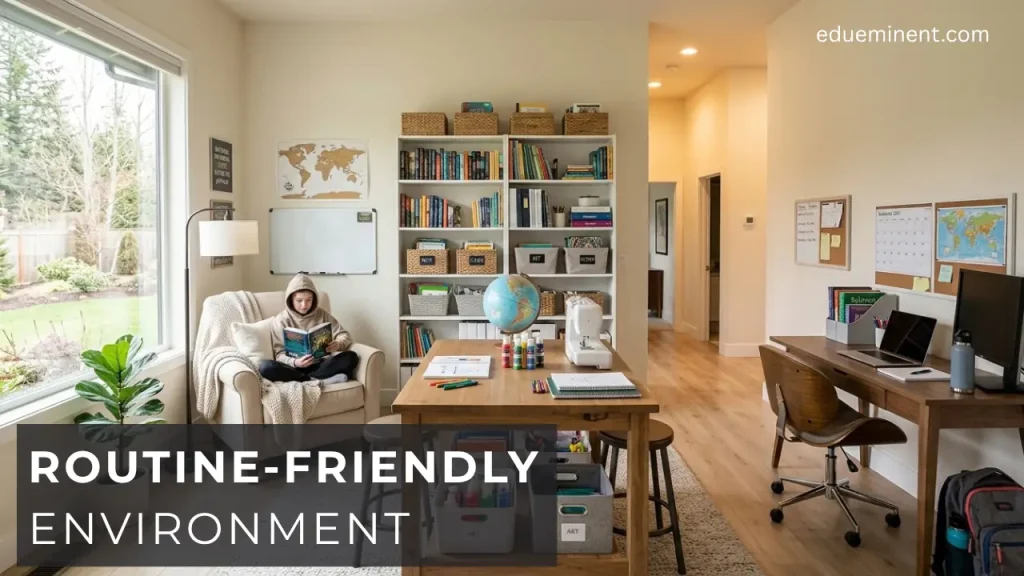
- A visible checklist, whiteboard, or printed schedule posted near the workspace helps a middle schooler start and track their own day with less parental prompting.
- A simple start of day ritual, such as clearing the desk, checking the day’s checklist, and setting a timer for the first subject, signals to the brain that focused work is beginning.
- An end of day ritual, such as putting materials away and briefly noting what still needs finishing, prevents the workspace from slowly accumulating clutter over the course of a week.
- Keeping the same general start time and same general location, even if exact subjects shift day to day, gives a middle schooler’s brain a reliable cue that it is time to focus.
Adjusting the Environment as You Move From Grade 6 to Grade 8
The needs of a sixth grader and the needs of an eighth grader are genuinely different, even though both fall under the same middle school label, so it helps to think of the learning environment as something that evolves rather than something you set up once and leave untouched.
- Sixth graders are often still adjusting to more independent work and may benefit from a workspace kept within easy sight of a parent, even if not directly supervised the entire time.
- Seventh graders typically manage longer independent stretches and may be ready for a slightly more private or separated space, along with more responsibility for organizing their own materials.
- Eighth graders, especially those preparing for high school level coursework, often benefit from a more serious, less playful feeling workspace, closer in tone to what a high schooler might use, along with expanded digital research tools.
- Revisit the setup at least once a year, ideally at the start of a new school year, and ask your child directly what is working and what feels outdated or uncomfortable.
| Grade | Environment Priority | Practical Example |
| Grade 6 | Gentle transition to independent work, kept within easy sight of a parent | Desk placed in a shared family space with visible daily checklist |
| Grade 7 | Growing independence and personal organization | Slightly separated desk with labeled personal storage bins |
| Grade 8 | More privacy, a more serious tone, expanded digital research tools | A quieter, more closed off corner with a laptop station for research projects |
Think of this table as a general trend rather than a strict rule, since some sixth graders are ready for more independence right away, and some eighth graders still benefit from working closer to a parent. Use your own child’s behavior, not their grade level alone, as the real guide.
For parents deciding between home education and a regular school, the differences can go beyond the classroom. Homeschooling vs Traditional School compares the two approaches in terms of routine, flexibility, learning, and involvement.
Budget Friendly Ways to Build an Effective Space
An effective homeschool learning environment does not require an expensive overhaul, and many of the most useful upgrades cost very little or nothing at all.
- A secondhand desk and chair, refreshed with a coat of paint or a new cushion, function just as well as new furniture for most families.
- Repurposed bins, jars, and boxes from around the house make perfectly good organizers once labeled clearly.
- A single well placed desk lamp, often available inexpensively, can solve most lighting problems without any electrical work or major purchase.
- Free or low cost printable checklists and schedule templates, found through a quick search or a homeschool planning app, remove the need to buy a specialty planner just for this purpose.
Common Mistakes Parents Make When Setting Up the Space
A handful of setup mistakes come up again and again among homeschool families, and knowing about them ahead of time can save real frustration during the school year.
- Assuming a middle schooler can focus anywhere simply because they used to do homework at the kitchen table as a younger child, without noticing that their needs have genuinely changed.
- Overloading the space with decorations, supplies, or gadgets, which can overwhelm rather than inspire a child who is easily distracted.
- Placing the workspace directly in front of a television, gaming console, or high traffic hallway, then wondering why focus is difficult.
- Setting up the space once at the very start of the year and never adjusting it, even after it becomes clear something about the location, lighting, or organization is not working.
- Making every decision about the space without input from the child who will actually be using it every day.
Signs Your Current Learning Environment Needs a Change
Sometimes it is not the curriculum or the schedule that is causing a rough patch, but the physical environment itself, and a few signs tend to point clearly in that direction.
- Your middle schooler frequently complains about being uncomfortable, too hot, too cold, or unable to see the page or screen clearly.
- Work sessions are constantly interrupted by requests to get up for supplies, snacks, or a change of scenery.
- Siblings, screens, or household noise seem to derail focus on a near daily basis, regardless of how the schedule itself is structured.
- Your child seems to dread sitting down to work specifically in their usual spot, even when they are otherwise willing to do the assignment itself.
If several of these signs sound familiar, it is worth treating the physical environment as a variable worth testing and changing, rather than assuming the child or the curriculum is the sole source of the struggle.
Conclusion
A homeschool learning environment does not need to look like a real classroom, and it does not need a large budget or a spare room to actually work. What it needs is consistency, reasonable comfort, manageable distractions, and enough flexibility to grow alongside your child as they move from sixth grade into eighth.
Start by looking honestly at your current setup and asking whether it still fits the child sitting in it today, not the child who used that same spot two or three years ago.
Small, deliberate changes, whether that means moving a desk closer to a window, adding a labeled bin, or simply asking your middle schooler what is bothering them about their current spot, often make a bigger difference than any complete overhaul ever could.
Give any change you make a genuine trial period of a few weeks before deciding whether it worked, and stay open to adjusting again as your child continues to grow and change across these three formative middle school years.
Frequently Asked Questions
Do I need a separate room for homeschooling a middle schooler?
No, a separate room is not required, though it can be helpful if your home has one available. A consistent corner, a section of a shared room, or even a well organized rolling cart paired with a regular table spot can work just as well for most middle schoolers.
How much does it cost to set up a good homeschool learning space?
It can cost very little, since secondhand furniture, repurposed storage bins, and a single inexpensive desk lamp solve most of the common problems. Spending more money does not automatically create a better learning environment, and many families find that consistency and organization matter far more than budget.
Should a middle schooler be allowed to use their phone while doing schoolwork?
Most experts and experienced homeschool families recommend keeping personal phones out of the learning space during school hours whenever possible, since even a silenced phone nearby has been shown to reduce focus. If a phone is genuinely needed for a specific assignment, using it only for that purpose and then setting it aside again tends to work better than leaving it accessible throughout the day.
What if my middle schooler shares a bedroom or workspace with a sibling?
Staggering subjects and work times between siblings, along with using headphones or a visual divider such as a bookshelf, can help reduce conflict and distraction in a shared space. Many families also find that giving each child a small personal storage bin, even within a shared area, helps maintain a sense of individual ownership.
How often should I change or update the learning space?
A yearly check in, ideally at the start of each new school year, is usually enough for most families, though it is worth revisiting sooner if you notice consistent frustration or discomfort. As a child moves from sixth to eighth grade, their needs for independence and privacy typically grow, so the space should be allowed to grow with them.
Does the learning environment matter as much for hands on or project based homeschooling?
Yes, though the specific needs shift somewhat. Hands on and project based learning benefits from a durable, easy to clean surface and accessible storage for supplies and materials in progress, rather than the quiet focused desk setup that suits reading and writing heavy work.
Is it bad to let my middle schooler study on the couch or bed sometimes?
Occasional flexibility is not a problem, and in fact many middle schoolers benefit from a designated relaxed reading spot for subjects like literature or history. The concern arises mainly when a bed or couch becomes the default spot for all subjects, since it can blur the line between rest and focused work over time.