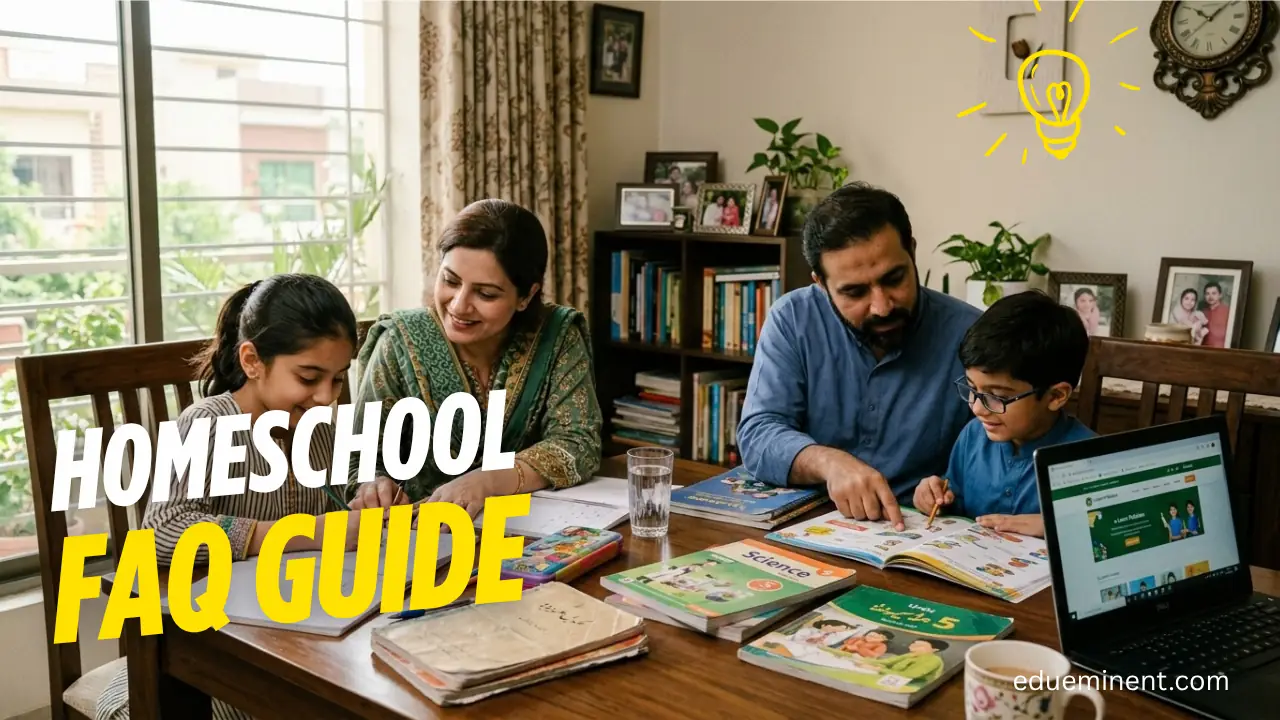
This homeschooling FAQ answers 53 common questions parents have about home education. It covers getting started, legal requirements, curriculum, daily schedules, socialisation, testing, recordkeeping, costs, high school, college, and special situations, giving parents a practical reference for understanding how homeschooling works.
Homeschooling comes with a lot of questions, and that is true whether you are just starting to research it or you have already been teaching your own kids for years. This guide collects the questions real parents ask most often and answers each one in plain, simple language.
Instead of one long article you have to read start to finish, think of this as a reference you can search through. Jump to the section that matches your question, or read straight through if you are new to the whole idea. Either way, by the end you should have a clear, honest picture of how homeschooling actually works.
Getting Started Questions
What exactly is homeschooling?
Homeschooling means a parent or guardian takes responsibility for a child’s education instead of enrolling them in a public or private school building. Lessons can happen at a kitchen table, in a home office, at a library, or anywhere else that works for the family. It is a fully legal, recognized form of education in every state in the country.
How do I know if homeschooling is right for my family?
There is no single right answer here, since every family’s situation is different. Families often choose homeschooling for more control over curriculum, a flexible schedule, concerns about a local school, religious or personal values, or simply wanting more one-on-one time with their child’s learning. If you are still deciding, many families try a short trial period, sometimes just one semester, before committing to a full year.
What is the very first step to start homeschooling?
The first real step is checking your state’s specific homeschool laws, since requirements vary widely from state to state. Some states ask for almost nothing, while others require a notice of intent, minimum instructional days, or periodic testing. Once you know your state’s rules, you can move on to choosing a teaching approach and curriculum.
What is the difference between homeschooling and online public school?
Traditional homeschooling is led entirely by the parent, who chooses the curriculum, sets the schedule, and often has full control over every subject. Online public school, sometimes called a virtual charter school, is technically a public school delivered through a computer, with state-certified teachers, a set curriculum, and grading, even though the student learns from home.
Some families consider online public school a form of homeschooling, while others draw a clear line between the two, since online public school comes with more outside structure and fewer choices than independent homeschooling.
Do I need a teaching degree to homeschool my child?
In most states, no formal teaching license or degree is required to homeschool. A small number of states ask for a high school diploma or its equivalent, and an even smaller number have additional requirements. Most homeschool parents learn as they go, using curriculum designed to guide both the child and the parent through each lesson.
Can I homeschool if I work full time?
Yes, though it takes more planning. Some working parents split teaching duties with a spouse, hire a part-time tutor, enroll their child in an online program that runs largely independently, or join a co op that shares teaching responsibilities among several families. It takes creativity, but plenty of working parents make it work.
What if I feel unqualified or nervous about teaching my own child?
This feeling is extremely common, especially in the first year, and it does not mean you are making the wrong choice. Most curriculum programs are built to guide both the parent and the child through each lesson, so you do not need to already be an expert in every subject. Confidence tends to grow naturally with a semester or two of real experience.
Legal and Requirements Questions
Is homeschooling legal everywhere in the United States?
Yes, homeschooling is legal in all fifty states and Washington, D.C. However, each state sets its own specific rules, so what one state requires can look completely different from what a neighboring state requires. Always check your own state’s current requirements rather than assuming a friend’s experience in another state applies to you.
Do I have to notify anyone before I start homeschooling?
This depends entirely on your state. Some states require a written notice of intent filed with the local school district or a state office, sometimes on a specific yearly schedule. Other states ask for no notification at all. Checking your state department of education website is the most reliable way to find your exact requirement.
Do homeschoolers have to follow the same required subjects as public schools?
Many states list required subjects for homeschoolers, and these usually mirror public school requirements, typically reading, math, science, and social studies or history. Beyond the required list, families are generally free to add whatever additional subjects they choose.
Are homeschoolers required to take standardized tests?
It depends on the state. Some states require periodic standardized testing or evaluation at specific grade levels, while others leave testing entirely up to the family. Where testing is required, families typically have some choice in which approved test to use.
What happens if I do not follow my state’s homeschool laws?
Ignoring legal requirements can create real problems, ranging from a warning to more serious legal consequences depending on the state and the specific violation. It is worth taking the time to understand and follow your state’s rules from the very beginning rather than risking trouble later.
Do I have to renew my homeschool paperwork every single year?
In states that require a notice of intent, yes, this is usually an annual requirement, though the exact process varies. Some states use a simple one-time filing that stays valid unless something changes, while others expect a fresh notice each school year. Checking the exact renewal schedule for your specific state avoids any accidental lapse in compliance.
Curriculum and Teaching Questions
How do I choose a curriculum?
Start by considering your child’s learning style, your state’s required subjects, and your own comfort level with each subject area. Some families buy a full, boxed curriculum covering every subject for the year, while others build their own mix from library books, free online resources, and workbooks. Many families also adjust or switch curriculum after trying it for a semester.
What if the curriculum I bought is not working?
It is completely normal to switch curriculum mid-year if something clearly is not fitting your child’s needs. Give a new curriculum a fair trial, usually four to six weeks, before deciding, since some adjustment period is normal. If it still causes consistent frustration or confusion after that, it is reasonable to try something else.
What is a homeschool co-op?
A homeschool co op, short for cooperative, is a group of homeschool families who meet regularly, often weekly, to share teaching duties and social time. One parent might teach science to the whole group while another leads art, spreading the workload and giving kids regular group learning experiences.
Can I teach subjects I am not confident in myself?
Yes. Many curriculum programs are designed to guide a parent through unfamiliar material step by step. For subjects you feel especially unsure about, options include an online program with a real instructor, a tutor, a co op class taught by another parent, or simply learning alongside your child.
What teaching methods do homeschool families use?
Common approaches include traditional textbook-based learning, classical education built around stages of a child’s development, the Charlotte Mason method focused on living books and nature study, unit studies that combine subjects around one theme, unschooling that follows a child’s own interests, and full-time online or virtual school programs. Many families blend more than one approach.
What exactly is unschooling?
Unschooling is a child-led approach where a student’s own interests and curiosity guide most of the learning, with the parent acting more as a facilitator than a lesson planner. Some families use unschooling for every subject, while others apply it only to certain areas, like free reading or elective interests, while keeping a more structured approach for core subjects like math.
What should I do if my child hates a specific subject?
First, try to figure out whether the resistance is about the subject itself or the format it is being taught in. A child who dislikes writing on paper might respond much better to typing, dictating out loud, or a more creative writing prompt. Adjusting the format, adding real-world connection, or simply slowing the pace can often turn around a subject a child claims to hate.
How closely should I follow a curriculum’s suggested daily schedule?
Treat a curriculum’s built-in schedule as a helpful starting point rather than a strict requirement. If your child needs more time on a concept, or moves through material faster than expected, adjusting the pace to fit your child usually produces better results than rigidly following a publisher’s suggested timeline regardless of how the lessons are actually going.
Daily Life and Schedule Questions
How many hours a day does homeschooling actually take?
This varies by age and approach, but many families find that core academic subjects take three to five hours for a middle school-age student. Homeschooling generally requires less time than a public school day, since a parent working with one child or a small group does not lose time to transitions, attendance, or waiting for the whole class to catch up.
Do homeschoolers follow a public school calendar?
Not necessarily. Families can choose their own calendar, as long as they meet any state-required number of instructional days or hours. Some families follow a schedule close to their local public school for social reasons, while others school year-round with shorter, more frequent breaks.
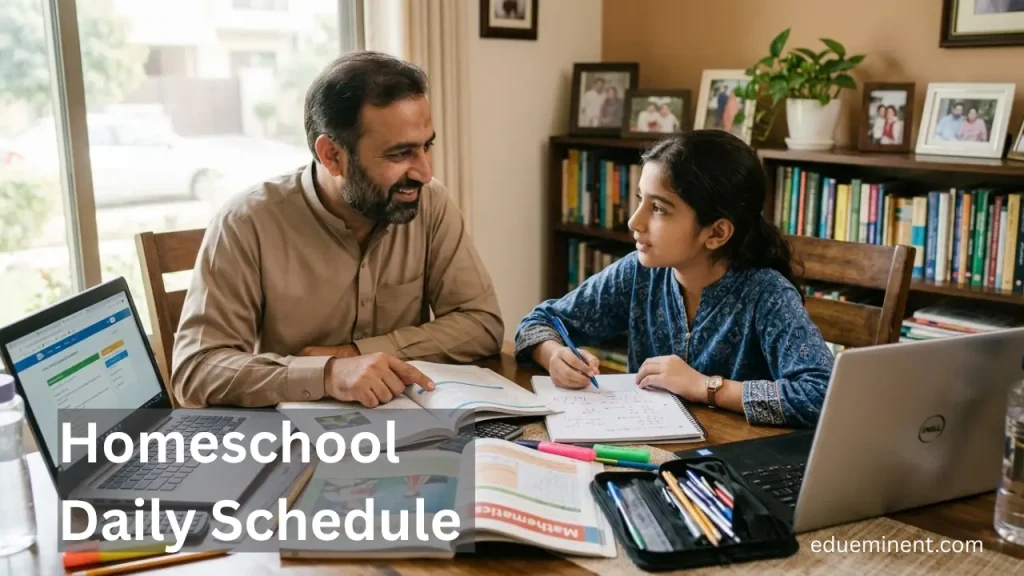
What does a typical homeschool day look like?
Most homeschool days include a morning routine, a block of core academic subjects, some independent work, enrichment activities like art or music, and time for outside activities in the afternoon. The exact order and length vary widely from family to family.
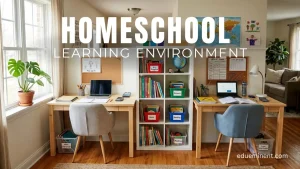
Do I need a dedicated homeschool room?
No, though some families find it helpful. Many homeschool families work at a kitchen table, a shared office, or even different rooms depending on the activity. What matters more than a dedicated space is having the materials and structure you need close at hand.
How do I homeschool multiple children at different grade levels at once?
Many families combine subjects like history, science, and read-aloud time across age groups, while keeping subjects like math and reading instruction individualized for each child’s actual level. This takes some planning, but it is a common and manageable part of homeschooling more than one child.
Do homeschoolers get summer vacation?
Many do, though it is entirely optional rather than required. Some families follow a schedule similar to a public school calendar, with a long summer break, while others school year-round with shorter, more frequent breaks spread throughout the year. The right pattern is whatever fits your family’s needs and state requirements.
What should I do if my child simply refuses to do schoolwork on a given day?
Occasional refusal is normal and usually resolves with a short break, a format change, or addressing an underlying issue like hunger or tiredness. If refusal becomes a frequent pattern, it is worth stepping back and evaluating whether the current schedule, curriculum, or pace actually fits your child, rather than treating every instance as simple defiance.
Can I homeschool while traveling or living a nontraditional lifestyle?
Yes, and this flexibility is actually one of the reasons some families choose homeschooling in the first place. Lessons can happen in a car, an airport, a campsite, or wherever the family happens to be, and many curriculum programs and digital resources are designed to work well on the go. Some traveling families lean more heavily on real-world experiences, like visiting a historical site or a science museum, as a direct part of the curriculum itself.
Socialization Questions
Do homeschooled kids get enough social interaction?
Yes, in most cases, though it requires some planning. Common sources of social time include homeschool co-ops, community sports leagues, scouting or church groups, field trip clubs, and simple park days with other homeschool families. Homeschooled students are not isolated at home all day unless a family actively chooses that.
Is homeschool socialization different from public school socialization?
It is different, though not necessarily worse. Public school socialization tends to happen automatically within one age group during the school day. Homeschool socialization is usually more intentional and often spans a wider range of ages, through family friendships, co-ops, and community activities.
Can homeschooled kids play sports or join clubs at a public school?
In many states, yes. A number of states have laws, sometimes called Tim Tebow laws, requiring public schools to allow homeschooled students to try out for sports teams and other extracurricular activities. Availability and specific rules vary by state and local school district.
How do homeschoolers make friends?
Homeschoolers typically make friends through co-ops, sports teams, scouting, church or community groups, neighborhood friendships, and organized homeschool meetups. Many communities have active homeschool groups specifically built around connecting families with children of similar ages.
Is homeschooling isolating for the parent too, not just the child?
It can be, particularly in the first year before a family finds a community. Many homeschool parents address this by joining local or online homeschool groups, attending co op days themselves, or connecting with other homeschool parents specifically for adult support and encouragement, not just their child’s social needs.
Testing, Grades, and Records Questions
How are homeschoolers graded?
There is no single required grading system for homeschoolers. Parents often use curriculum-based tests and quizzes, standardized achievement tests where required by the state, portfolio reviews by a certified evaluator, or their own observation and assessment, especially in earlier grades.
Do homeschoolers need to keep records?
Even in states with light regulation, keeping records is a smart practice. Useful records include a log of instructional days or hours, subjects covered, samples of completed work, and any test results. Good records matter most when a family moves to a stricter state, a child transfers into a traditional school, or it is time to apply to college.
What is a homeschool transcript?
A homeschool transcript is a document listing a student’s courses, grades, and credit hours across their homeschool years, typically built by the parent for high school-level work. Colleges generally accept a well-organized homeschool transcript the same way they would a transcript from a small private school.
What is a portfolio review, and how does it work?
A portfolio review is when a certified teacher or evaluator looks through a folder of a student’s work collected over the school year, confirming that real academic progress has been made. States that require this typically leave the exact format flexible, allowing samples of writing, completed workbooks, projects, and test results as evidence of progress.
Do homeschoolers take the same standardized tests as public school students?
Not usually the same test, but often a similar type of test. States that require testing for homeschoolers typically allow a choice among several nationally recognized standardized achievement tests, which measure similar skills to the tests used in public schools without requiring enrollment in the public school system itself.
Cost Questions
How much does homeschooling cost?
Costs vary widely, but a commonly cited estimate places average spending somewhere between 700 and 1,800 dollars per student per year, covering curriculum, books, and basic supplies. Costs can run higher with private tutoring or expensive programs, and lower for families who rely on free library resources and secondhand materials.
Is homeschooling cheaper than private school?
Almost always, yes. Private school tuition can reach into the tens of thousands of dollars per year, while even a fairly well-equipped homeschool rarely approaches that level of spending. Some states also offer financial assistance programs, like education savings accounts, that can offset homeschool costs further.
Are there completely free homeschool curriculum options?
Yes. A number of full curriculum programs are available online at no cost, and public libraries offer an enormous range of free books and resources that can cover most subjects without ever buying a boxed curriculum. Combining free resources with a public library card is a common strategy for families homeschooling on a tight budget.
High School, Graduation, and College Questions
Can homeschoolers graduate high school?
Yes. Most homeschool families create their own diploma once state and personal graduation requirements are met. This diploma is recognized the same way a diploma from a small private school would be, for purposes like employment or further education.
Do colleges accept homeschooled applicants?
Yes, including highly selective colleges and universities. Homeschooled applicants typically submit a detailed transcript, a course description document explaining what each class covered, and standardized test scores like the SAT or ACT, which often carry extra weight since they help colleges compare a homeschool transcript against a national standard.
Can a homeschooled student switch to public school later?
Yes. Students can enroll in public school at nearly any point. Schools generally review the student’s records or administer a placement test to determine the appropriate grade level and course placement based on the student’s current academic standing.
Do homeschoolers need to take the SAT or ACT?
Requirements depend on the specific college a student is applying to, though many homeschooled applicants choose to take the SAT or ACT even when not strictly required, since a strong score helps colleges evaluate a homeschool transcript against a national standard. Homeschooled students register for these tests the same way any other student does, directly through the testing organization.
How do homeschoolers earn high school credits?
Most families track credits the same way a school would, generally counting a certain number of instructional hours in a subject as one credit. Coursework from an accredited online program, a community college class, or a well-documented independent study can typically count toward these credit totals, depending on how the family structures their transcript.
Do homeschooled students perform better or worse academically than public school students?
Research on this question shows mixed results depending on the specific study and how it measures achievement, and outcomes vary enormously based on the individual family, curriculum, and level of involvement. Rather than focusing on broad averages, it is generally more useful to track your own child’s specific progress against their own starting point and goals.
Special Situations Questions
Can I homeschool a child with a learning difference or disability?
Yes, and many families successfully do. Homeschooling actually allows for a highly individualized pace and teaching format, which can benefit a child with a learning difference. Some families also bring in outside specialists, tutors, or therapy services alongside regular homeschool instruction.
What if I need to move to a different state while homeschooling?
Simply follow the new state’s homeschool laws going forward. Keeping thorough records from your previous state helps smooth the transition, especially if the new state has stricter requirements around testing or portfolio review than your old one did.
Can grandparents or other relatives help with homeschooling?
Yes, and many families lean on this kind of support. A grandparent might handle a weekly reading session, a relative with a strong subject background might teach a particular class, or extended family might simply provide extra supervision on days a parent needs to work. Sharing teaching responsibilities across trusted family members is a common and effective strategy.
Can I homeschool temporarily, just for one school year or a short period?
Yes. Homeschooling does not have to be a permanent, all-or-nothing decision. Some families homeschool for a single difficult year, during a family move, a health situation, or simply to try it out, then return to a traditional school afterward. Most states allow this kind of flexibility without requiring a long-term commitment.
Can I homeschool a child with ADHD or another attention-related need?
Yes, and homeschooling can actually offer real advantages here, including a flexible pace, built-in movement breaks, and a teaching format tailored specifically to how that child focuses best. Many families also bring in outside support, like an educational therapist or a tutor experienced with attention-related needs, alongside their regular homeschool instruction.
Final Thoughts
Homeschooling raises a lot of legitimate questions, and there is nothing wrong with wanting clear answers before or during the process. What this guide shows is that most of these questions have straightforward, well-established answers, even though the exact details can shift depending on your state, your child’s age, and your family’s specific situation.
If a question you had is not covered here, your state department of education, a local homeschool advocacy group, or an experienced homeschool family in your area are all solid places to look for more specific guidance. Homeschooling has a long track record at this point, and plenty of families and resources exist to help answer whatever comes up next.