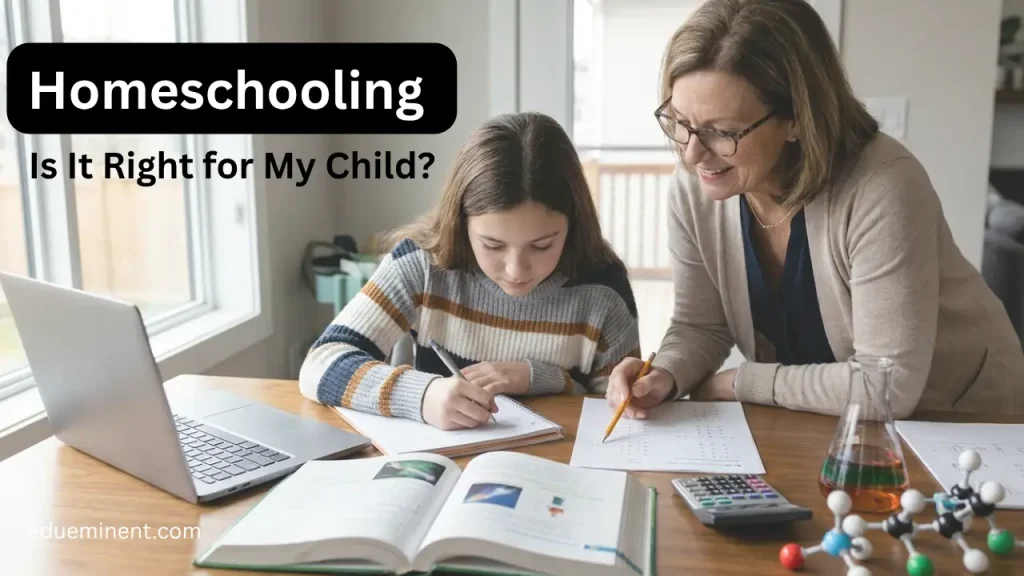
Is Homeschooling Right for My Child
This guide helps parents decide whether homeschooling is right for their child in grades 6 to 8. It explores the benefits, challenges, costs, socialisation, curriculum options, legal requirements, and practical signs that can help families choose between homeschooling, traditional school, or hybrid learning.
Middle school changes everything. The easy, sunny confidence of elementary years starts to wobble around sixth grade, and by eighth grade, many parents are watching a completely different kid walk through the door every afternoon.
Grades and moods swing. Friend groups shift overnight. Some kids sink into new pressures they cannot name, and some simply stop wanting to go to school at all.
It is exactly at this stage, more than any other, that families start seriously asking whether homeschooling might be the better path. Recent data from the National Center for Education Statistics backs this up.
Middle schoolers, specifically those in grades 6 through 8, now show the highest homeschooling rate of any grade band in the country, even higher than high school. That is a real shift from a decade ago, when families more often waited until high school to make the switch.
So is homeschooling right for your child? There is no single answer that fits every family, but there is a clear way to think it through.
This guide walks you through what homeschooling in grades 6 to 8 actually looks like day to day, the honest benefits and downsides, the signs that point toward one path or the other, and a practical framework for deciding with confidence rather than guesswork.
Students today have several options when it comes to choosing a school curriculum, and the best choice often depends on their learning style and plans. An O Level program can help students build a solid base in different subjects while preparing them for further studies.
Many families choose IGCSE because of its broad subject choices and flexible structure, while others follow the Cambridge O Level pathway for its well-established academic framework. For students looking for a different style of learning, International Baccalaureate can also be an option, with greater emphasis on inquiry, creativity, and developing a wider understanding of subjects.
Why Middle School Is the Turning Point for Homeschooling Decisions
Ask any parent of a middle schooler what changed, and you will hear a similar list. Bullying gets sharper and more social media-driven. Academic pace picks up fast, especially in math, and a kid who was doing fine in fifth grade can suddenly feel lost. Puberty adds emotional volatility on top of all of it.
Researchers who study this trend point to the same pattern. Families are increasingly pulling children out of traditional classrooms right at the point where social pressure, academic frustration, and identity questions all peak at once. It is not that elementary or high school years are free of these issues. It is that middle school concentrates them into a short, intense stretch of just three years.
This matters for your decision because it means the question is rarely just “is homeschooling good in general.” It is usually much more specific: “is homeschooling the right response to what my particular child is going through right now, at this age, in this school, with these friends, in this subject.”
That is a very different question, and it deserves a very different kind of answer than a generic pros and cons list.
What Homeschooling Actually Looks Like in Grades 6 to 8
Before weighing whether homeschooling fits your family, it helps to know what an average day actually involves, because the popular image is often wrong in both directions. It is not six unstructured hours of freedom, and it is not a miniature copy of a traditional school day either.
Families who homeschool middle schoolers typically report about three to five hours of focused academic work on a school day. Compare that to a traditional six-and-a-half-hour school day, much of which goes to transitions between classes, lining up, announcements, and managing a room of twenty-five students moving through the same material at the same pace.
One-on-one or small-group teaching covers the same academic ground in far less time, which is why homeschool days can look shorter on paper while covering just as much material.
The remaining hours in a homeschool day are not wasted. They usually go toward independent reading, hands-on projects, outside classes, sports, volunteer work, or simply unstructured time for a child to think, create, or rest.
Many educators argue that this unstructured stretch is where a lot of the real benefit of homeschooling actually happens, since it gives a middle schooler room to develop interests and self-direction that a packed school schedule rarely allows.
A typical grades 6 to 8 homeschool plan covers the same core subjects a public or private school would require: math, English language arts, science, and social studies, along with electives such as a foreign language, art, coding, or a hands-on skill the child is drawn to.
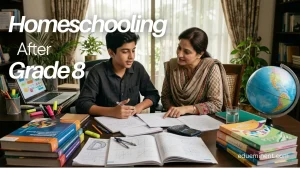
Parents who teach at home need reliable material to keep learning structured. Explore these homeschool resources in Pakistan for books, online platforms, and curriculum tools that make teaching easier.
Middle school is also the stage where students are expected to build stronger research, writing, organizational, and independent study skills before they enter high school, so a good curriculum will deliberately hand more responsibility to the student as the three years go on.
The Real Benefits of Homeschooling for Middle Schoolers
Learning Paced to the Actual Child
Every parent knows their child does not learn at a uniform speed across every subject. A kid might read two grades ahead but struggle with fractions, or breeze through science while writing essays feels like pulling teeth. In a classroom of twenty-five students, a teacher cannot slow down for one child in math and speed up for the same child in reading. At home, that flexibility is the default, not an accommodation you have to request.
Escaping a Toxic Social Environment
Sometimes the honest reason a family considers homeschooling has nothing to do with academics. It is bullying, social exclusion, or a friend group dynamic that has turned genuinely harmful. Removing a child from that environment, even temporarily, can be the single most protective decision a parent makes during these years.
More Family Time and a Calmer Pace of Life
Middle schoolers on a traditional schedule often leave home before seven in the morning and return after seven at night once sports or clubs are factored in. Homeschooling families frequently describe getting back hours of connected time together, room for a real conversation at lunch, a walk in the afternoon, or simply less rushing.
Academic Performance That Holds Up
Homeschooled students consistently score above average on standardized measures used for college admissions, and multiple studies point to homeschoolers scoring meaningfully higher than their institutionally schooled peers on general academic testing. Interestingly, this advantage shows up regardless of a parent’s income or education level, which challenges the common assumption that only highly credentialed parents can homeschool effectively.
Room to Explore Interests Deeply
A student obsessed with marine biology, coding, or history does not have to wait for a unit that touches on it for two weeks a year. Homeschool schedules can build entire projects, field trips, and reading lists around a genuine passion, which tends to build both confidence and real expertise.
Protection for Kids With Learning Differences or High Anxiety
Not every child with ADHD, dyslexia, or an anxiety disorder needs to spend their day masking symptoms in front of thirty classmates. A calmer, more individualized setting can lower stress dramatically for these kids, though it is worth noting that some children with learning differences genuinely benefit from the specialized services and trained staff a school provides, which is a real tradeoff discussed further below.
Fewer Wasted Hours on Transitions and Classroom Management
A typical school day loses a large share of its hours to things that are not actual instruction, including hallway transitions, attendance checks, waiting for a class to settle, and repeating instructions for students who were not paying attention the first time. None of that is anyone’s fault; it is simply the reality of managing a large group. At home, that overhead mostly disappears, which is part of why a focused three- or four-hour homeschool day can cover the same academic ground as a full school day.
Values and Worldview Alignment
Some families choose homeschooling specifically because they want more say in how certain topics are taught, whether that is related to religious values, a particular teaching philosophy, or simply wanting more oversight during a formative age. This is a deeply personal reason, and it is worth being honest with yourself about whether it is the true driver of your interest, since it shapes which curriculum approach will feel like the right fit.
The Honest Challenges and Downsides
No fair guide pretends homeschooling is free of real costs. Here is what families consistently report as the hard parts.
It Demands Serious Time From a Parent
Someone has to plan lessons, teach, grade, and manage the logistics of field trips, co-ops, and extracurriculars. Research on why families continue homeschooling long term points to work flexibility, not income, as the strongest predictor of whether a family sticks with it. A parent working a rigid nine-to-five job, especially in a high-intensity career, will find this genuinely difficult without a partner or extended family who can cover daytime hours.
Specialized Support Can Be Harder to Access
Public schools are legally required to provide services like speech therapy, occupational therapy, and individualized education plans for students who qualify. Homeschooling families can access many of these services independently, but it usually takes more effort, more research, and sometimes more money to arrange privately.
Socialization Takes Deliberate Effort
This is the objection every homeschooling parent has heard a hundred times, and the research on it is actually more reassuring than most people expect. Multiple peer-reviewed studies on the social, emotional, and psychological development of homeschooled kids show them performing as well as, or statistically better than, traditionally schooled peers on measures like self-concept, peer relationships, and community involvement. Homeschooled students tend to stay regularly engaged with people outside their immediate family through co-ops, scouting programs, sports leagues, and community service.
That said, this positive outcome is not automatic. It requires a parent who actively builds a social calendar, since a homeschooled child will not simply absorb peer interaction the way a school setting provides it by default.
Self-Discipline Is a Real Hurdle, Especially With Online Programs
Middle schoolers are at an age where independence is growing but far from fully formed. Families using online or virtual homeschool programs often report that keeping a child on task without built-in classroom structure takes real effort, and some students genuinely need the external accountability a school schedule provides.
The Cost of a Parent Stepping Back From Paid Work
If homeschooling means one parent reduces work hours or leaves a job entirely, that is a genuine financial tradeoff for the family to weigh honestly, separate from the curriculum cost itself.
Signs Your Child Might Thrive With Homeschooling
Every family situation is different, but certain patterns show up again and again among kids who do well outside a traditional classroom.
- Your child is a self-starter who gets restless waiting for the rest of the class to catch up.
- School anxiety, dread, or physical symptoms like stomachaches show up regularly on school mornings.
- Bullying or social exclusion has become a genuine safety or wellbeing concern.rn
- Your child has a deep, specific interest that a standard curriculum has no room for
- Learning differences mean your child needs a much slower or much faster pace than a classroom allows
- Your family travels often, or your work schedule does not match a traditional school calendar.
- Your child learns best through hands-on projects rather than sitting through lectures.
- You have the time, patience, and genuine interest in teaching, or the budget for outside tutors andco-opss
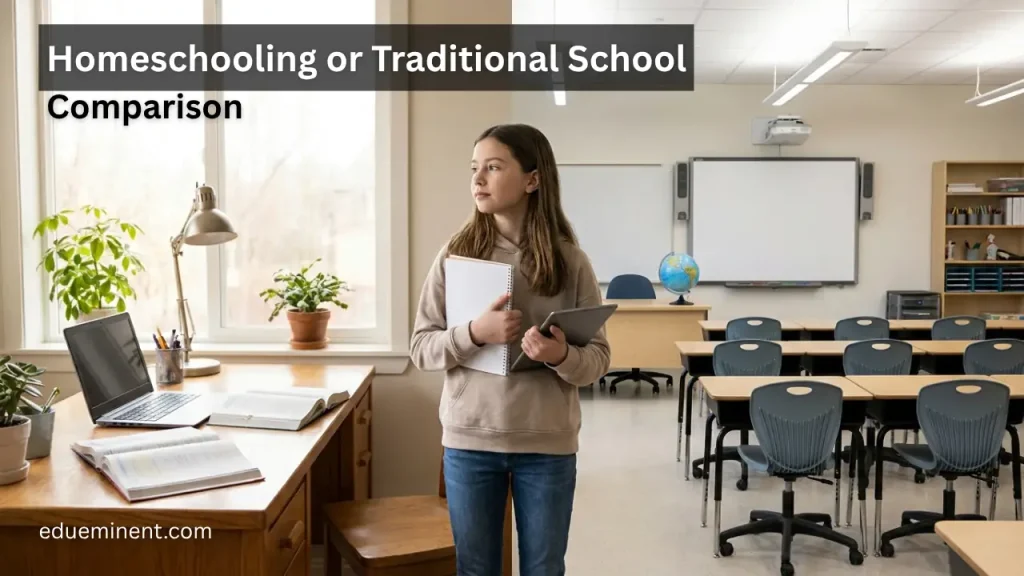
Signs Your Child Might Do Better in a Traditional School
Homeschooling is not the right fit for every family or every child, and there is no shame in recognizing that.
- Your child genuinely thrives on the structure and rhythm of a traditional school day.
- Your child’s closest friendships are built almost entirely through the school community.
- Your child needs specialized services, such as speech therapy or a formal IEP, that are easier to access through a public school. ol
- No adult in the household has the daytime flexibility to teach, supervise, and manage a homeschool schedule.
- Your child craves the built-in social variety of a larger peer group and extracurricular teams.
- You do not feel confident guiding subjects like algebra or middle school science without significant outside support.t
How to Decide: Step-by-Step Framework for Parents
Step One: Name the Real Problem or Goal
Write down, honestly, what is driving the conversation. Is it a bullying situation, a mismatch in academic pace, a mental health concern, a scheduling conflict, or simply curiosity about a different approach? The clearer the real reason, the easier it is to judge whether homeschooling actually solves it.
Step Two: Talk to Your Child
A twelve- or thirteen-year-old has real opinions about their own education, and middle school is exactly the age where their input matters. Ask what they like and dislike about school right now, and listen for what they are actually describing underneath the surface complaint.
Step Three: Check Your Family’s Logistics Honestly
Look at work schedules, income needs, and who would actually do the teaching and supervising day to day. This is often the single biggest factor in whether homeschooling is realistic, separate from whether it would be beneficial in theory.
Step Four: Research Your State or Country’s Legal Requirements
Homeschooling regulations vary widely by location. Some places require simple notification, while others require standardized testing, portfolio reviews, or specific curriculum approval. Look up your local department of education’s homeschooling requirements before making any final decision, since this affects both the paperwork and the curriculum choices available to you.
Step Five: Try a Trial Period if Possible
Many families test the waters over a summer, a single semester, or even just a few weeks before committing to a full year. A trial period lets you gauge how your child responds and whether the daily rhythm actually works for your household, without the pressure of an irreversible decision.
Step Six: Explore Hybrid and Middle Ground Options
Full-time homeschooling is not the only alternative to a traditional five-day school week. Many communities now offer hybrid schools that meet two or three days a week, learning co-ops that split teaching duties among several families, and online academies that provide structure without a physical classroom. These middle ground options are worth exploring before assuming it is an all-or-nothing choice.
Homeschooling Approaches and Curriculum Options for Grades 6 to 8
There is no single way to homeschool, and knowing the main approaches helps you pick one that matches both your child’s learning style and your own bandwidth as a parent.
A traditional or textbook-based curriculum follows a structured, sequential plan similar to what a school would use, with textbooks, workbooks, and clear grade-level benchmarks. This works well for families who want a familiar, easy-to-follow structure.

Classical education emphasizes logic, rhetoric, and the great works of literature and history, building toward independent critical thinking as the student matures. It suits kids who enjoy deep reading and structured argument.
Unit studies organize learning around a central theme, pulling in math, science, reading, and writing all connected to one topic, such as ancient Egypt or the solar system. This suits kids who like connecting ideas across subjects rather than studying them in isolation.
Online or virtual academies provide a full curriculum delivered through video lessons, digital assignments, and sometimes live classes with certified teachers. These offer more built-in structure than a fully independent program, which can help kids who need external accountability, though they still require solid self-discipline and screen-time management.
Unschooling follows the child’s natural curiosity with little formal structure, trusting that real learning happens through exploration, projects, and life experience. This fits highly self-directed kids but requires a parent comfortable with a much looser approach.
Homeschool co-ops and hybrid programs split teaching responsibilities among a group of families or combine home learning with a few days a week at a physical location. This is often the best entry point for families new to homeschooling, since it spreads out the teaching workload and builds in a peer group automatically.
Most families land somewhere in between these categories, mixing a structured core curriculum for math and language arts with a looser, interest-driven approach for electives and projects.
Homeschooled students still need recognized qualifications to move ahead. Learn how homeschooling exams in Pakistan work, including registration, boards, and the options available for each grade.
Addressing the Socialization Question Directly
Because this comes up in nearly every conversation about homeschooling, it deserves a direct answer rather than a quick dismissal.
The research picture has grown more detailed over the past several years. A meaningful majority of peer-reviewed and representative sample studies on the social, emotional, and psychological development of homeschooled kids find them performing as well as or better than traditionally schooled peers, across measures like peer relationships, self-esteem, leadership, and community involvement. Some longer-term studies have even found lower reported anxiety and depression scores among long-term homeschoolers compared to other groups.
The important caveat is that this outcome depends heavily on what a family actually does with their time. Homeschooled kids who are regularly involved in co-ops, scouting, community sports, volunteer work, and group classes tend to build strong, varied peer relationships.
A family that isolates a child at home with no outside activities is a very different situation, and that is where legitimate concerns about isolation can become real. The research supports homeschooling as a socially sound choice when families are intentional about building outside connections, not as an automatic guarantee regardless of effort.
Conclusion
There is no universal right answer to whether homeschooling fits your family. What matters is being honest about the actual problem you are trying to solve, realistic about your family’s logistics, and willing to revisit the decision if it is not working after a real trial period.
Middle school is a short but intense stretch of just three years, and the right setting for your child during this window may not be the same setting that worked in elementary school or the one that will work in high school.
Whatever you decide, the goal is the same one every parent is already working toward: a child who feels confident, capable, and genuinely supported as they grow into the next stage of their education.
If you are still weighing the decision, talk it through with your child, look into a local homeschool co op or support group in your area, and consider starting with a short trial period before committing to a full academic year. That is often the clearest way to find out what actually works for your family, rather than guessing from the outside.
Legal Requirements and Getting Started
Homeschooling laws differ significantly depending on where you live, so this is not a step to skip or guess at.
In general, most regions require at least one of the following: a formal notice of intent filed with a school district or state education office, periodic assessment through standardized testing or portfolio review, and a record of instructional hours or subjects covered.
Some places are far more relaxed, while others have detailed requirements around curriculum approval or teacher qualifications for the instructing parent.
Before your first day of homeschooling, take these practical steps. Contact your local or state department of education directly to confirm the current requirements, since rules do change from year to year. Withdraw your child formally from their current school if required, rather than simply not showing up, to avoid truancy complications.
Choose your curriculum approach based on the options above, matched to your child’s learning style and your own schedule. Set up a simple record-keeping system for attendance, assignments, and any required testing.
Finally, connect with a local or online homeschooling community early, both for support and for the social opportunities that make such a real difference during these years.
Frequently Asked Questions
Is it too late to start homeschooling in sixth, seventh, or eighth grade?
No. Middle school is actually one of the most common points at which families begin homeschooling, precisely because it is when academic and social challenges tend to surface most clearly. Many kids adjust within the first few weeks to a couple of months.
Will my child fall behind academically if I homeschool them?
The evidence points the other way for most homeschooled students, who tend to score above average on standardized measures. What matters most is choosing a curriculum with clear grade-level benchmarks and staying consistent with it, especially in math, where gaps are easiest to accumulate unnoticed.
Do I need to be a certified teacher to homeschool my middle schooler?
In most places, no formal teaching credential is required, though requirements vary by location. Many families successfully teach middle school subjects without a teaching background, often supplementing harder subjects like algebra or a foreign language with online courses, tutors, or co op classes.
How much does homeschooling cost for grades 6 to 8?
Costs vary enormously depending on the curriculum and outside classes you choose, ranging from very low-cost options using free or library-based materials up to several thousand dollars a year for full online academies, tutors, and co op fees.
Can my child go back to a traditional school later if homeschooling does not work out?
Yes. Most students can reenroll in public school, and many districts have a straightforward process for evaluating grade placement based on the records or portfolio you have kept.
How do I make sure my homeschooled middle schooler stays socially connected?
Build outside activities into the weekly schedule deliberately, through a homeschool co op, sports league, scouting group, community volunteer work, or regular classes with other homeschooled peers. Socialization at this age works best when it is planned rather than left to chance.
What if only one parent can be home during the day?
This is workable but demanding. Families in this situation often lean more heavily on online academies, co-ops, and outside tutors to cover instructional time, reserving the working parent’s evenings and weekends for review and connection rather than full-day teaching.
What subjects tend to be hardest for parents to teach at grades 6 to 8?
Algebra readiness, middle school level science labs, and a foreign language are the three subjects parents most commonly outsource, whether through an online course, a co op class, or a tutor. It is completely normal to teach most subjects yourself while bringing in outside help for one or two harder ones.
How many hours a day should a grade 6 to 8 homeschool schedule include?
Most families land somewhere between three and five hours of focused academic work, with the exact number depending on the child’s pace, the subjects covered that day, and how much independent work the student can handle without direct supervision.