
IGCSE and GCSE are equivalent secondary school qualifications but differ in curriculum, assessment, flexibility, and international recognition. This guide compares both systems, explaining their advantages, grading, difficulty, and future study opportunities to help students choose the qualification that best matches their academic goals.
Choosing the right qualification during secondary school can have a big impact on your future academic journey. Two of the most popular options for students around the world are the IGCSE (International General Certificate of Secondary Education) and the GCSE (General Certificate of Secondary Education).
Both are equivalent in level and are typically taken by students aged 14 to 16, but they differ in structure, examination boards, teaching approach, and recognition.
The GCSE is mainly offered in the United Kingdom and follows the national curriculum, focusing on local educational standards. In contrast, the IGCSE was developed by the University of Cambridge International Examinations (CIE) to provide an international alternative, making it ideal for students outside the UK or those in international schools.
While both qualifications prepare students for A Levels or equivalent higher-level studies, the IGCSE is often seen as more flexible, globally recognized, and suited to diverse learning environments, whereas the GCSE is known for its strong foundation in the UK education system.
In this article, we’ll break down the key similarities and differences between IGCSE and GCSE, compare their curriculum design, assessment methods, grading systems, and future opportunities, and help you decide which qualification is best for you.
What Is GCSE?
The GCSE (General Certificate of Secondary Education) is a well-established academic qualification typically taken by students in the United Kingdom at the end of Key Stage 4, usually around the ages of 14 to 16. It serves as the main school-leaving qualification and a foundation for further education, such as A Levels, vocational training, or college diplomas.
The GCSE curriculum is designed by UK examination boards such as AQA, Edexcel (Pearson), and OCR, and it follows the UK National Curriculum. Students usually study a range of subjects, including English Language, English Literature, Mathematics, Science, History, Geography, and Modern Languages, along with optional courses based on their interests.
GCSE exams are subject-based and include a combination of written exams, coursework, and practical assessments, depending on the subject. Grading is now done on a numerical scale from 9 to 1, where 9 is the highest grade.
In essence, GCSEs provide a broad academic foundation, helping students develop key analytical, writing, and problem-solving skills that are essential for higher education and future careers. They are recognized throughout the UK and internationally, particularly for students continuing their studies in A Levels or equivalent programs.
Key Features of GCSE
Here are the main features that define the GCSE qualification:
- Age Group: Typically designed for students aged 14 to 16 in the United Kingdom (Years 10 and 11).
- Curriculum Structure: Based on the UK National Curriculum, ensuring consistency and quality across subjects such as English, Mathematics, and Science.
- Subjects Offered: Students generally take 8 to 10 subjects, including core subjects (English, Math, Science) and optional ones like Geography, History, Art, or Computer Science.
- Assessment Method: Primarily assessed through final written examinations, with some subjects including coursework, projects, or practical work (e.g., in Art or Science).
- Grading System: Uses a numerical grading scale (9–1), where 9 represents the highest achievement and 1 the lowest. A grade 4 is considered a standard pass, while 5 is a strong pass.
- Exam Boards: Conducted by major UK boards such as AQA, Edexcel (Pearson), and OCR, ensuring reliability and standardization across schools.
- Duration: The GCSE course usually takes two academic years to complete, with exams held at the end of Year 11.
- Purpose: Acts as a gateway qualification for further education such as A Levels, vocational diplomas, or apprenticeships.
- Recognition: Widely recognized within the UK and internationally for its academic rigor and comprehensive assessment approach.
- Skills Development: Encourages the development of critical thinking, analytical, research, and problem-solving skills, preparing students for higher education and professional life.
Overall, the GCSE system offers a balanced academic framework that combines theoretical knowledge with practical application, giving students a solid foundation for their next educational steps.
What Is IGCSE?
The IGCSE (International General Certificate of Secondary Education) is an internationally recognized qualification designed for students aged 14 to 16, similar in level to the UK’s GCSE. Developed by Cambridge Assessment International Education (CAIE), the IGCSE was created to provide a flexible, global alternative to the traditional UK curriculum, making it suitable for students studying in international schools or outside the UK.
IGCSE offers a broad range of subjects, including Mathematics, English, Sciences, Humanities, Languages, Business, and Technology, allowing students to tailor their education according to their interests and future career goals. The curriculum emphasizes conceptual understanding, analytical skills, and practical knowledge, preparing students for further studies such as A Levels, IB, or vocational programs.
Assessment for IGCSE is exam-based, but many subjects also include coursework, practical tasks, or oral assessments. Exams are typically conducted in May/June and October/November, with grading on a 9–1 scale or A*–G, depending on the examination board.
The IGCSE is a globally flexible and internationally recognized qualification that equips students with the knowledge, skills, and confidence needed to succeed in higher education and competitive academic environments worldwide.
Key Features of IGCSE
The IGCSE (International General Certificate of Secondary Education) offers a flexible and globally recognized secondary education qualification. Here are its main features:
- International Recognition: Accepted by universities and schools worldwide, making it ideal for students aiming for global higher education opportunities.
- Age Group: Designed for students aged 14 to 16, similar to the GCSE age group.
- Wide Range of Subjects: Offers over 70 subjects, including core subjects like English, Mathematics, and Science, as well as electives in Languages, Humanities, Arts, and Business.
- Flexible Curriculum: Allows students to choose subjects based on their interests, strengths, and career goals, promoting a personalized learning experience.
- Assessment Method: Primarily exam-based, with some subjects including coursework, practicals, or oral assessments, depending on the subject.
- Grading System: Uses either the 9–1 numerical grading scale or A–G*, depending on the examination board, providing clear academic benchmarks.
- Exam Sessions: Conducted twice a year in May/June and October/November, offering flexibility for students in different regions.
- Focus on Skills: Emphasizes critical thinking, problem-solving, research, and application-based learning, rather than rote memorization.
- Preparation for Higher Studies: Acts as a stepping stone to A Levels, IB Diploma, or vocational qualifications, equipping students with essential knowledge and skills.
- Global Learning Perspective: The curriculum is designed with an international outlook, making it suitable for diverse cultural and educational contexts.
Overall, the IGCSE provides a flexible, skills-oriented, and internationally recognized education, preparing students for success in advanced studies and global academic environments.
Main Differences; IGCSE vs GCSE
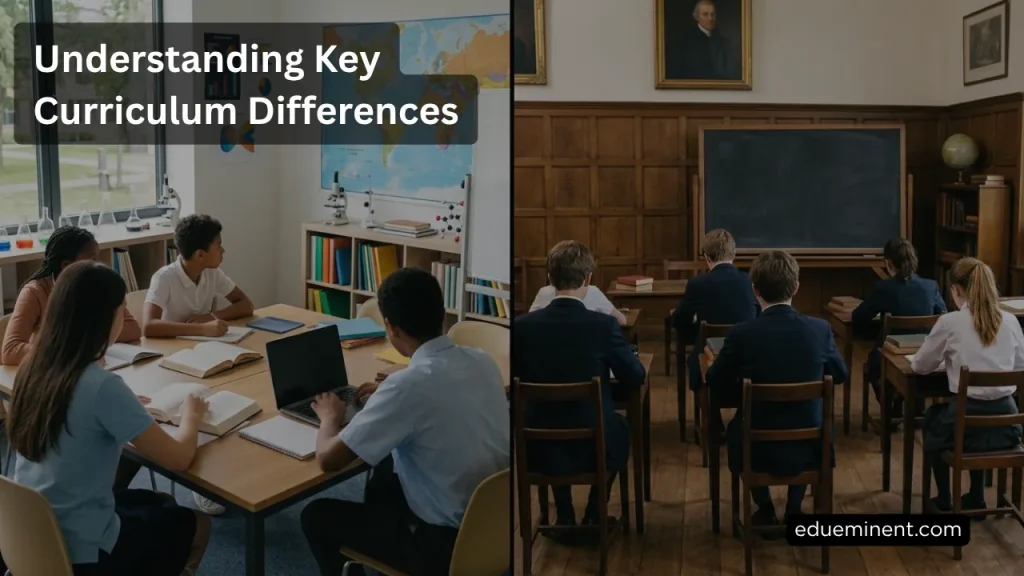
Although IGCSE and GCSE are both secondary education qualifications for students aged 14–16, they differ in several key aspects. Here’s a detailed comparison in paragraph format for easier understanding:
1. Curriculum and Focus
The GCSE follows the UK National Curriculum, focusing on British educational standards and preparing students primarily for further study in the UK. In contrast, the IGCSE is internationally oriented, offering a flexible syllabus that accommodates students from diverse countries and educational systems.
2. Exam Boards
GCSE exams are conducted by UK-based boards such as AQA, Edexcel, and OCR. IGCSE exams, on the other hand, are mainly offered by Cambridge Assessment International Education (CAIE) and Edexcel International, with a focus on global applicability.
3. Assessment Method
While both qualifications are primarily exam-based, IGCSE often includes coursework, practicals, and oral assessments, depending on the subject. GCSE, though it may include coursework in some subjects, is largely standardized and exam-focused.
4. Subjects Offered
IGCSE provides over 70 subjects, giving students more elective options to align with their interests and career goals. GCSE usually offers 10–12 subjects, focusing more on core areas like English, Maths, and Science.
5. Grading System
Both qualifications use the 9–1 numerical grading system, although some IGCSE boards also use the A–G* scale. A grade of 9 represents the highest achievement, while 4 is a standard pass.
6. Global Recognition
IGCSE is highly recognized worldwide, making it ideal for students planning to study abroad. GCSE is primarily recognized within the UK, though it is also accepted by some international universities.
7. Flexibility and Learning Style
IGCSE is generally considered more flexible and analytical, emphasizing conceptual understanding and practical skills. GCSE is more structured and standardized, suitable for students who prefer a traditional UK exam-focused approach.
- Choose IGCSE if you want a globally recognized, flexible qualification with a wide range of subjects and practical learning.
- Choose GCSE if you are following the UK curriculum or studying in the UK and prefer a more structured, exam-driven approach.
Both qualifications provide a strong foundation for A Levels, IB, or other higher education pathways, so the choice depends on your location, learning style, and future academic goals.
Which Is Harder: IGCSE or GCSE?
When comparing IGCSE and GCSE, the question of difficulty depends largely on a student’s learning style, curriculum familiarity, and exam preferences. Both qualifications are designed for students aged 14–16 and cover similar core subjects, but some differences can affect perceived difficulty.
1. Curriculum Approach
- GCSE follows the UK National Curriculum, which is standardized and exam-focused. Students study prescribed content, making it easier to predict exam topics.
- IGCSE has a broader, international curriculum with a focus on analytical thinking, conceptual understanding, and application-based learning. Some students may find this approach more challenging because it tests understanding rather than memorization.
2. Assessment Style
- GCSE exams are mainly written and structured, with some coursework depending on the subject.
- IGCSE exams often include coursework, practicals, and oral assessments in addition to written tests. This multi-component assessment can be demanding but also offers flexibility for students who excel in different types of evaluation.
3. Subject Options
- IGCSE offers a wider range of subjects, some of which are more advanced or internationally oriented. The diversity of content can make IGCSE appear harder for students unfamiliar with global contexts.
- GCSE has fewer subject options and a more standardized syllabus, which can make it easier to focus and prepare.
4. Skills Required
- IGCSE emphasizes critical thinking, problem-solving, and practical application, which can be challenging for students accustomed to rote learning.
- GCSE focuses more on memorization and standard exam techniques, which may be easier for students who thrive in a structured environment.
Final:
- IGCSE can be considered slightly more challenging due to its international approach, analytical focus, and broader subject range.
- GCSE is generally easier to navigate for students following the UK curriculum or who prefer a standardized exam-based system.
Ultimately, the difficulty of either qualification depends on your strengths, learning style, and preparation strategy. Students who enjoy practical, application-based learning may find IGCSE engaging, while those who prefer structured exams may feel more comfortable with GCSE.
Advantages and Disadvantages of IGCSE & GCSE

Both IGCSE and GCSE are widely respected secondary education qualifications, but each has its strengths and drawbacks depending on a student’s learning style, goals, and study environment.
Advantages of IGCSE
- International Recognition: Accepted by universities and schools worldwide, making it ideal for students planning to study abroad.
- Wide Range of Subjects: Offers over 70 subjects, allowing students to choose according to their interests and career plans.
- Flexible Curriculum: Designed for a global audience, it accommodates different learning contexts and cultural perspectives.
- Skills-Oriented Learning: Emphasizes analytical thinking, problem-solving, and practical application rather than rote memorization.
- Preparation for Higher Studies: Acts as a strong foundation for A Levels, IB, and other advanced qualifications.
Disadvantages of IGCSE
- Higher Difficulty for Some Students: The international and analytical approach may be challenging for students accustomed to exam-focused or rote learning.
- Limited Local Resources: Some regions may have fewer experienced teachers, textbooks, or past papers compared to the UK-based GCSE.
- Cost: Often more expensive than GCSE due to international exam fees and resources.
Advantages of GCSE
- Aligned with UK Curriculum: Follows a standardized syllabus, making it easier to predict exam content.
- Accessible in the UK: Widely offered across schools in the UK, with plenty of learning materials, practice exams, and teacher support.
- Structured Assessment: Mostly exam-based with clear grading, suitable for students who prefer traditional evaluation methods.
- Recognized Nationally: Well-recognized by universities and employers in the UK and some international institutions.
Disadvantages of GCSE
- Limited International Focus: The curriculum is less flexible and internationally oriented compared to the IGCSE.
- Fewer Subject Options: Offers fewer electives, which may limit exploration of diverse interests.
- Less Skills-Based Learning: Focuses more on memorization and standard exams rather than practical and analytical skills.
Both qualifications provide a strong academic foundation, but the choice depends on your goals, location, and learning preferences.
Which Qualification Should You Choose: IGCSE or GCSE?
Choosing between IGCSE and GCSE depends on your academic goals, learning style, and plans. Both qualifications provide a solid foundation for higher education, but they differ in flexibility, international recognition, and assessment style.
Choose IGCSE if you:
- Plan to study abroad or attend an international school.
- Prefer a flexible and skills-oriented curriculum with a wide range of subjects.
- Enjoy analytical thinking, problem-solving, and application-based learning.
- Want a qualification that is globally recognized for university applications.
Choose GCSE if you:
- Are you studying within the UK or following the UK national curriculum?
- Prefer a structured, standardized, and exam-focused system.
- Want a predictable syllabus and assessments with ample learning resources.
- Aim for qualifications that are widely recognized by UK universities and employers.
Both IGCSE and GCSE are respected internationally, and either choice can lead to success in A Levels, IB, or vocational studies. The key is to select the qualification that aligns with your strengths, study environment, and long-term academic goals.
Consider your future university plans, preferred learning style, and subject interests before making the decision. This ensures you choose the qualification that best supports your educational journey.
Conclusion
Choosing between IGCSE and GCSE is an important decision that can shape your educational journey and future opportunities. Both qualifications are designed for students aged 14–16 and prepare them for higher education, but they differ in curriculum design, assessment methods, flexibility, and global recognition.
- IGCSE offers a more flexible, internationally-oriented curriculum with a wide range of subjects and a focus on analytical thinking, problem-solving, and practical skills. It is highly suitable for students who aim to study abroad or pursue higher education in international universities. Its broad subject choices also allow students to explore their interests and align learning with career goals.
- GCSE, on the other hand, is structured around the UK National Curriculum and is primarily recognized in the UK. It provides a standardized and exam-focused learning experience, making it easier for students to navigate if they are familiar with the British education system. GCSE is ideal for students who prefer traditional assessment methods, consistency in grading, and a clear pathway to A Levels or vocational studies in the UK.
Both qualifications develop strong academic foundations, critical skills, and subject knowledge, ensuring students are well-prepared for A Levels, IB, or other advanced programs. The choice ultimately depends on your personal learning style, future academic plans, and career ambitions. By carefully considering your strengths, goals, and preferences, you can select the qualification that best supports your long-term success and educational growth.
There is no one-size-fits-all answer. Both IGCSE and GCSE offer valuable learning experiences and can lead to excellent opportunities. The most important factor is to choose the path that aligns with your aspirations, challenges you appropriately, and prepares you for the next stage of your academic journey.
Frequently Asked Questions (FAQs)
1. What is the main difference between IGCSE and GCSE?
IGCSE is internationally focused, flexible, and recognized worldwide, while GCSE follows the UK national curriculum and is mainly recognized in the UK.
2. Which one is harder: IGCSE or GCSE?
IGCSE is generally considered slightly harder due to its analytical and application-based approach, whereas GCSE is more exam-focused and standardized.
3. Are IGCSE and GCSE equivalent?
Yes, both are considered equivalent in terms of academic level, typically taken by students aged 14–16, and both prepare students for A Levels or IB.
4. Can IGCSE students study in the UK for A Levels?
Yes, IGCSE is widely accepted in the UK and internationally for progression to A Levels, IB Diploma, or other advanced qualifications.
5. How many subjects can a student take in IGCSE and GCSE?
- IGCSE: Offers 70+ subjects, allowing more flexibility.
- GCSE: Usually 10–12 subjects, focusing on core subjects.
6. Which qualification is better for studying abroad?
IGCSE is preferred for international education because it is recognized by universities worldwide.
7. Are both qualifications recognized in Pakistan?
Yes, both IGCSE and GCSE are recognized in Pakistan, but IGCSE is more commonly offered in international schools.
8. How are IGCSE and GCSE graded?
Both use the 9–1 numerical grading system (9 = highest), though some IGCSE boards also use A–G*.
9. Do IGCSE and GCSE include coursework?
IGCSE often includes coursework, practicals, or oral assessments, while GCSE is mostly exam-based with limited coursework.
10. Which qualification is better for critical thinking and skills development?
IGCSE emphasizes critical thinking, problem-solving, and application-based learning, making it more suitable for students aiming to develop analytical skills.
