
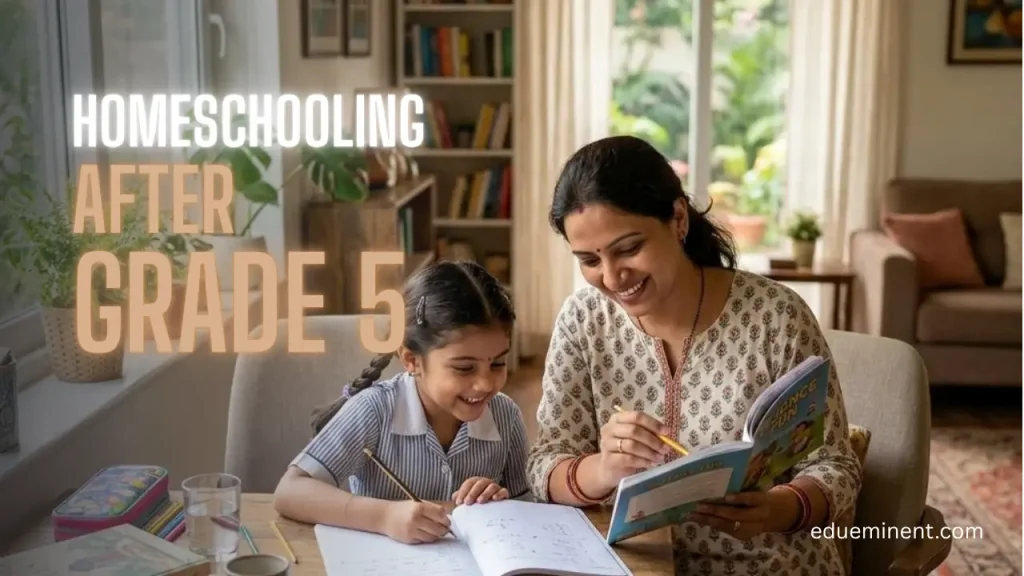
Homeschooling after grade 5 helps parents prepare children for the transition into grades 6 to 8. This guide covers curriculum selection, deschooling, legal requirements, academic assessments, learning gaps, student independence, socialisation, and practical steps for building a manageable homeschooling routine.
If you are new to home education, it helps to understand what homeschooling actually involves. What Is Homeschooling? explains the basics and gives parents a clearer starting point.
Homeschooling after grade 5 is one of the most common points where families make the switch from traditional school to learning at home, and for good reason.
Elementary school is ending, middle school is about to begin, and many parents see this natural break as the ideal moment to try something different before the workload and social pressures of grades 6 through 8 really ramp up.
This guide walks through everything a family needs to think about when starting homeschool right after grade 5, from the legal steps and academic transition to the emotional adjustment both parent and child go through in the first few months.
Whether you are still deciding or have already made the choice, this guide gives you a clear, realistic roadmap for the year ahead.
Why Grade 5 Is Such a Common Turning Point
Grade 5 sits at the very end of elementary school in most systems, which makes it a natural exit point rather than an awkward midstream withdrawal.
Starting homeschool at the beginning of grade 6 avoids pulling a child out partway through a school year and lets a family begin fresh at the start of a new academic stage.
Middle school itself is also a major shift, even for children who stay in traditional school. Students move from a single classroom teacher to multiple subject teachers, homework increases, and social dynamics become more complex.
Many parents who were on the fence about homeschooling decide that if their child is going to face a big transition anyway, it might as well be a transition into a home-based education they can shape directly.
Finally, grade 5 marks the point where many children are ready for real academic independence.
A ten- or eleven-year-old can read instructions, manage a simple schedule, and complete assignments with far less hand-holding than a first or second grader would need, which makes homeschooling logistically easier to start at this age than at many others.
Having the Conversation With Your Child Before You Start
How a child hears about the decision to homeschool matters almost as much as the decision itself, particularly for a ten- or eleven-year-old who has clear opinions and established friendships at their current school.
It is easier to plan lessons when you know what you want your child to achieve. Homeschooling Goals explains how parents can set realistic academic and personal goals for the year.
A calm, honest conversation, held well before the actual transition, gives a child time to process the change rather than feeling it was decided entirely without them.
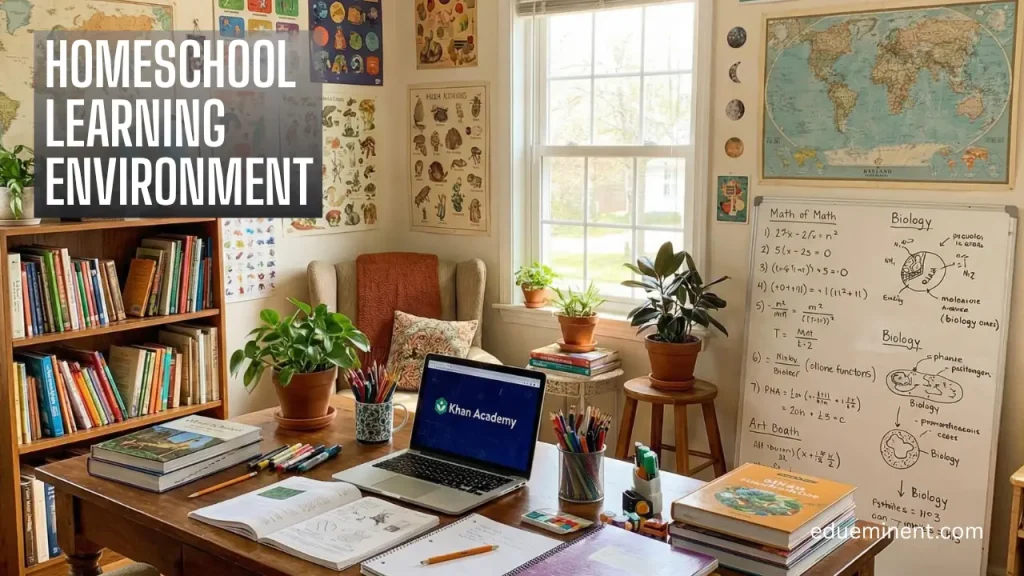
Explaining the reasons behind the choice in terms a middle schooler can understand, and directly addressing what will stay the same, such as existing friendships and outside activities, helps reduce anxiety about the unknown.
Inviting genuine questions, including ones you might not have a perfect answer for yet, builds trust in the process rather than presenting homeschooling as an already finalized plan with no room for the child’s own feelings.
Children who feel like active participants in this decision, even when the final choice ultimately rests with the parents, generally adjust to the transition with less resistance than those who feel the change happened entirely to them.
What Changes Academically Moving From Grade 5 Into Grade 6
Understanding what grade 6 actually demands, compared to grade 5, helps set realistic expectations for the first year of homeschooling.
Teaching at home involves more than simply following a textbook from beginning to end. How to Teach at Home covers useful approaches for explaining lessons, supporting your child, and keeping learning on track.
Math typically shifts from basic arithmetic and early fractions into more formal work with fractions, ratios, and the beginning of pre-algebra concepts.
Reading moves from mostly narrative fiction into more analytical work, including identifying themes, comparing texts, and writing longer, more structured essays.
Science becomes more specialized, often splitting into life science, earth science, and physical science rather than a single general science course.
Social studies expands into world history, geography, and civics topics that go beyond the community- and country-focused units common in elementary school.
None of these shifts are dramatic on their own, but together they represent a real step up in both content and expectation.
A homeschooling parent starting fresh after grade 5 should expect to spend more time locating grade-appropriate materials than they might have needed for earlier grades, simply because the subject matter itself has grown more specific.
Understanding Deschooling Before You Start
Deschooling is the process of mentally and emotionally adjusting away from a traditional school mindset before diving into a new homeschool routine, and it matters more for a child leaving school after grade 5 than many parents expect.
A child who has spent five or six years in a traditional classroom has absorbed certain expectations about what learning looks like, including grades, bells, worksheets, and a fixed schedule.
Jumping straight into an intense, fully scheduled homeschool day can backfire, since the child has not yet adjusted to the freedom and different rhythm that homeschooling offers.
One commonly used guideline suggests allowing roughly one month of deschooling time for every year a child spent in traditional school, though this is a general rule of thumb rather than a fixed requirement, and many families adjust it based on how their own child responds.
During this period, formal lessons often take a back seat to reading for pleasure, exploring interests, and simply resetting the emotional relationship a child has with learning.
Skipping deschooling entirely is not a mistake every family regrets, since some children transition smoothly with little adjustment needed.
It is, however, worth watching for signs of resistance, exhaustion, or anxiety in the first few weeks, since these often signal that a short break from formal structure would help more than pushing through a rigid plan.
How to Legally Withdraw From School After Grade 5
Before anything else, families need to handle the legal side of ending traditional enrollment and beginning homeschooling, since requirements vary depending on where you live.
Most places require some form of written notice to the current school or a local education authority, and many also require simple recordkeeping going forward, such as an attendance log or a portfolio of work samples.
Some regions require standardized testing at certain grade levels, while others ask for almost nothing beyond the initial notice.
- Contact your local school district or education department directly to confirm the exact withdrawal process, since procedures differ even between neighboring areas.
- Request your child’s full academic records and any standardized test history before finalizing the withdrawal, since these become much harder to obtain later.
- Ask specifically whether any testing or reporting is required during the upcoming grade 6 to 8 years, and note those deadlines on your calendar immediately.
- Keep a copy of every document you submit, including the exact date of withdrawal, in case questions arise later.
Handling this paperwork properly at the very start avoids complications down the road, particularly if a family later decides to return a child to traditional school or needs official documentation for another purpose.
Getting Academic Records and Identifying Learning Gaps
Academic records from the previous school serve two purposes when starting homeschool after grade 5. They provide a paper trail for legal and administrative purposes, and they give you a genuine starting point for planning the coming year’s curriculum.
Report cards and any standardized test scores show where a child was performing relative to grade-level expectations, though these numbers rarely tell the full story.
A short series of informal assessments during the first few weeks of homeschooling, covering core subjects like math and reading, often reveals far more useful detail than an old test score, especially since children sometimes underperform in a traditional classroom setting for reasons that have nothing to do with their actual understanding.
Rather than assuming a child is exactly on grade level in every subject, use this early assessment period to identify genuine strengths and specific gaps.
It is completely normal, and extremely common, for a child moving into homeschooling to be ahead in one subject and slightly behind in another, and knowing this upfront lets you build a first-year plan that actually fits rather than one based on assumptions.
Catching Up in a Specific Subject Without Overwhelming Your Child
Discovering a genuine gap, most commonly in math, is one of the more stressful moments for a parent in this first year, though it is far more manageable than it initially feels.
The instinct to immediately double up on lessons or add extra worksheets often backfires, since a child who already feels behind rarely responds well to more of the same pressure that likely contributed to the gap in the first place.
A more effective approach usually involves stepping back to find the last concept a child genuinely mastered, rather than starting at their official grade level, even if that means beginning several months or even a full grade level earlier in that one subject.
Short, consistent daily practice in the specific skill that is missing, combined with patience and a willingness to move at the pace the child actually needs, closes most gaps within a single semester for a motivated middle schooler.
It also helps to separate a subject-specific gap from a child’s overall intelligence or capability in your own mind and in how you talk to your child about it, since a struggling math score after years in a traditional classroom is rarely a reflection of genuine ability, and treating it as a temporary, fixable gap rather than a permanent label makes a real difference in how quickly a child recovers their confidence.
Choosing a Curriculum for the Grade 6 to 8 Transition
Curriculum choice matters enormously in this first year, since the right program can make an already significant transition much smoother, while the wrong fit can add unnecessary stress on top of everything else changing at once.
All-in-one or boxed curriculum. These programs bundle every core subject together with a clear scope and sequence, which removes much of the planning burden during a year when a family is already adjusting to a completely new routine.
Online and video-based programs. A structured online platform can provide built-in lessons, practice, and grading, which is especially helpful for a parent who feels less confident teaching grade 6-level material directly, particularly in math or science.
Local co-op or hybrid programs. Meeting with other homeschooling families a few days a week gives a newly homeschooled child social contact and outside instruction during a transition that can otherwise feel isolating if a family jumps straight into a fully independent, at-home-only routine.
Eclectic and interest-led approaches. Some families prefer to mix and match resources by subject, choosing whatever fits each area best rather than committing to one full package, which works well for parents who already have a clear sense of their child’s specific needs after reviewing report cards and initial assessments.
Whatever you choose, consider starting with a curriculum that includes a placement test or clear entry assessment, so your child begins at the right level in each subject rather than repeating material they already know or struggling with content introduced too soon.
Building Independence: The Biggest Shift After Grade 5
The single biggest change in homeschooling grades 6 through 8, compared to homeschooling younger children, is how much responsibility shifts onto the student rather than the parent.
A child moving from grade 5 into a homeschooled grade 6 should begin taking on real ownership of their daily checklist, their assignment deadlines, and eventually their own study strategies. This does not mean removing parental involvement entirely.
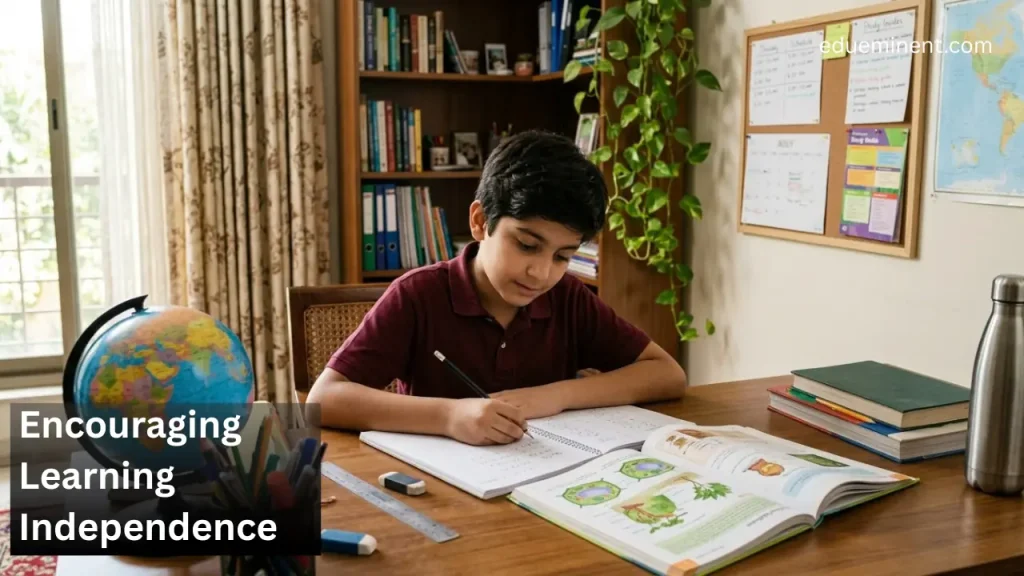
It means shifting from direct instruction toward mentorship and periodic check-ins, letting the child manage more of the actual process.
Building this independence gradually, rather than all at once, tends to work best. In the first few weeks, a parent might sit alongside a child for most lessons.
By a few months in, that same parent might only be checking in at the start and end of each day, with the child managing the middle of the day independently.
- Give your child a written or digital daily checklist rather than verbal instructions delivered one at a time.
- Ask them to estimate how long each task will take, then compare that estimate to the actual time spent, which builds planning skills over time.
- Introduce a simple planner or calendar app so the student begins tracking their own deadlines rather than relying entirely on parental reminders.
- Praise organized, independently completed work as much as correct answers, since the organizational habit matters just as much as the academic content at this stage.
A Sample First 90 Days Plan for New Homeschoolers
Breaking the first three months into distinct phases helps set realistic expectations rather than assuming the ideal homeschool routine should appear on day one.
| Timeframe | Primary Focus |
| Weeks 1 to 2 | Deschooling, light reading, exploring interests, minimal formal lessons |
| Weeks 3 to 4 | Informal assessments in core subjects, curriculum selection and ordering |
| Weeks 5 to 8 | Gradual introduction of a daily schedule, starting with two or three subjects |
| Weeks 9 to 12 | Full subject schedule in place, increasing independent work blocks |
This pacing is a general guide rather than a strict rule, and some children move through these phases faster or slower depending on their personality and how the previous school experience felt to them.
The goal is steady progress toward a sustainable routine, not rushing to replicate a full school day from the very first week.
Addressing the Socialization Question Honestly
Almost every family considering homeschooling after grade 5 hears some version of the socialization question from friends, relatives, or their own internal doubts, and it deserves an honest answer rather than a dismissive one.
Traditional school does provide built-in, daily peer contact, and removing that requires intentional replacement rather than assuming it will simply happen on its own.
Homeschool co-ops, sports teams, community classes, religious youth groups, and structured friend meetups all provide the kind of regular social contact that middle schoolers genuinely need during these socially important years.
Many families find that homeschooling actually allows for higher-quality social interaction, since children can pursue activities and friendships based on genuine shared interest rather than simply being grouped by age and neighborhood.
The key is being proactive about building this social structure rather than assuming it is a problem that will resolve itself, or alternatively assuming it will never be an issue at all.
Keeping Existing Friendships and Activities Intact
One practical way to ease the social side of this transition is deliberately preserving as much of a child’s existing social world as possible, rather than treating homeschooling as a complete break from their previous life.
Sports teams, music lessons, religious youth groups, and neighborhood friendships do not need to end simply because the academic setting has changed.
Many school districts and community organizations also allow homeschooled students to participate in select extracurricular activities, sports teams, or elective classes, though policies vary significantly by location and should be confirmed directly with the school or program in question.
Reaching out proactively, rather than assuming participation is automatically unavailable, often reveals more options than a family initially expects.
Encouraging your child to keep in touch with close friends from their previous school, through planned meetups rather than leaving it entirely to chance, also helps maintain a sense of continuity during a year when so much else is changing at once.
Common Mistakes New Grade 6 to 8 Homeschoolers Make
A handful of predictable mistakes show up repeatedly among families in their first year homeschooling after grade 5, and knowing about them ahead of time can help you avoid unnecessary stress.
Trying to replicate a full school day immediately. Attempting six or seven hours of structured lessons from day one, matching a traditional school schedule, often leads to burnout for both parent and child, especially before deschooling has had a chance to work.
Assuming grade level equals ability level. A child who struggled in one subject at traditional school may need to start slightly behind grade level in that area, while excelling ahead of grade level in another, and forcing a uniform pace across all subjects ignores this reality.
Underestimating the emotional adjustment. Even children who wanted to leave traditional school often go through a period of missing certain routines or friendships, and treating this as a problem to fix immediately, rather than a normal adjustment, can create unnecessary pressure.
Choosing curriculum before assessing the child. Buying a full curriculum package before understanding your specific child’s strengths and gaps often results in a mismatch that becomes clear only after the money has already been spent.
Neglecting the legal and recordkeeping steps. Skipping proper withdrawal paperwork or failing to keep basic records can create real complications later, particularly if a family ever needs to prove enrollment history or return a child to traditional school.
How to Know If the Transition Is Going Well
Give any new homeschool routine at least a full semester before judging whether it is truly working, since both the deschooling period and the gradual build-up of independence take real time.
A few signs point to a transition that is genuinely succeeding. Your child completes most assignments without daily battles or constant reminding. They can explain what they learned in their own words, rather than simply going through the motions.
Social needs feel reasonably met through co-ops, activities, or friendships outside the home. And perhaps most importantly, the overall mood in the household has settled into something sustainable rather than a constant source of stress.
If instead you notice ongoing resistance, a child who cannot function without a parent physically present for every task, or persistent unhappiness that is not improving over time, treat this as useful information rather than proof that homeschooling was the wrong choice.
Often, adjusting the curriculum, the schedule, or the amount of independent work required solves the problem more effectively than abandoning the whole approach.
Final Thoughts
Homeschooling after grade 5 is a genuinely practical starting point, but it works best when a family respects the real adjustment involved rather than rushing straight into a full academic schedule.
Deschooling, an honest assessment of where your child actually stands, and a gradual build toward independence matter just as much as the curriculum you eventually choose.
Give the transition real time, expect some bumps along the way, and adjust your approach based on what you observe rather than what you originally planned.
Families who start homeschooling after grade 5 with realistic expectations, rather than a rigid ideal, are the ones who tend to look back on that first year as the beginning of something that genuinely worked for their child.
Frequently Asked Questions
Is grade 6 a good time to start homeschooling?
Yes, grade 6 is one of the most common and practical points to start, since it falls at a natural break between elementary and middle school and avoids withdrawing a child partway through an academic year.
How long does deschooling take after leaving school in grade 5?
A commonly used guideline suggests roughly one month of deschooling for every year spent in traditional school, though this varies by child and should be adjusted based on how your specific child responds.
Will my child fall behind switching to homeschool after grade 5?
Not typically. Homeschooling allows for a more individualized pace, and many children who seemed behind in a traditional classroom catch up quickly once instruction matches their actual level rather than a fixed class pace.
Do I need my child’s old school records to start homeschooling?
It is strongly recommended, since academic records provide a useful starting point for curriculum planning and may be required for legal withdrawal documentation, depending on where you live.
How much independent work should a sixth grader handle in their first year of homeschooling?
Start with shorter independent blocks and increase gradually over the first few months, rather than expecting full independence immediately, since this skill builds over time rather than appearing all at once.
What if my child wants to go back to traditional school later?
This is entirely possible for most families. Keeping proper records and following a curriculum reasonably aligned with standard grade-level expectations makes a future return to traditional school much smoother if that becomes the right choice later.
Should I start homeschooling right at the beginning of the school year or can I start mid-year?
Starting at the beginning of a school year is simplest administratively and avoids the awkwardness of a partial year of traditional records followed by a partial year of homeschool records, though starting mid-year is entirely possible if circumstances require it.
How do I know if my child needs a longer deschooling period than average?
Watch for ongoing signs of resistance, anxiety, or exhaustion once you introduce even light formal lessons. If those signs persist beyond the general guideline for your child’s age, extending the deschooling period further before pushing forward usually helps more than sticking rigidly to a preset timeline.
