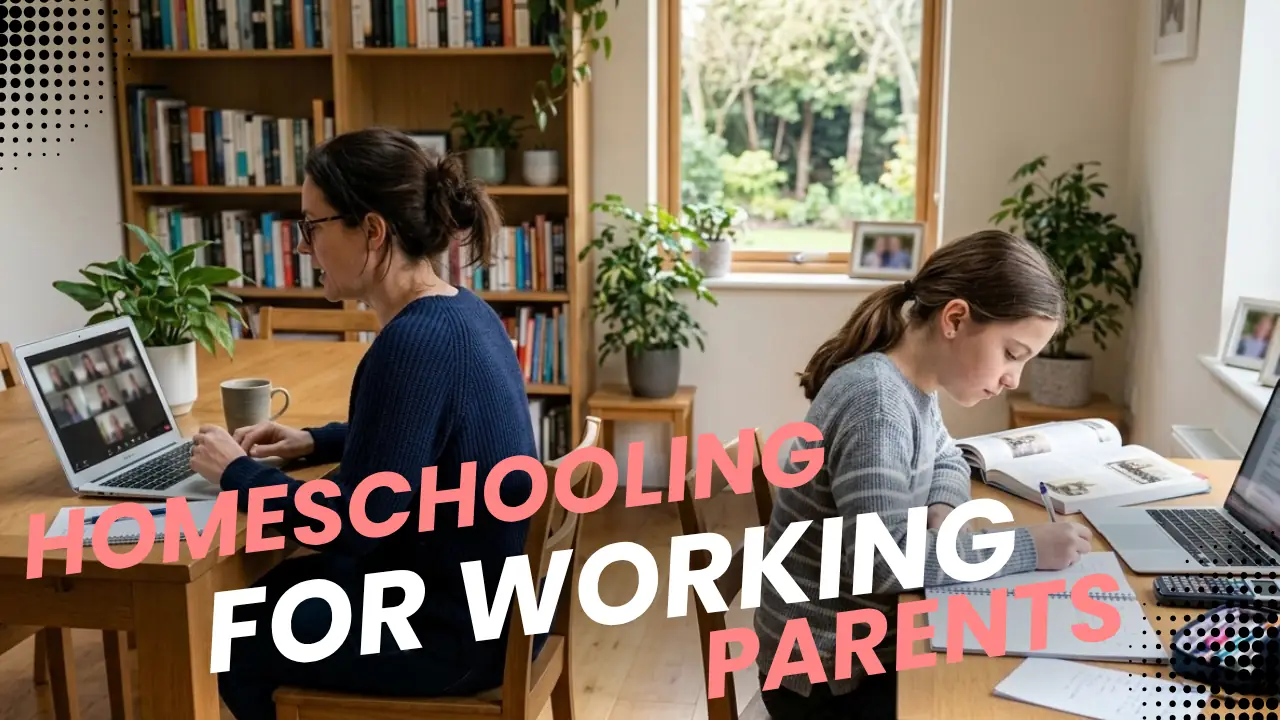
Homeschooling for working parents can be manageable when families build the school routine around actual work hours. This guide explains flexible schedules, independent learning, curriculum choices, tutors, co-ops, costs, and practical strategies for helping students in grades 6 to 8 learn with less direct supervision.
Homeschooling for working parents can feel like an impossible balancing act, especially once a child reaches grades 6 through 8. At this stage, schoolwork becomes more demanding, subjects grow more specialized, and children need less hand holding but more structure.
Many parents assume they must choose between a paycheck and a homeschool lesson plan, but that assumption is simply outdated.Curious about how learning at home works compared with traditional education? Start by understanding what homeschooling is and why more families are considering this approach.
Thousands of families across the country combine full time jobs, part time work, and even rotating shifts with a home based middle school education. This guide walks through the legal basics, the schedules that actually work, the curriculum types built for middle schoolers, and the tools that let a child learn with less supervision while a parent is on a call or at a job site.
By the end, you will have a realistic plan for homeschooling for working parents in grades 6 to 8.If you’re thinking about educating your child at home, the first step is knowing where to begin. Our guide explains how to start homeschooling with simple and practical steps.
Is Homeschooling Realistic When Both Parents Work?
Yes, and the data backs it up. Homeschooling participation among children in the grade 6 to 8 range is now higher than in almost any other age group, according to national surveys of home educated families. Many of those households include one or two working parents who have simply restructured the school day around work hours instead of the other way around.
The middle school years actually make this easier, not harder. A sixth, seventh, or eighth grader can read instructions, manage a checklist, and complete assignments without a parent sitting beside them the entire time. That shift in independence is exactly what allows a parent to keep a job while still directing their child’s education.
Working parents who succeed at this usually share three habits. They lean on structured curriculum instead of building every lesson from scratch, they set clear blocks of independent work time, and they check in at natural breaks in their own workday, such as lunch or the end of a shift.
Understanding the Legal Basics of Homeschooling
Homeschooling is legal in all fifty states, though the rules for notifying your state, keeping records, and testing your child vary quite a bit. Some states ask for almost nothing beyond a simple notice of intent. Others require standardized testing, portfolio reviews, or a set number of instructional hours per year.
Before you build a schedule or buy a curriculum, look up your state’s specific requirements through your state department of education or a trusted organization such as the Home School Legal Defense Association.
Working parents should pay close attention to any required instructional hour counts, since those hours can be logged in the evening or on weekends if your weekday schedule is tight.
A predictable routine can make learning easier for both parents and children. Creating a practical homeschooling routine can help keep lessons, breaks, activities, and family time balanced.
A few practical steps make compliance painless.
- File your notice of intent or withdrawal paperwork as soon as you decide to homeschool.
- Keep a simple log of subjects covered, hours spent, and any assessments completed.
- Save samples of your child’s work each month in case a portfolio review is required.
- Note testing deadlines on your work calendar, not just a home calendar, so they do not get missed during a busy season at the office.
Four Common Working Parent Scenarios and How Each One Adapts
There is no single formula for homeschooling for working parents, because work situations vary so widely. Looking at your own scenario first makes every later decision, from curriculum to schedule, much easier.
Both parents work full time outside the home. This is the tightest schedule to manage, so structure matters most here. Families in this situation usually lean on an all in one curriculum or an online program with automatic grading, plus a co op, tutor, or after care program that covers part of the school day.
One parent works full time and the other has more flexible hours. Here, the flexible parent often becomes the primary point of contact during the day, while the full time working parent handles evening review, weekend planning, or a single subject such as math. Splitting responsibility this way keeps the workload from falling entirely on one person.
A single working parent is the sole educator. This scenario benefits the most from outside support such as co ops, grandparents, older siblings, or a part time tutor. Building a network before the school year starts, rather than scrambling once things feel overwhelming, makes a lasting difference.
A parent works from home. Working from home offers flexibility but also constant interruption risk. These parents often do best with a visible do not disturb signal for work hours, a child who is trained to save non urgent questions for a break, and a curriculum that includes enough independent work to fill entire meeting heavy days.
Whichever scenario fits your family, the underlying principle stays the same. Match the curriculum and schedule to the hours you actually have, not the hours you wish you had.
A Sample Weekly Schedule for a Working Household
Seeing a full week laid out can make the whole idea feel less abstract. The sample below reflects a household where both parents work a standard daytime job, with a co op meeting once a week.
| Day | Morning | Afternoon | Evening |
| Monday | Independent math and reading before work | Online science lesson and writing | Fifteen minute review of the day’s work |
| Tuesday | Language arts and vocabulary practice | Co op class covering electives and group projects | Discuss co op highlights and homework |
| Wednesday | Independent math and reading before work | Social studies and current events discussion | Plan the next two days together |
| Thursday | Language arts and writing project time | Science experiment or hands on activity | Fifteen minute review of the day’s work |
| Friday | Independent math and reading before work | Lighter academic load, catch up, or a field trip | Weekly progress check and light planning for next week |
Notice that the parent’s direct involvement is concentrated into short windows, mostly in the evening or during a lunch break, while the bulk of the day relies on independent or online work. This structure can flex around a parent’s actual meeting schedule from week to week.
Building a Homeschool Schedule That Fits a Work Day
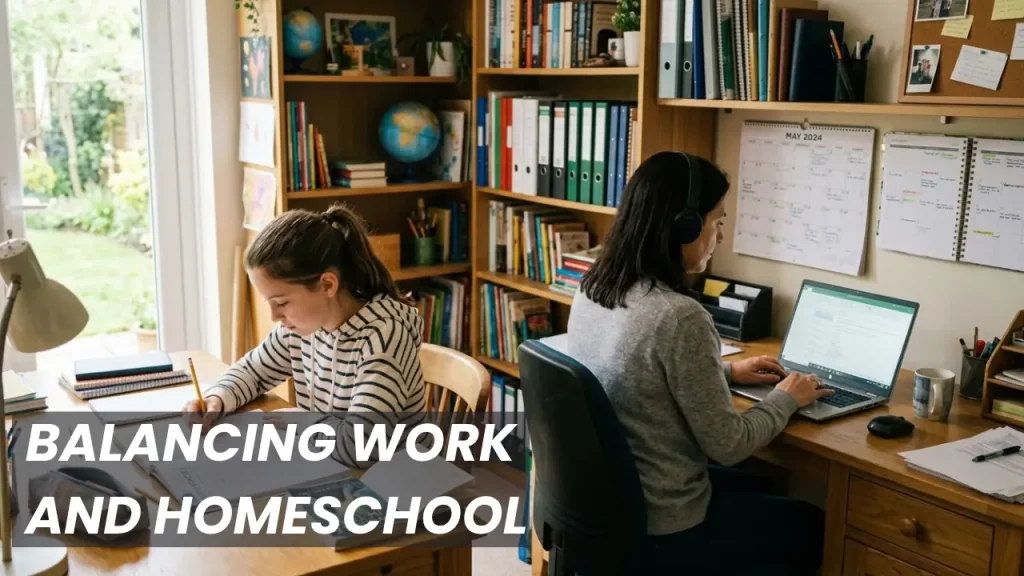
A rigid nine to three school day rarely survives contact with a real job. Instead, successful working parents design a schedule around the natural rhythm of their workday and their child’s attention span.
Block Scheduling Around Work Hours
Block scheduling groups subjects into focused chunks rather than a strict hour by hour timetable. A common pattern for grades 6 through 8 looks like this.
- Early morning: independent reading, math practice, or an online lesson completed before a parent leaves for work or logs on.
- Midday: a scheduled check in during a lunch break to review progress and answer questions.
- Afternoon: hands on subjects such as science experiments, writing projects, or electives completed with less supervision.
- Evening: a short family review of the day’s work and planning for tomorrow.
Using Independent Work Blocks
Middle schoolers are ready for longer stretches of independent work than younger children. A parent can assign a full lesson, a chapter of reading, or an online module and trust the student to complete it while the parent is in a meeting or on a shift.
This only works if the curriculum is structured enough that a child does not need constant clarification. Programs with clear daily instructions, built in grading, or video based lessons remove much of the guesswork.
Splitting Duties Between Two Working Parents
In two parent households where both adults work, splitting subjects by strength or availability often works better than trying to cover everything together. One parent might handle math and science check ins in the morning before work, while the other reviews writing and reading in the evening.
Grandparents, older siblings, or a hired tutor can also cover a midday block for families where neither parent has flexible daytime hours. This kind of shared responsibility is common and does not reduce the quality of the education, as long as someone is tracking overall progress.
Choosing the Right Curriculum for Grades 6 to 8
Curriculum choice matters more for working parents than for stay at home educators, because the right program reduces daily prep time to almost nothing. Middle school curricula generally fall into four categories.
All in one or boxed curriculum. These programs bundle math, language arts, science, and social studies into a single package with a clear scope and sequence. They remove planning time almost entirely, which makes them popular with busy households, though they tend to cost more than piecing together individual subjects.
Online and video based programs. Platforms such as Time4Learning or similar self paced digital programs deliver lessons, practice, and grading through a screen. A working parent can review a dashboard in minutes instead of grading by hand, and the student can often log in and start without help.
Co op and hybrid programs. Hybrid schools and homeschool co ops meet in person one to three days a week and assign independent work for the remaining days. This model gives a working parent built in coverage for part of the week while still keeping the family in control of the curriculum.
Unit studies and interest led learning. These programs organize subjects around a central theme, such as ancient civilizations or ecosystems, and pull in reading, writing, and science together. They require more upfront planning, so they suit parents with a bit more flexible time or the ability to plan on weekends.
There is no single best option. A parent working a rigid nine to five job might lean toward an online program with automatic grading, while a parent with a flexible freelance schedule might enjoy unit studies more.
A Quick Checklist for Evaluating Any Curriculum
Before purchasing a curriculum, run it through a short evaluation so it actually fits a working household instead of adding more pressure to an already full day.
- Does it include clear daily instructions a middle schooler can follow without a parent explaining every step?
- Does it grade automatically or provide an answer key, so review does not require re teaching the lesson?
- Can it be paused, sped up, or reordered around a busy work week without falling behind?
- Does it offer a parent dashboard or progress report that can be reviewed in five to ten minutes?
- Is customer support or a teacher available for subjects where the parent may need backup?
A curriculum that scores well on these five points will usually integrate smoothly into a working parent’s schedule, regardless of which of the four categories it falls into.
Core Subjects to Cover in Middle School
Grades 6 through 8 mark a shift from broad elementary topics into more specialized instruction. The table below outlines the core areas most state guidelines and curriculum publishers expect at this stage.
| Subject | What Grades 6 to 8 Typically Cover | Time Saving Tools |
| Math | Fractions, ratios, pre algebra, and an introduction to algebra | Teaching Textbooks, Mr D Math, Khan Academy |
| Science | Life science, earth science, physical science, and basic experiments | Video labs, science kits, local museum programs |
| Language Arts | Literature analysis, grammar, vocabulary, and essay writing | Writing programs with built in feedback, library reading lists |
| Social Studies | World history, geography, civics, and current events | Documentaries, primary source websites, family discussion |
| Electives | Foreign language, coding, art, music, or a skill based hobby | Online course platforms, community classes, local clubs |
Covering these five areas does not require five separate hours of direct teaching every day. Many working families rotate subjects across the week or pair a lighter day with a heavier one to match their own work calendar.
Using Online Programs and Tutors to Cover Work Hours
Online programs and outside tutors are some of the most effective tools for homeschooling for working parents, because they shift part of the daily instruction away from the parent without giving up academic quality. A middle schooler can complete an entire math or language arts lesson through a video based platform while a parent is unavailable for several hours.
Live online classes add another layer of support. Many families hire a subject specific tutor for math, writing, or a foreign language, especially in subjects where the parent feels less confident. This is particularly useful in grades 6 through 8, when math and science begin to require more specialized knowledge than earlier grades.
A short weekly check in with any outside tutor or program keeps a parent informed of progress even when they cannot sit through every lesson. Most platforms also provide a parent dashboard summarizing scores, time spent, and areas of struggle, which turns a five minute review into a full progress report.
What Homeschooling Actually Costs a Working Family
Budget is often as tight as time for working parents considering homeschooling, so it helps to know the real range before committing to a curriculum. Costs vary from a few hundred dollars a year for a mostly library based approach to well over a thousand dollars for a full online program with live classes.
An all in one boxed curriculum typically costs the most upfront but saves time, since it removes the need to research and assemble individual subjects. Online programs often charge a monthly or yearly subscription that includes grading, which can be worth the cost for a parent who cannot spend evenings checking homework by hand.
Co ops usually charge a membership or per class fee, and tutors are billed hourly or per course. Many working families find that the time saved by paying for a tutor in one difficult subject, such as algebra or a foreign language, is worth more than the money saved by teaching it themselves.
Balancing a paid tool against your own available hours each week is often the most useful budgeting question, not just the dollar amount on a price tag.
Homeschool Co-ops and Community Support
A homeschool co op is a group of families who meet regularly to share teaching duties, offer classes, and provide social opportunities for children. For a working parent, a co op can cover an entire day or a set of subjects each week, freeing up time for a job while still giving a child structured, in person instruction.

Co ops also solve one of the biggest concerns families raise about home education: socialization. Grades 6 through 8 are a socially important stage, and regular group classes, field trips, and team activities through a co op or local sports league give middle schoolers the peer interaction they need.
Many communities also have hybrid schools that operate two or three days a week, run by a mix of certified teachers and parent volunteers. These programs are especially popular among working parents because they combine classroom style instruction with the flexibility of homeschooling on the remaining days.
Teaching Independence and Executive Function Skills
By grade 6, a homeschool parent’s role naturally shifts from direct instructor to mentor and coach. This shift is good news for working parents, because it means the child begins managing more of their own learning process.
Executive function skills such as planning, time estimation, and self checking work become just as important as academic content during these years. A parent can build these skills intentionally rather than leaving them to chance.
- Give your child a written or digital checklist for the day instead of verbal instructions.
- Ask them to estimate how long each assignment will take, then compare it to the actual time spent.
- Introduce a simple planner or app so the student tracks due dates and long term projects on their own.
- Praise completed, well organized work as much as correct answers, since organization is the skill that will carry them through high school and beyond.
These habits do more than fill a working parent’s schedule gap. They prepare a middle schooler for the independent study skills that high school and college will demand.
Balancing Work Meetings with School Time
Calendar conflicts are inevitable, so plan for them instead of hoping they will not happen. A shared family calendar that includes both work meetings and school check in times prevents the two from colliding.
Batch similar tasks together where possible. If a parent knows Tuesday afternoons are always full of meetings, that block can become the student’s independent reading or online course time, while Wednesday morning becomes the parent led math lesson.
Buffer time also matters. Building a fifteen minute cushion around each planned check in absorbs the small delays that come from both a workday and a school day, so one late meeting does not derail the entire afternoon.
Common Challenges and How Working Parents Solve Them
Not enough hands on teaching time. Many working parents worry they cannot deliver enough direct instruction. Structured curricula with video lessons or built in explanations fill this gap without sacrificing quality, and a fifteen minute nightly review keeps a parent connected to what was learned.
Guilt over limited involvement. Feeling guilty about a shorter check in time is common, but research on home educated students consistently shows strong academic outcomes across a wide range of parental involvement levels and income levels. Quality time spent reviewing progress often matters more than total hours logged.
Inconsistent schedules, such as shift work. Families with rotating or night shifts often flip the traditional day, running school in the afternoon or using weekend catch up blocks. Curriculum flexibility, not a fixed clock, is what makes this manageable.
Socialization concerns. Co ops, sports teams, community classes, and local library programs fill this need without requiring a parent to be present for every interaction.
Signs Your Routine Is Working, and Signs It Needs Adjusting
Give any new schedule at least three or four weeks before judging it, since both a parent and a middle schooler need time to adjust to a new rhythm. After that window, a few signs point to a routine that is genuinely working.
- Assignments are usually finished without daily reminders or last minute scrambling.
- Your check in times feel like a quick review rather than a stressful catch up session.
- Your child can explain what they learned that day in their own words.
- Work meetings and school time rarely collide, or collisions are resolved calmly using a buffer or backup plan.
If instead you notice constant missed assignments, a child who cannot start work without a parent present, or check ins that always run long, treat that as useful information rather than failure.
Adjust one variable at a time, such as switching to a more structured curriculum or moving independent blocks to a different time of day, before assuming the whole approach needs to change.
Conclusion
Homeschooling for working parents is not about doing everything a full time educator does in fewer hours. It is about building a system, a schedule, a curriculum, and a support network so that a middle schooler can learn well even when a parent is not available every minute of the day.
Start small. Pick one curriculum type that matches your work schedule, set two or three fixed check in times around your job, and add a co-op or tutor for the subjects that need extra support.
Grades 6 through 8 are the years when children can take on real independence, and that independence is exactly what makes homeschooling and a career possible at the same time.
If you are just getting started, review your state’s homeschool requirements first, then build your schedule around your actual work calendar rather than an idealized school day. Choose one curriculum type, set your check in times, and give the routine a few weeks before adjusting it further.
Homeschooling for working parents will rarely look like a traditional classroom, and that is the point rather than a compromise. A flexible, well planned routine can give a sixth, seventh, or eighth grader strong academics, real independence, and a parent who is still present for the moments that matter most, even on a full workday.
Frequently Asked Questions
Can I homeschool grades 6 to 8 while working full time?
Yes. Many working parents combine a full time job with homeschooling by using structured curriculum, independent work blocks, and outside support such as co ops or tutors for part of the week.
How many hours a day does homeschooling take in middle school?
Most middle schoolers need roughly three to five hours of focused academic time per day, which is often less than a traditional school day because there is no commute, passing periods, or large class management involved.
Do I need a teaching certificate to homeschool my middle schooler?
No. Homeschooling does not require a teaching license in any state, though some states ask that the instructing parent hold at least a high school diploma or equivalent.
What if I am not strong in math or science?
Online courses, video based curriculum, and outside tutors can cover subjects where a parent feels less confident, while the parent still oversees progress and overall learning goals.
How do I handle socialization if I am working most of the day?
Homeschool co ops, sports leagues, community classes, and library programs give middle schoolers regular peer contact without requiring a parent to supervise every activity.
Is online curriculum enough, or do I need textbooks too?
Either can work well on its own, and many families blend both, using an online platform for core subjects and physical books or hands on kits for science and electives.
What happens if my state requires standardized testing?
Check your state’s specific requirement, schedule the test well in advance, and choose curriculum aligned to the standards your state expects so your child is prepared without extra cramming.