
This guide compares O Level vs Matric in Pakistan, covering curriculum, grading systems, costs, recognition, teaching methods, and career opportunities. It helps students and parents choose the education system that best matches their academic goals, budget, and future study plans.
In Pakistan, students typically choose between two major educational paths after completing middle school: O Level (Ordinary Level) under the Cambridge International Examination (CAIE) system, and Matriculation under the local Board of Intermediate and Secondary Education (BISE) system.
Both serve as foundational qualifications leading to higher secondary education, but they differ significantly in curriculum, teaching methods, grading systems, international recognition, and cost.
The O Level system follows a British-based curriculum that emphasizes conceptual learning, analytical thinking, and global academic standards, making it a popular choice for students aiming for international universities.
On the other hand, the Matric system is locally governed and more exam-oriented, providing an affordable and accessible route for students continuing their education within Pakistan’s national education framework.
Understanding the key differences between O Level and Matric helps students and parents make informed decisions that align with their academic goals, financial situation, and plans.
In this article, we’ll compare both systems in terms of curriculum, grading, recognition, costs, and career outcomes to help you make an informed choice.
What is O Level?
O Level (Ordinary Level) is an internationally recognized qualification offered by the Cambridge Assessment International Education (CAIE), part of the University of Cambridge in the UK. It is typically taken by students aged 14 to 16 years and serves as an equivalent to Grades 9 and 10 in Pakistan’s local education system.
The O Level curriculum is designed to promote conceptual understanding, analytical skills, and critical thinking, rather than rote memorization. Students can choose from a wide range of subjects, including English, Mathematics, Physics, Chemistry, Biology, Computer Science, Accounting, Business Studies, and more.
Key Features of O Level
- International Curriculum: Follows the Cambridge Assessment International Education (CAIE) syllabus, focusing on global academic standards and conceptual learning.
- Wide Range of Subjects: Offers flexibility with over 40 subjects, including core and elective options like Mathematics, English, Sciences, Business Studies, and Computer Science.
- Concept-Based Learning: Encourages critical thinking, problem-solving, and analytical skills instead of rote memorization.
- External Examinations: All exams are set, marked, and graded by Cambridge, ensuring fairness and international credibility.
- Grading System: Uses a letter-based grading scale from A (highest)* to E (lowest), based on overall performance.
- Medium of Instruction: Entirely English-based, this approach enables students to develop strong communication and comprehension skills essential for a global education.
- Recognition: Accepted by universities and colleges worldwide, and considered equivalent to Matric (SSC) by the Inter Board Committee of Chairmen (IBCC) in Pakistan.
- Progression Path: Leads to A Level (Advanced Level) studies, serving as a stepping stone toward higher education in Pakistan or abroad.
- Assessment Pattern: Includes written exams, practicals, and coursework, testing both theoretical and applied knowledge.
- Skill Development: Builds research, communication, and independent learning abilities, preparing students for university-level academics.
What is Matric?
Matric, short for Matriculation, is the Secondary School Certificate (SSC) qualification awarded to students in Pakistan after completing Grades 9 and 10 under the Board of Intermediate and Secondary Education (BISE).
It represents the final stage of secondary education in the national curriculum and serves as a gateway to Intermediate (FA, FSc, ICS, ICom) or other post-secondary programs.
Matric students typically choose between two main study groups:
- Science Group: Includes subjects like Physics, Chemistry, Biology, and Mathematics.
- Arts (Humanities) Group: Focuses on subjects such as General Science, Civics, Education, and Economics.
The respective BISE boards conduct examinations at the provincial or regional level, and results are given in grades or percentages. The medium of instruction can be English or Urdu, depending on the school.
Key Features of Matric
- National Curriculum: Follows the curriculum approved by the Government of Pakistan and implemented by local Boards of Intermediate and Secondary Education (BISE).
- Two-Year Program: Covers Grade 9 and Grade 10, culminating in the Secondary School Certificate (SSC) examination.
- Study Groups: Students can choose between major streams:
- Science Group: Physics, Chemistry, Biology/Computer Science, Mathematics.
- Arts (Humanities) Group: Civics, Education, Economics, General Science, etc.
- Exam-Oriented System: Focuses mainly on textbook-based learning and rote memorization, with exams testing theoretical knowledge.
- Medium of Instruction: Offered in both Urdu and English, depending on the school type (public or private).
- Assessment and Grading: Conducted by provincial BISE boards, results are given in grades or percentage marks (e.g., A+, A, B, etc.).
- Accessibility and Affordability: The most common and affordable education system in Pakistan, available in almost all cities and rural areas.
- Recognition: Accepted by all colleges and universities in Pakistan and considered equivalent to O Level for further education (as verified by IBCC).
- Subjects Structure: Includes compulsory subjects such as English, Urdu, Islamiyat, and Pakistan Studies, along with elective subjects based on the chosen stream.
- Pathway to Higher Education: Leads to Intermediate programs (FA, FSc, ICS, ICom) and serves as the foundation for professional degrees like Engineering, Medicine, and Commerce.
Grading System: O Level vs Matric
Here is the grading system of O-level vs Matric are given below:
| Features | O Level Grading System | Matric Grading System |
| Exam Board | Cambridge Assessment International Education (CAIE) | Board of Intermediate and Secondary Education (BISE) |
| Grading Method | Alphabetical Grades (A to E)* based on student performance compared to global standards | Percentage & Letter Grades based on marks obtained in exams |
| Grade Scale | A*: Exceptional performanceA: ExcellentB: Very GoodC: GoodD: SatisfactoryE: Minimum passU: Ungraded (Fail) | A+: 80% and aboveA: 70–79%B: 60–69%C: 50–59%D: 40–49%E: 33–39% (Pass)F: Below 33% (Fail) |
| Passing Criteria | Minimum Grade E required to pass | Minimum 33% marks required to pass |
| Evaluation System | Assessed through external marking by Cambridge, it focuses on conceptual understanding and analytical ability | Assessed through local board exams; focuses on written and theoretical performance |
| Result Format | Statement of Results issued by Cambridge showing grades per subject | Mark sheet issued by BISE showing marks and overall percentage |
| Equivalence (IBCC) | O Level grades are converted to percentage marks for equivalence with Matric | Directly based on marks; no conversion required |
The O Level grading system is globally recognized, emphasizing quality and conceptual learning, while the Matric grading system focuses on numerical performance and local standards. Both systems ultimately evaluate student achievement but differ in approach, recognition, and academic philosophy.
Cost and Accessibility:
O Level: High-cost, internationally recognized, and urban-focused education system, suitable for families seeking global opportunities.
Matric: Low-cost, nationally recognized, and widely available, ideal for local education continuity and affordability.
O Level (Cambridge System)
The O Level system is generally considered expensive and less accessible compared to Matric because it follows an international standard and is offered mainly by private schools.
1. Cost:
- Tuition Fees: High, as O Level schools charge more due to the foreign curriculum and resources.
- Examination Fees: Paid to Cambridge International (CAIE) in foreign currency (usually USD or GBP), making it costly.
- Books & Resources: Imported textbooks, study guides, and learning materials increase expenses.
- Additional Costs: Include registration, lab fees, and extracurricular charges.
Average Cost (Estimated):
- Around PKR 300,000–700,000 per year, depending on the school and city.
2. Accessibility:
- Available mainly in major urban centers like Karachi, Lahore, and Islamabad.
- Offered by private and international schools such as Beaconhouse, Roots, City School, KIMS and LGS.
- Not easily accessible for middle- or low-income families due to higher costs.
- Requires proficiency in English, as all instruction and exams are conducted in English.
Matric (BISE System)
The Matric system is affordable and widely accessible, making it the most common educational path in Pakistan.
1. Cost:
- Tuition Fees: Very low in public schools; moderate in private schools.
- Examination Fees: Minimal and paid in local currency to BISE.
- Books & Resources: Provided by the Punjab Textbook Board or other regional boards, often at low or no cost.
Average Cost (Estimated):
- Around PKR 10,000–60,000 per year, depending on the type of school (public or private).
2. Accessibility:
- Available in all regions, including rural areas.
- Conducted in both Urdu and English, allowing broader participation.
- Easily accessible for students from all economic backgrounds.
- Supported by government schools and local education boards.
O Level is often considered expensive and urban-centered, while Matric is affordable and accessible to all income levels.
Recognition and Future Opportunities
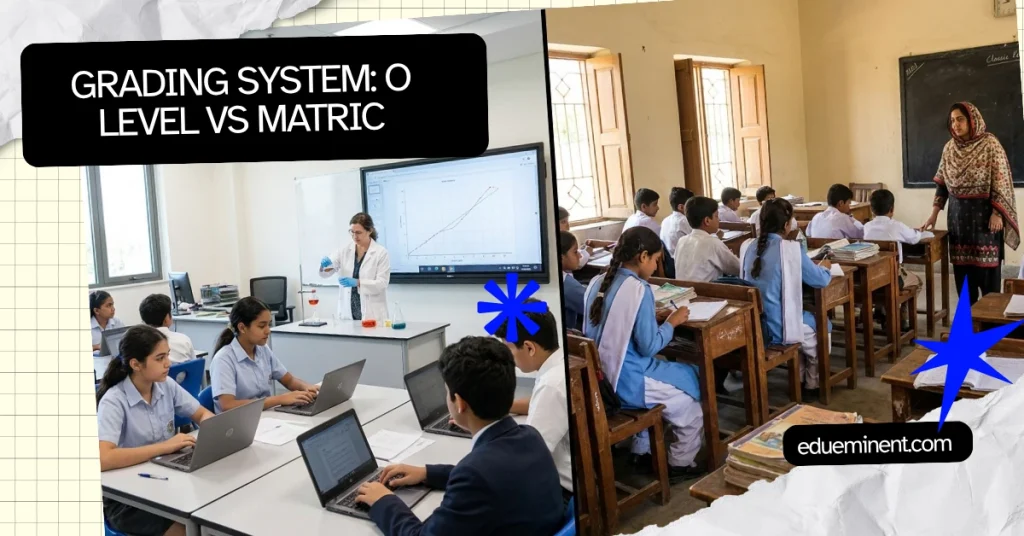
After completing secondary education, one of the most important factors students and parents consider is the recognition of their qualification and the future opportunities it can provide. Both O Level and Matric open doors to higher education, but they differ in scope, acceptance, and the type of academic or professional paths they lead to.
O Level (Cambridge International System)
The O Level qualification holds international recognition, making it highly valuable for students who plan to pursue education abroad or in globally affiliated institutions.
1. Recognition:
- Accepted by universities and colleges worldwide, especially in the UK, USA, Canada, Australia, and other Commonwealth countries.
- Recognized in Pakistan as equivalent to Matric (SSC) by the Inter Board Committee of Chairmen (IBCC), provided students pass the required subjects (English, Urdu, Islamiyat, and Pakistan Studies).
- Considered a strong academic foundation for A Level (Advanced Level) studies.
2. Future Opportunities:
- Opens the pathway to A Levels, IB (International Baccalaureate), or other international programs.
- Offers better chances for foreign university admissions and scholarships due to international credibility.
- Develops key skills like critical thinking, research, and communication, which are essential for success in global education systems.
- Provides flexibility to shift between international and local education systems with proper equivalence.
Matric (Board of Intermediate and Secondary Education System)
The Matric qualification is nationally recognized and serves as the standard route for local higher education in Pakistan.
1. Recognition:
- Officially recognized by all educational boards, colleges, and universities in Pakistan.
- Accepted for admission into Intermediate programs such as FSc (Pre-Medical/Pre-Engineering), FA (Arts), ICS (Computer Science), and ICom (Commerce).
- Recognized by government departments and local institutions for entry-level employment and further studies.
2. Future Opportunities:
- Leads to Intermediate education, which is the foundation for Bachelor’s programs in Pakistan.
- Offers pathways into professional fields like Medicine, Engineering, Computer Science, Commerce, and Humanities.
- Easier access to public universities and government scholarships within the local education system.
- Suitable for students aiming to build their careers in Pakistan.
O Level is globally recognized and provides access to international academic and career opportunities, best suited for students aspiring to study abroad.
Matric is locally recognized and cost-effective, ideal for students who plan to continue their studies and careers within Pakistan’s education system.
O Level Pros
- Globally recognized qualification
- Encourages critical thinking
- Better English proficiency
- Flexible subject choices
O Level Cons
- Expensive fees
- Limited availability in rural areas
- Pressure due to international standards
Matric Pros
- Affordable and accessible
- Well-structured for local education
- Easier for government job eligibility
Matric Cons
- Focuses more on rote learning
- Limited recognition abroad
- Outdated syllabus in some boards
O Level offers global recognition, modern learning, and critical thinking, but comes with high costs and limited accessibility.
Matric provides an affordable, locally recognized, and structured path to higher education in Pakistan, though it lacks international competitiveness and innovative teaching methods.
Which One Should You Choose? O Level or Matric?
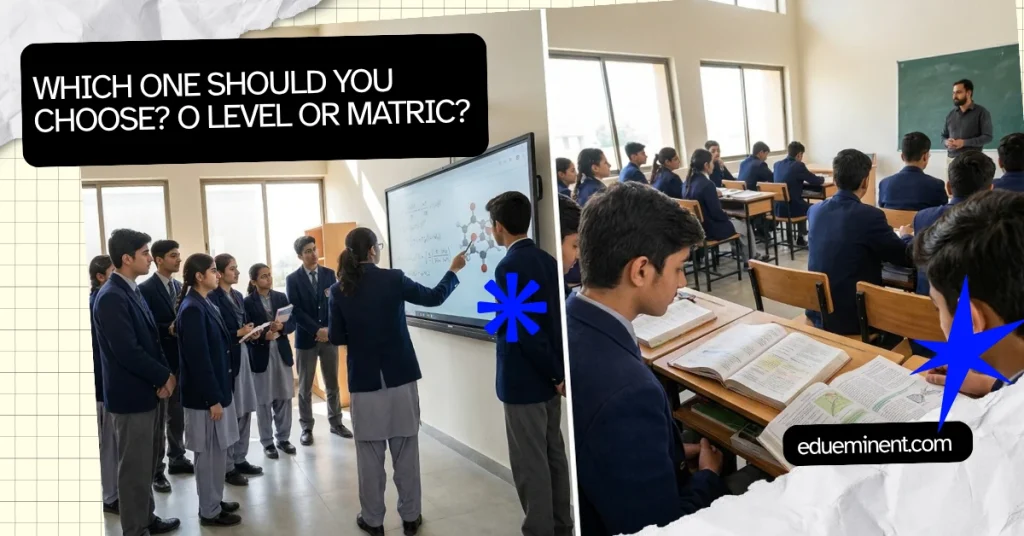
Choosing between O Level and Matric depends on your future goals, financial situation, learning style, and career aspirations. Both systems offer valuable educational experiences, but serve different purposes and audiences.
Choose O Level if:
- You plan to study abroad or at international universities in the future.
- You want to develop strong English communication and analytical skills.
- You prefer conceptual and practical learning over rote memorization.
- You can afford higher tuition and exam fees at private or international schools.
- You are aiming for a global career path or want exposure to international education standards.
Choose Matric if:
- You plan to continue your studies in Pakistan through Intermediate (FSc, ICS, FA, ICom).
- You need an affordable education system with accessible resources.
- You live in an area where O Level schools are limited or unavailable.
- You prefer a structured, exam-oriented system that’s easier to manage.
- You aim to pursue professional degrees like Engineering, Medicine, Commerce, or Computer Science locally.
Both paths can lead to success; what matters most is how well the chosen system aligns with your personal goals, dedication, and long-term vision.
Conclusion
The choice between O Level and Matric is one of the most important academic decisions for students and parents in Pakistan. Both systems aim to educate, but they follow very different philosophies.
O Level, being an international qualification by Cambridge Assessment (CAIE) or Edexcel, promotes critical thinking, creativity, and global awareness. It equips students with modern analytical and communication skills that are highly valued around the world.
On the other hand, Matric follows the national curriculum of Pakistan, focusing on textbook learning and exam preparation. It provides a cost-effective, accessible, and familiar path for millions of students who plan to continue their education locally, especially in intermediate programs like FSc, ICS, or ICom.
If your goal is to study abroad, develop international-level skills, and think beyond rote learning, the O Level is the better choice. But if you prefer to save costs, stay within Pakistan’s education system, and pursue local universities or government jobs, Matric is a solid and practical option.
In the end, success depends not only on the system you choose but on how well you learn from it. A dedicated student can excel in either O Level or Matric because education is not defined by the board, but by the effort, passion, and consistency you bring to it.
Frequently Asked Questions (FAQs)
1. Which is better in Pakistan, O Level or Matric?
Both systems have their strengths. O Level (by Cambridge or Edexcel) focuses on conceptual learning, global recognition, and critical thinking, while Matric emphasizes textbook-based, exam-oriented education suited for local universities.
If a student plans to study abroad or in international programs, the O Level is better. For cost-effective, local options, Matric is more practical.
2. Is O Level harder than Matric?
Yes, generally O Level is considered harder because it involves analytical questions, English-based exams, and a deeper understanding of concepts. Matric exams are usually more straightforward and memorization-based, which can be easier for some students.
3. Can O Level students apply for Pakistani universities?
Yes, O Level students can apply to Pakistani universities, but they must equate their grades through IBCC (Inter Board Committee of Chairmen). Most universities accept O/A Level students after equivalence, though admission criteria may slightly differ from Matric/FSc students.
4. Is O Level more expensive than Matric?
Yes, O Level is significantly more expensive. It involves international exam fees, foreign textbooks, and higher school charges. Matric education, being government-regulated, is much more affordable for the average Pakistani student.
5. Which system is better for studying abroad?
O Level is undoubtedly better for international studies. It’s globally recognized and aligns with the academic expectations of foreign universities. Matric, however, is mainly accepted within Pakistan, and foreign institutions may not recognize it without additional qualifications.
6. Can Matric students switch to A Level?
Technically, yes, but it’s challenging. Matric students may face difficulty adjusting to the English-medium, analytical nature of A Level studies. Many schools require students to take a bridging course or show strong English and academic skills before switching.
7. Which system builds better English skills?
O Level strongly enhances English reading, writing, and communication skills, as all subjects (except Urdu, Islamiyat, and Pakistan Studies) are taught in English. Matric, on the other hand, focuses less on English fluency and more on grammar and translation-based learning.
8. How do grades compare between O Level and Matric?
O Level uses *grades (A, A, B, etc.), while Matric uses marks (out of 1100). For equivalence, *A and A are considered 90%+, while C equals around 70%. IBCC converts these grades to Pakistani percentages for college admissions.
9. Which is more recognized by employers in Pakistan?
For local jobs, both are equally valid, but O Level graduates may have better communication and problem-solving skills, giving them an edge in international companies. For government jobs, Matric/FSc is often more straightforward due to local documentation.
10. Can I do O Level privately in Pakistan?
Yes, students can appear privately through the British Council Pakistan without attending a school. However, self-study for O Levels requires discipline, strong English comprehension, and access to study materials.
